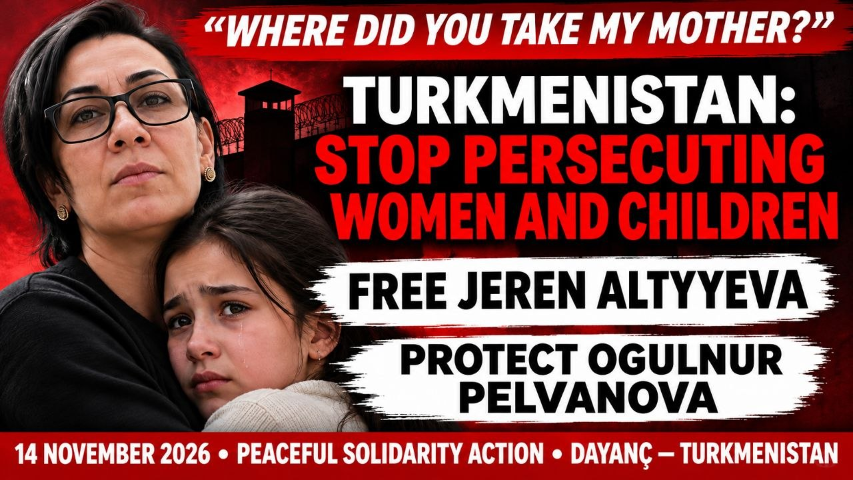
“WHERE DID YOU TAKE MY MOTHER?” — SECURITY FORCES IN TURKMENISTAN TOOK AWAY A WOMAN WHO WAS SEEKING JUSTICE FOR VIOLENCE AGAINST HER AND HER DAUGHTER Jeren Altyyeva and Ogulnur Pelvanova: The story of a mother and daughter who reported suffering violence, and a struggle for justice that resulted in the persecution of the complainant herself. November 13, 2026 There are crimes that are terrifying to speak about. But even more terrifying is a situation in which those who should be protecting their own children are afraid to speak out. There are mothers who turn to the police for help, only to face intimidation, threats, and criminal prosecution instead of protection. And there are children who suddenly find themselves in a world where uniformed officers can take their mother away, while no one considers it necessary to explain where she has been taken or why. This is the tragedy unfolding around Jeren Altyyeva and her minor daughter, Ogulnur Pelvanova, in Turkmenistan. This case has long ceased to be merely a family dispute. Today, it raises a fundamental question for the state and the international community: what happens to the rights of women and children in a country where seeking protection may result in the persecution of the complainant herself? Jeren sought justice after alleged domestic and sexual violence against herself and her underage daughter. Yet instead of receiving effective protection from the state, she herself became the subject of forcible detention and criminal prosecution. Her daughter was left without her mother, struggling with severe emotional distress and asking a question to which the authorities of Turkmenistan have yet to provide a convincing answer: “Where did you take my mother? You took her away, so bring her back home!” This story is not merely the tragedy of one family. It has become a disturbing illustration of how vulnerable women and children can be in the face of potential abuses of state power. JEREN ALTYYEVA: A WOMAN WHO REFUSED TO REMAIN SILENT Jeren Altyyeva is a mother who repeatedly sought an investigation into alleged domestic and sexual violence against herself and her minor daughter. In her appeals to Turkmenistan's law enforcement authorities, she reported abuse, threats, and the urgent need to protect her child. According to the case materials, Jeren accused her husband, Mesgen Akmammedov, a customs officer, of violence and alleged acts of a sexual nature involving their daughter. These allegations require an independent investigation. The criminal responsibility of any individual must be established through lawful judicial proceedings. However, rather than receiving a transparent examination of her complaints, the woman reportedly faced actions by state authorities that raise serious questions about legality, impartiality, and respect for her fundamental rights. On October 16, 2026, law enforcement officers arrived at Jeren's home in the city of Bayramaly and forcibly took her away. According to reports, numerous security personnel participated in the operation. There were also reports of electricity and communications being cut off and obstacles being placed in the way of obtaining medical assistance. These circumstances require independent verification. For several weeks afterward, her relatives had no reliable information about her whereabouts, her state of health, or her access to legal assistance. Reports subsequently emerged that criminal proceedings had been initiated against her on fraud charges. The grounds for these proceedings warrant particular scrutiny, given that they followed the woman's repeated complaints concerning violence. This raises an obvious question. Why did a woman who demanded an investigation into alleged violence against herself and her child end up facing criminal charges? Why did reports of possible sexual violence against a minor not result in demonstrably effective protective measures? Who is responsible for the safety of the mother and daughter? And, most importantly, who can guarantee that the criminal proceedings against Jeren are not being used as a means of pressuring a woman who dared to demand justice? These questions cannot be left unanswered. OGULNUR PELVANOVA: A CHILD PLEADING FOR HER MOTHER'S RETURN “Where did you take my mother? You took her away, so bring her back home!” Behind these words lies the desperation of a young girl who, according to published reports, recorded a video appeal following her mother's detention. This is not a political statement. It is not an opposition demand. It is not an attempt to interfere in state affairs. It is the plea of a child who wants to be reunited with her mother. Ogulnur Pelvanova has the right to safety, family care, psychological support, and protection from all forms of violence. According to previously submitted case materials, the girl experienced severe psychological trauma. There were also reports of behavior indicating a serious risk of self-harm following the alleged abuse. Such information calls for particularly sensitive treatment of the child, professional medical and psychological assistance, respect for confidentiality, and safeguards against further traumatization. No child should have to endure such experiences alone. And no state authority has the right to disregard reports of possible violence against a minor simply because those allegations may affect the interests of influential individuals. The state has an obligation to protect the child regardless of the position, social status, or family connections of the person against whom a complaint has been filed. The initiation of criminal proceedings against the mother does not relieve the authorities of their duty to investigate allegations of violence against her daughter. On the contrary, in such circumstances, state authorities must exercise particular care to ensure that their actions do not aggravate the trauma already experienced by the child. Today, what matters most is neither political statements nor the reputation of government institutions. What matters most is Ogulnur's safety. Her right to live without fear. Her right to receive assistance. Her right to be heard. And her right to know what has happened to her mother. WHEN SEEKING HELP LEADS TO PERSECUTION Jeren Altyyeva's case raises particular concern because of the sequence of events. A woman reports alleged violence. She seeks help. She demands an investigation. She insists that her child be protected. She is then forcibly taken away by law enforcement officers, and reports subsequently emerge that the complainant herself is facing criminal prosecution. This sequence of events does not automatically establish that the criminal case has been fabricated. However, it provides serious grounds for examining whether the prosecution may constitute retaliation for her complaints. When a woman begins to fear that reporting violence could lead to her own detention, the system designed to protect human rights ceases to perform one of its most essential functions. Fear becomes a barrier to seeking help. Other women, witnessing these events, may conclude that enduring abuse is safer than reporting it. This is precisely why Jeren Altyyeva's case matters far beyond her own family. It raises questions about the ability of Turkmenistan's state institutions to protect victims, ensure the independence of investigations, and guarantee equality before the law. Reports suggesting that family and professional connections may have influenced the handling of Jeren's complaints also require separate examination. Such claims must not be treated as established facts without evidence. Nevertheless, their existence makes an investigation free from unlawful interference especially important. Neither official position, social standing, nor family connections can exempt anyone from responsibility for crimes proven in accordance with the law. GULALA HASANOVA: FOUR CHILDREN WHO ARE STILL WAITING FOR THEIR FATHER The tragedy of Jeren and Ogulnur is not the only case in which Turkmen women and children have faced fear, uncertainty, and alleged state repression. Gulala Hasanova continues to seek information about the fate of her husband, Alisher Sakhadov, a civil society activist who disappeared together with Abdulla Orusov following their detention in Türkiye in July 2025. The circumstances of their disappearance, including reports of their possible transfer to the Turkmen authorities, require an independent investigation. Four children are waiting for Alisher to return home. Their mother has been forced to search for answers, appeal to international organizations, speak publicly about what happened, and demand that her husband's whereabouts be established. For her, the struggle for human rights is not an abstract political debate. It is a daily struggle for her family's right to know the truth. For the children's right to know what happened to their father. For the right not to live in endless uncertainty. Regardless of a disappeared person's political views, their family has the right to reliable information about their fate. Gulala and her children must not be left alone to bear the consequences of a suspected enforced disappearance. LEYLA KAMALOVA: A MOTHER FACING THE THREAT OF FORCED RETURN Another deeply concerning case involves Leyla Kamalova, a civil society activist from Turkmenistan who, according to the latest information available to DAYANÇ, was being held in detention in Northern Cyprus. Leyla fears forced return to Turkmenistan, where she believes she may face political persecution, imprisonment, and ill-treatment. She has a son, Atajan. Behind legal procedures, court hearings, and immigration decisions lies the fate of a mother and her child. Any decision concerning Leyla's return must be made only after a thorough individual assessment of the risks and in accordance with the international principle of non-refoulement, which prohibits returning a person to a country where they face a real risk of torture. A woman's safety must never become a matter of administrative convenience or political arrangements. Her right to a fair hearing and protection must be guaranteed regardless of her nationality or political activities. MARAL ANNAYEVA: A MOTHER OF TWO DAUGHTERS FORCIBLY RETURNED TO TURKMENISTAN Maral Annayeva, a mother of two daughters, was forcibly returned from the United Arab Emirates to Turkmenistan on April 15, 2026. According to DAYANÇ case materials, her situation involved detentions in Dubai, including the use of international law enforcement mechanisms following requests from the Turkmen authorities. Maral was subsequently released. However, her continued safety and ability to leave Turkmenistan remain matters of serious concern. International police cooperation must not be used as an instrument of politically motivated persecution. Every state has a duty to assess the consequences of its decisions, particularly when they may result in a person's return to a country where they could face serious human rights violations. Maral's case also concerns the future of her two daughters, whose well-being depends on their mother's safety. This family needs guarantees of protection, freedom of movement, and the opportunity to seek international assistance. UMIDA BEKJANOVA: A WOMAN WHOSE FATE REQUIRES URGENT ATTENTION The situation of Umida Bekjanova, a Turkmen civil society activist who reportedly faced the threat of deportation from Türkiye, also requires an urgent international response. The available information does not allow her current whereabouts or legal status to be reliably established. However, this very lack of up-to-date, verified information calls for urgent attention from human rights protection mechanisms. It is essential to establish where Umida is, whether she has access to a lawyer, whether the necessary procedural safeguards are in place, and whether she is protected against forced return to Turkmenistan without an assessment of the risks to her safety. We must not allow another woman's story, involving a possible need for international protection, to disappear from public attention. DIFFERENT WOMEN. DIFFERENT LIVES. ONE COMMON PROBLEM. Jeren Altyyeva is seeking justice following reported violence against herself and her daughter. Gulala Hasanova is searching for her missing husband, the father of four children. Leyla Kamalova fears being returned to a country where she may face persecution. Maral Annayeva needs security guarantees for herself and her two daughters. Umida Bekjanova remains a woman whose current situation requires urgent verification and international attention. The circumstances of these cases differ. Each case requires an individual assessment and independent verification of the allegations involved. Taken together, however, they reveal a serious problem: women and families associated with civic activism, complaints about human rights violations, or efforts to seek international protection may face intimidation, family separation, and prolonged uncertainty. The consequences become particularly devastating when children are affected. Children must not pay the price for their parents' civic engagement. Mothers must not face persecution for seeking help. Families must not be left without information about the fate of their loved ones. And no woman should ever have to choose between her right to justice and her personal safety. NOVEMBER 14 — A PEACEFUL DEMONSTRATION IN DEFENSE OF JEREN ALTYYEVA AND OGULNUR PELVANOVA On November 14, 2026, a peaceful demonstration of solidarity will take place, with the primary objective of drawing international attention to the fate of Jeren Altyyeva and her minor daughter, Ogulnur Pelvanova. This is a demonstration in support of a woman who sought an investigation into alleged violence. This is a demonstration in defense of a young girl pleading for her mother's return. This is a demonstration against impunity, potential abuses of state power, and the failure to provide effective protection for women and children. The Human Rights Platform of the DAYANÇ Civil Movement — Turkmenistan appeals to the United Nations, the Office of the United Nations High Commissioner for Human Rights, UNICEF, the UN Committee on the Rights of the Child, the UN Committee on the Elimination of Discrimination against Women, the OSCE, the European Union, diplomatic missions, and international human rights organizations. We call for the following measures: 1. Immediately establish and officially confirm Jeren Altyyeva's whereabouts, legal status, and conditions of detention. 2. Ensure that she has access to independent legal counsel, medical assistance, appropriate procedural safeguards, and protection against all forms of unlawful pressure. 3. Conduct an independent and impartial investigation into allegations of domestic and sexual violence against Jeren Altyyeva and Ogulnur Pelvanova. 4. Immediately ensure Ogulnur's safety, protect the confidentiality of her personal information, provide access to necessary psychological assistance, and prevent further traumatization. 5. Examine the legality of Jeren's detention, the grounds for the criminal proceedings against her, and any possible connection between the charges and her earlier complaints of violence. 6. Ensure an independent investigation into any possible unlawful interference by public officials in the handling of complaints and the investigation of the case. 7. Use available international mechanisms to obtain official information about the situation of the mother and daughter and to monitor respect for their rights. 8. Protect Jeren and Ogulnur against all forms of retaliation, intimidation, or pressure related to their efforts to seek legal assistance and draw international attention to the case. We also urge the international community not to overlook the cases of Gulala Hasanova, Leyla Kamalova, Maral Annayeva, Umida Bekjanova, and other Turkmen women facing threats of persecution and the consequences of alleged human rights violations. A STATE CANNOT CLAIM TO PROTECT THE FAMILY WHEN A CHILD FEARS UNIFORMED OFFICERS Turkmenistan regularly declares its commitment to supporting motherhood, protecting children, upholding family values, and respecting human dignity. Yet such commitments must not be measured by the number of official events held or ceremonial speeches delivered. They must be measured by what happens when a woman walks into a prosecutor's office and reports violence. By whether a child receives the protection they need. By whether a mother can count on a fair investigation. By whether people can genuinely report alleged crimes and misconduct by public officials without fearing retaliation. The case of Jeren Altyyeva and Ogulnur Pelvanova has become a test of the state's ability to fulfill its most fundamental obligations toward its citizens. Until convincing answers are provided to the central questions in this case, concerns about the safety of the mother and daughter will remain. The international community must not limit its response to expressions of concern. Every organization with a mandate to protect women and children should use the powers available to it to obtain official answers, prevent possible violations, and secure effective guarantees of protection. Because human rights do not exist merely for international conferences. They exist for those moments when a vulnerable person finds themselves confronted by overwhelming power. For a woman who demands justice after experiencing violence. For a mother who tries to protect her child. For a young girl who turns to adults and asks them to bring her mother home. WE MUST NOT WAIT FOR A TRAGEDY BEFORE ACKNOWLEDGING THE DANGER On November 14, we will raise our voices above all for Jeren Altyyeva and Ogulnur Pelvanova. For a mother's right to seek justice. For a child's right to live free from violence and fear. For every woman's right to seek help without facing persecution. And for every family's right to know that the state exists to protect people, not to silence them. Today, Ogulnur is asking: “Where did you take my mother?” This question must be heard not only in Turkmenistan but also in every international institution that declares its commitment to protecting children's rights. Because tomorrow may be too late. And silence in the face of possible violence against a child must never become the norm. JEREN ALTYYEVA AND OGULNUR PELVANOVA NEED PROTECTION NOW. HUMAN RIGHTS PLATFORM OF THE DAYANÇ CIVIL MOVEMENT / TURKMENISTAN Supporting Citizens. Strengthening Solidarity. Official website: https://dayanchcivil.com/ Email: dayanch.civil@gmail.com
As a foundation, every individual's fundamental
protect and develop their rights
we are working for.