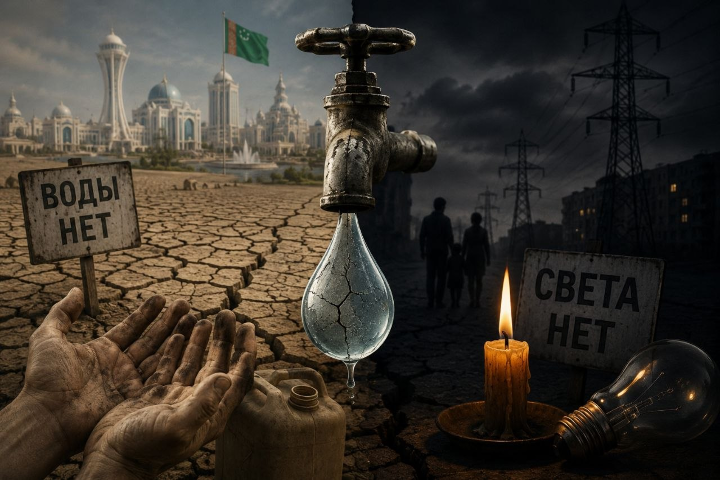
When Water and Electricity Become Scarce: Turkmenistan’s Utilities Crisis as a Human Rights Issue Disruptions to water and electricity supplies across Turkmenistan’s regions increasingly appear to be more than isolated everyday inconveniences. They point to a systemic problem. While significant state resources are directed toward maintaining the showcase appearance of the capital and the Avaza tourist zone, residents of a number of communities face hours-long power outages, days without running water, and the need to purchase water at prices many times higher than the official state rate. On 27 July 2026, Turkmen.news reported that problems with the provision of public utilities had worsened in various regions of Turkmenistan. According to the outlet, the situation is particularly serious with regard to water and electricity supplies. Water Once Every Four Days According to Turkmen.news, residents of the town of Hazar, formerly known as Cheleken, in Balkan Region receive running water approximately once every four days—for only about an hour and a half and at low pressure. Against this backdrop, what is effectively an alternative market for water delivery has emerged. According to the source, water trucks bring water from neighbouring areas and sell it to residents for 50 manats or more per cubic metre, while the official state price is approximately 0.5 manat. This means that residents may be forced to pay around one hundred times the official price. The situation has an especially severe impact on low-income families, older people, families with children, and others who cannot afford to regularly purchase water from private suppliers. According to the publication, residents’ appeals to local authorities and the water utility have failed to bring about any fundamental improvement. People are effectively told to find and order water trucks themselves. Turkmenbashi: A Problem That Has Persisted for Decades A similar situation has been reported in Turkmenbashi. In some residential buildings, running water may be unavailable for several consecutive days. Water tanks are placed outside apartment buildings, while residents are forced to install plastic pipes to pump water up to their homes. The contrast is particularly striking given the nearby Avaza National Tourist Zone, where, according to the source, water is available around the clock in a number of hotels. This disparity inevitably raises questions about state priorities: why, in a country with significant natural resources, has access to basic public utilities remained an unresolved problem for ordinary citizens for decades? Electricity Outages During Extreme Heat According to Turkmen.news, the situation with electricity supplies in Mary and Dashoguz Regions is equally concerning. In some communities, electricity is reportedly cut off for five to six hours every day. When power is restored, voltage levels may fluctuate between 170 and 300 volts. These fluctuations reportedly damage refrigerators, air conditioners, and other household appliances. During summer temperatures exceeding 40°C, a stable electricity supply is no longer simply a matter of household comfort. It is directly connected to people’s health and safety, particularly those of children, older people, and individuals with health conditions. When People Are Afraid to Complain The most serious aspect of the situation, however, concerns more than the deteriorating infrastructure. According to Turkmen.news, citizens who have lost hope of receiving an effective response from local authorities record video appeals and publish them on social media. Yet instead of addressing the problems raised, law enforcement agencies reportedly track down the authors of such videos and force them to remove content considered undesirable. When citizens cannot safely report the absence of water or electricity, a utilities problem simultaneously becomes an issue of freedom of expression and the right to raise complaints with public authorities. People should not have to choose between remaining silent and risking pressure or retaliation for publicly describing their living conditions. Basic Services Are Not a Privilege Access to safe drinking water is recognised by the international community as a fundamental human right. In 2010, the United Nations General Assembly recognised the human right to safe and clean drinking water and sanitation. States have an obligation to take consistent steps to ensure that essential services are accessible without discrimination. The situation in Turkmenistan therefore cannot be viewed solely as the consequence of drought, extreme heat, or ageing pipes. When infrastructure remains inadequately modernised for decades, residents’ complaints receive no effective response, and citizens fear speaking publicly about these problems, the issue becomes one of systemic governance failures and respect for human rights. The contrast between large-scale prestige projects and the everyday conditions faced by ordinary citizens is particularly revealing. Illuminated buildings, fountains, tourist complexes, and international events cannot replace running water in people’s homes, reliable electricity, and functioning public infrastructure. The Problem Must Be Solved, Not Hidden What is needed is a transparent assessment of the condition of water and electricity networks, infrastructure modernisation, accessible emergency water supplies during disruptions, oversight of prices for essential services, and mechanisms to compensate residents for damage caused by unstable voltage. Above all, citizens must be guaranteed the right to freely report problems with public utilities and to address state authorities, the media, and social networks without threats, persecution, or pressure to remove their publications. Criticism does not create a utilities crisis. It merely makes the crisis visible. And when the state attempts to eliminate information about a problem instead of eliminating its causes, the problem does not disappear—it only becomes more deeply entrenched. Source: Turkmen.news, 27 July 2026, “Problems with the Provision of Public Utilities to the Population Worsen in Turkmenistan” https://turkmen.news/2026/07/27/v-turkmenistane-obostrilis-problemy-s-predostavleniem-naseleniyu-kommunalnyh-uslug/
As a foundation, every individual's fundamental
protect and develop their rights
we are working for.