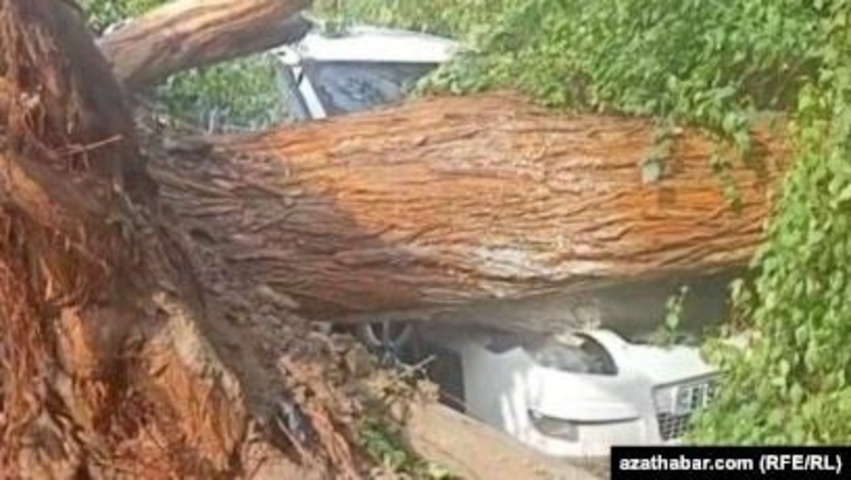
When the State Remains Silent: Natural Disasters in Turkmenistan Become a Personal Problem for Citizens On August 3, 2026, Ashgabat and its surrounding areas were hit by strong winds and heavy rain. The storm uprooted trees, tore off metal structures and roofing, and damaged vehicles and other property. According to Radio Azatlyk, at least one person was killed as a result of the severe weather. However, this tragedy once again raises a much broader and more painful question: why do natural disasters, their consequences, and even human casualties so often become information that the Turkmen authorities prefer not to discuss publicly? A Person Died — Yet the State Remains Virtually Silent According to Radio Azatlyk, the tragedy occurred in a residential area of Ashgabat commonly known as “Khitrovka.” A man approximately 35–40 years old was crossing the street when a large piece of metal, torn loose by the strong wind, struck him on the head. According to eyewitnesses, the man died at the scene, and emergency medical services were unable to save him. The storm also caused significant damage in other parts of the capital. Mature trees were uprooted, metal parts of buildings and other structures were torn away, and vehicles were damaged. A representative of the Ashgabat city administration confirmed to Radio Azatlyk that cleanup operations were underway following the storm but said that, at that time, the administration had no information about the reported fatality. This detail is particularly revealing. When a person dies, society has the right to receive official information: what happened, why it happened, whether the tragedy could have been prevented, and what assistance was provided to the victim’s family. Silence does not bring the victim back. It merely removes the tragedy from public view. “If We Had Been Warned in Advance, the Damage Could Have Been Reduced” Particularly important are the statements of local residents cited by Radio Azatlyk: if the population had been warned in advance about the approaching severe weather, some of the damage could have been prevented. This is no longer merely a question of transparency. It is a matter of public safety. A modern state must have an effective early-warning system for dangerous weather events. Citizens should receive timely information about strong winds, heavy rainfall, floods, extreme heat, and other potential threats. Warnings are not a formality. A few hours of advance notice can sometimes save property. In other cases, it can save a human life. In Baherden, Residents Were Once Again Left to Face the Disaster Alone The severe weather did not affect only the capital. According to Radio Azatlyk, floodwaters in the Baherden district of Ahal Province damaged rural roads and agricultural land. Here, once again, we see an all-too-familiar pattern. Local residents reported that they were forced to deal with the consequences of the flooding on their own. People used shovels to fill washed-out sections of roads, transported soil, and attempted to restore access themselves. According to residents, they received no meaningful assistance from the local authorities. This raises an obvious question: What is the purpose of a state emergency response system if, after a natural disaster, citizens are forced to repair roads themselves and cope with the consequences of flooding without adequate government assistance? A Hidden Disaster Does Not Cease to Be a Disaster The problem extends far beyond the events of August 3. For many years, Turkmenistan has maintained a practice of severely restricting information about emergencies and natural disasters. Independent reports about powerful storms, floods, heavy rainfall, hail, destruction, and other incidents often stand in stark contrast to the picture presented by state-controlled media. But if a destroyed home is not shown on television, the home does not rebuild itself. If a flooded road is not reported, the water does not disappear. If damage to farms is concealed, families do not recover their lost crops. Most importantly, if the authorities remain silent about a person’s death, that person’s life does not become any less valuable. The State Must Protect People, Not Hide Problems The Human Rights Platform of the Dayanç / Turkmenistan Civil Movement believes that the consequences of natural disasters must also be viewed as a matter of protecting fundamental human rights. The state is not responsible for the fact that a storm or flood occurs. No government can stop the wind or rain by decree. But the state is responsible for emergency preparedness, timely warnings to the population, the effective operation of emergency services, accurate public information, assistance to victims, and transparent investigations into fatalities. It is particularly alarming when citizens are effectively left alone to deal with their losses. A vehicle is damaged? Deal with it yourself. Your property is flooded? Restore it yourself. A road is washed away? Take a shovel and repair it yourself. A person is killed? Society may not even receive an official statement. This is not how a system designed to protect the population should function. Why Are the Authorities Afraid to Speak About Tragedies at Home? The contrast between how Turkmenistan seeks to present itself internationally and how problems affecting its own citizens are covered inside the country is particularly striking. State-controlled media report extensively on achievements, construction projects, official ceremonies, and international engagements. But when disaster strikes, buildings are damaged, or people lose their lives, transparency suddenly disappears. A natural disaster is not a disgrace for a state. What can become a disgrace is how the state treats its people after the disaster. Acknowledging a problem, warning the population, mobilizing emergency services, providing compensation, and publicly explaining what happened are not signs of weakness. They are the responsibilities of government. We Demand Transparency and Real Assistance The Human Rights Platform of the Dayanç / Turkmenistan Civil Movement calls on the authorities of Turkmenistan to end the practice of concealing or downplaying emergencies and to establish a transparent system for informing and supporting the population. The authorities must ensure timely warnings about dangerous weather conditions; publish accurate information about deaths, injuries, and the scale of destruction; investigate circumstances in which people lose their lives; ensure the rapid and effective operation of emergency and medical services; establish a clear compensation mechanism for damaged homes, vehicles, agricultural land, and other property; and provide genuine assistance to communities affected by floods and other natural disasters. Most importantly, a citizen of Turkmenistan must not be left alone in the face of disaster simply because acknowledging that disaster would undermine the official image of prosperity. Human life matters more than image. The safety of citizens matters more than a polished official report. And the duty of the state is not to make the consequences of a disaster invisible, but to warn, rescue, assist, and rebuild. Source: Radio Azatlyk, August 4, 2026, “One Person Killed as Strong Winds Hit Ashgabat, Damaging Homes, Trees and Vehicles.”
As a foundation, every individual's fundamental
protect and develop their rights
we are working for.