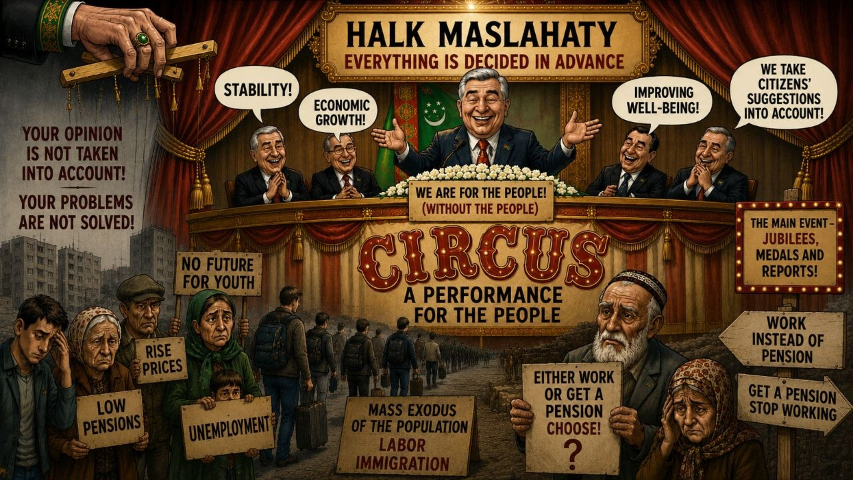
When the People's Council Stops Representing the People: Turkmenistan's Halk Maslahaty Increasingly Resembles a Political Performance On 15 July, Gurbanguly Berdimuhamedov, Chairman of the Halk Maslahaty, held a Presidium meeting dedicated to preparations for the celebration of the 35th anniversary of Turkmenistan's independence. As expected, the official statements were once again filled with familiar rhetoric about "stable development," "economic growth," "improving the well-being of the population," "strengthening food security," and "taking citizens' proposals into account." Yet behind these carefully crafted slogans, one essential question remained unanswered: What are the real concerns of the people of Turkmenistan? The authorities claim to govern in the interests of the people, yet for many years citizens have been deprived of any genuine opportunity to participate in public decision-making. There are no free elections, no independent political parties, no independent media, and no effective mechanisms for public oversight. Any criticism of the government may result in dismissal from employment, travel bans, administrative punishment, or criminal prosecution. This raises an obvious question: Whom does the Halk Maslahaty actually represent? If the people cannot freely elect their representatives, openly discuss national problems, or influence political decisions, then such meetings increasingly resemble carefully staged political performances where every participant knows their role and every decision has already been made long before the session begins. The People Are Not Being Heard During the meeting, officials once again spoke about economic development, industrial modernization, agriculture, investment, workforce training, and reviewing citizens' appeals. But where was the discussion of the issues that affect ordinary people every single day? Why was there no discussion of the mass emigration of Turkmen citizens? Why was nothing said about the hundreds of thousands of people who have been forced to leave their homeland in search of employment and a decent life? Why was there no acknowledgment of labor migration, which has become one of the country's most pressing social challenges? Why was there no discussion of poverty, unemployment, rising food prices, declining living standards, travel restrictions, deteriorating healthcare, or the problems facing the education system? Shouldn't these be the central issues addressed by a body that claims to represent the people? Pensions Are Becoming Another Instrument of Pressure Particularly alarming are reports that the September session of the Halk Maslahaty may consider a proposal requiring working pensioners to choose between two options: continue working without receiving their pension, or retire completely in order to receive it. Such a proposal raises serious social, legal, and ethical concerns. People spent decades working honestly and contributing to the state throughout their careers with the legitimate expectation of receiving a pension in retirement. A pension is not a gift from the government nor an act of charity—it is a legal entitlement earned through years of work. Instead of improving the living conditions of elderly citizens, the authorities now appear ready to restrict their right to benefit from what they have rightfully earned. This proposal is especially troubling given that the government has already abandoned the previous practice of increasing pensions by 10 percent annually. As inflation continues to erode purchasing power, many pensioners are forced to remain employed simply because surviving on a pension alone has become impossible. Now they are effectively being asked to choose between two fundamental rights: the right to work and the right to receive the pension they have earned. This raises another important question: Why does the state believe it has the authority to manipulate benefits that belong to citizens by right? The Country's Real Problems Remain Unaddressed While officials focus on anniversary celebrations, medals, and ceremonial events, Turkmenistan continues to face far more serious challenges. The country is experiencing a continuing mass exodus of its population. Young people increasingly see no future at home and seek opportunities abroad. Hundreds of thousands of families depend on money sent by relatives working in foreign countries. Food prices continue to rise. Farmers struggle with severe water shortages. Power outages and electricity supply problems continue in various regions. Citizens report difficulties accessing healthcare services and essential medicines. Human rights organizations continue documenting cases of political persecution, restrictions on freedom of expression, arbitrary travel bans, and pressure on the relatives of activists. Yet none of these issues appears to receive genuine public discussion within the country's highest representative institutions. A Performance Instead of Representation The Halk Maslahaty is officially presented as the supreme representative body of the people. But no representative institution can genuinely represent the people if the people themselves are excluded from meaningful participation. Without free elections, independent representatives, political pluralism, and freedom of expression, it becomes impossible to speak of authentic public representation. Instead of open debate, society witnesses carefully choreographed meetings featuring predetermined speeches and unanimous approvals. It increasingly appears that a small circle of officials is once again attempting to convince both the population and the international community that national consensus exists—despite the absence of the fundamental freedoms necessary for such consensus to emerge. This political spectacle no longer inspires respect. Instead, it raises growing concern both inside and outside the country. True Independence Begins with Respect for Citizens The independence of a nation cannot be measured by the number of anniversary celebrations, military parades, or commemorative medals. It should be measured by how freely citizens can express their views, how seriously the government listens to them, and how effectively human rights and social justice are protected. As long as millions of citizens remain unheard, as long as major political and social decisions are made without meaningful public participation, and as long as pensions earned through decades of honest work become instruments of political manipulation, it is difficult to speak of genuine popular governance. The Dayanç Human Rights Platform / Turkmenistan believes that the country's future cannot be built without respecting the voices of its own people. The authorities should abandon the practice of making socially significant decisions behind closed doors, establish genuine mechanisms for public participation, respect freedom of expression, and guarantee the protection of the social and economic rights of every citizen. A People's Council should serve the people—not function as a stage for predetermined decisions and carefully orchestrated political performances.
As a foundation, every individual's fundamental
protect and develop their rights
we are working for.