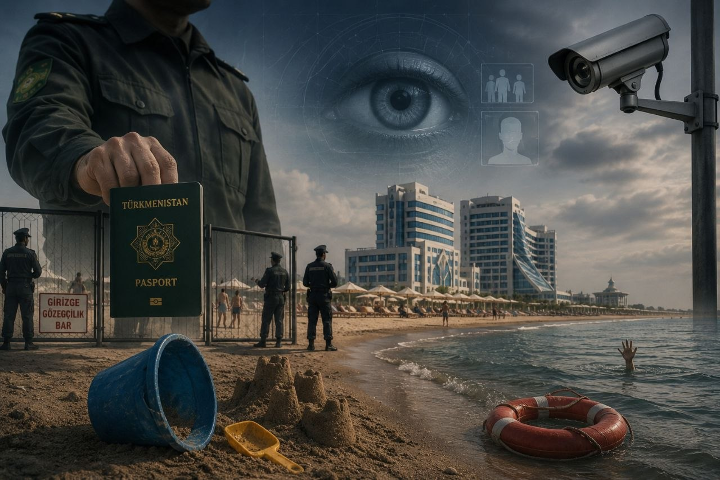
When the Authorities Do Not Want to Change the System: In Awaza, Control Is Tightened Instead of Safety Being Ensured Recent developments in the Awaza National Tourist Zone once again demonstrate a characteristic model of governance in Turkmenistan: when systemic problems can no longer be concealed, the authorities do not address their root causes but instead tighten control over citizens. On 31 July 2026, Radio Azatlyk’s Turkmen Service reported another tightening of security measures in Awaza. According to the outlet, holidaymakers’ passports are being collected, personal information is being recorded, law enforcement officers are checking individuals, while taxi and bus drivers have complained about passengers being monitored and attempts being made to determine who is travelling where. It is particularly alarming that these measures are being introduced almost simultaneously with reports of a tragedy in the Caspian Sea, where two minors went missing. The body of one child was subsequently recovered. At the time the information was published, the fate of the second teenager remained unknown. According to Azatlyk, the authorities had not publicly responded to the incident. This raises a fundamental question: whom and what is the reinforced security apparatus in Awaza actually protecting? Holidaymakers’ Passports Are Under Control — But Who Is Responsible for Children’s Safety? According to Azatlyk’s sources, security officers deployed to Awaza are collecting hotel guests’ passports from reception desks and checking their personal information. One of the outlet’s sources said that he had attempted to book a hotel room, but after his passport was checked and his details were entered into a computer system, he was unexpectedly informed that the hotel could not accommodate him. No explanation was provided. Increased monitoring on public transport and in taxis has also been reported. This creates a striking paradox: the state apparatus appears to have substantial resources available for verifying the identities of holidaymakers, monitoring their movements and controlling public spaces, yet the public receives no transparent information about what measures were taken to prevent deaths at sea, how promptly the rescue services responded, and who is responsible for ensuring the safety of holidaymakers. This is no longer merely a question of how a tourist zone is managed. It is a question of state priorities. Security Is Being Turned Into an Instrument of Control The state unquestionably has an obligation to ensure safety in places of mass recreation. Strengthening rescue services, issuing warnings about dangerous weather conditions, ensuring access to medical assistance, deploying trained lifeguards, establishing clear swimming rules and promptly informing the public are all legitimate and necessary measures. But checking passports, collecting information about citizens, monitoring passengers and restricting movement represent an entirely different approach. When the concept of “security” comes to mean primarily controlling citizens themselves, there is a serious risk of interference with the right to privacy and freedom of movement. Article 12 of the International Covenant on Civil and Political Rights (ICCPR) guarantees the right of everyone lawfully within the territory of a state to liberty of movement and freedom to choose their residence. Article 17 of the Covenant prohibits arbitrary or unlawful interference with privacy. Furthermore, the state has positive obligations to protect life. Article 6 of the International Covenant on Civil and Political Rights protects every human being’s inherent right to life. State security policies must therefore be directed primarily at preventing genuine threats to people’s lives and health, while any restrictions on fundamental rights must have a lawful basis and must be necessary and proportionate. Instead of Solving the Problem, the Authorities Control Information About It Another aspect of Azatlyk’s report deserves particular attention: the outlet notes that the authorities rarely provide independent media with comments on issues of public concern. As a result, citizens are forced to record videos and audio themselves and contact independent journalists and bloggers in an attempt to bring problems to public attention. This reveals a much broader systemic problem. When a state does not want to reform the system and put an end to systematic human rights violations, it begins fighting not the causes of the problem, but its visibility. Instead of investigation — silence. Instead of transparency — secrecy. Instead of free access to information — control. Instead of ensuring citizens’ right to move and enjoy their holidays freely — passport checks and surveillance. Instead of dialogue with society — attempts to identify those who disseminate information. Such policies do not solve problems. They merely make those problems less visible within the country. After a Tragedy, Society Has the Right to Answers Following reports of the death of one child and the disappearance of another minor, the authorities should have done far more than simply increase the number of security personnel. There should be a transparent investigation into the circumstances of the tragedy, official information about the search-and-rescue operation, an assessment of beach and rescue infrastructure, an examination of possible shortcomings in safety arrangements, and proper public communication. If strong waves or other natural conditions posed a danger, citizens have the right to know when the authorities became aware of the threat, what warnings were issued to holidaymakers, and what restrictions on swimming were introduced. This is how a system genuinely focused on protecting people should operate. Awaza as a Reflection of a Broader Problem What is happening should not be viewed solely as a local issue affecting a tourist zone. It highlights a fundamental distinction between human security and the security of the system itself. Human security means protecting people’s lives, health, dignity, privacy and fundamental freedoms. The security of an authoritarian system too often means something very different: knowing where citizens are, whom they communicate with, where they travel, what information they receive, and what information they share with others. This is why an increased number of checks does not in itself mean greater security. A state becomes safer for its citizens not when every holidaymaker’s passport is checked, but when a child can enter the sea and their life is protected by a functioning system of prevention, rescue and accountability. Source This article is based on a report published by Radio Azatlyk’s Turkmen Service on 31 July 2026 concerning the renewed tightening of security measures in Awaza, including passport checks and surveillance, as well as Azatlyk’s related reporting on the death of one child and the disappearance of another in Awaza. Information attributed to Radio Azatlyk’s anonymous sources is presented in this article specifically as claims reported by the outlet and requires independent verification.
As a foundation, every individual's fundamental
protect and develop their rights
we are working for.