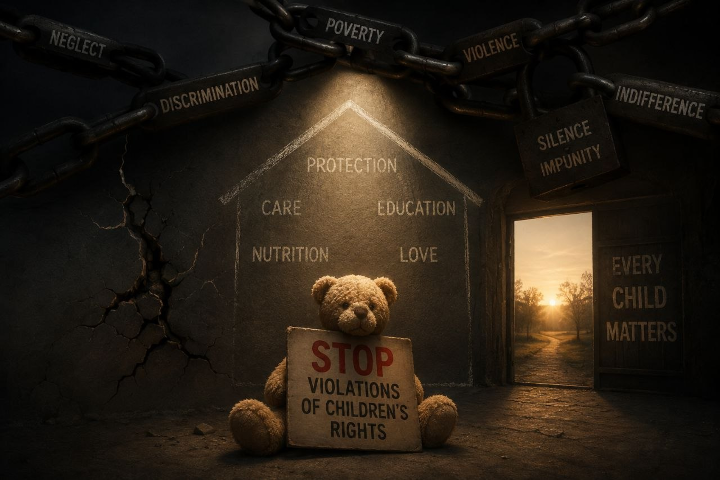
When Statements About Supporting Children Diverge from Reality: Kindergarten Nutrition in Turkmenistan and Questions for UNICEF While UNICEF in Turkmenistan marks World Breastfeeding Week and speaks about strengthening support systems for mothers and children, independent reports from Ashgabat paint a far more troubling picture: children are reportedly returning home hungry from state-run kindergartens, the quality of meals is deteriorating, and parents and staff are afraid to speak openly about the situation. On 31 July 2026, Radio Azatlyk’s Turkmen Service reported complaints from parents whose children attend kindergartens in Ashgabat. According to the outlet’s sources, children are returning home hungry, while meals provided in preschool institutions are becoming increasingly inadequate and limited. This is not simply a matter of dissatisfaction with a menu. If the accounts provided by parents and kindergarten employees are accurate, they raise serious concerns about one of the most fundamental rights of the child — the right to adequate nutrition, health, and conditions necessary for normal physical and mental development. One Apple for Four Children and a Monotonous Diet According to Radio Azatlyk, parents say that meals in some Ashgabat kindergartens have become monotonous and insufficient. They report that children are repeatedly served pasta, wheat porridge, sweetened tea, and bread. Even during the summer, when fresh fruit and vegetables should be more readily available, the amount provided has reportedly decreased. One source said that while children used to receive an apple, mandarin, or orange earlier in the year, one apple may now be divided into four pieces and shared among four children. Parents say that both the quantity and quality of the food are leaving children hungry when they return home. Even more concerning are reports regarding the quality of the food products themselves. Kindergarten employees had previously told Azatlyk about rotten vegetables, poorly baked bread, and other problems with supplied food products. The latest report also cites employees alleging that meat with an unpleasant smell sometimes has to be additionally treated before it can be prepared. All of these allegations require independent verification and an official response from the relevant state authorities. A Problem People Are Afraid to Discuss Another particularly concerning aspect is that the parents and kindergarten employees who spoke to Azatlyk did so anonymously because of concerns for their safety. This significantly changes the nature of the issue. When parents cannot freely complain about the food provided to their own children, and kindergarten employees are afraid to speak publicly about the quality of food products, the issue goes beyond shortcomings in the preschool education system. It raises questions about the existence of safe and effective complaint mechanisms, independent oversight, and the ability to report possible violations without fear of pressure or retaliation. At the same time, as Azatlyk notes, the Turkmen authorities do not publicly comment on reports about such problems published by independent media. Against This Background, UNICEF Speaks of “the Best Start in Life” The contrast becomes particularly striking in light of a UNICEF Turkmenistan publication marking World Breastfeeding Week, observed from 1 to 7 August. The publication states: > “Every child deserves the best start in life.” UNICEF describes its cooperation with Turkmenistan’s Ministry of Health and Medical Industry and the Gurbanguly Berdimuhamedov Charitable Foundation for Assistance to Children in Need of Care. It also states that the week will conclude with a National Round Table on “Strengthening Support Systems for Exclusive Breastfeeding,” bringing partners together to discuss further steps to develop policies, services, and support for mothers and children. Supporting breastfeeding is undoubtedly important. However, protecting a child’s right to adequate nutrition does not end when breastfeeding ends. A child certainly deserves the best start in life. But that same child also deserves adequate and nutritious food at the ages of three, four, and five. It is precisely here that public statements appear to diverge sharply from reports about the reality experienced by families. 40% of Children Attend Preschool Institutions This issue becomes even more significant in light of data cited by Azatlyk from a joint report by UNICEF and Turkmenistan’s State Committee on Statistics, published in June 2020. According to those figures, around 40% of children aged three to five attended preschool institutions. The condition of the preschool nutrition system may therefore affect a very large number of children and families. At the same time, as the report notes, the Turkmen authorities do not make sufficient up-to-date statistics publicly available regarding the number of children attending kindergartens, the condition of the preschool system, or the socio-economic situation of families. Without transparent and current data, it is impossible to properly assess the scale of the problem. UNICEF Must Hear More Than State Institutions This raises a fundamental question for UNICEF’s representation in Turkmenistan. Cooperation with ministries, state institutions, foundations, and the organization of round tables cannot, by themselves, serve as sufficient indicators of children’s actual well-being. If independent media report that children are returning home hungry from kindergartens, while parents and employees are afraid to speak openly about what is happening, an international organization whose mandate is directly connected to protecting children’s rights should seek information not only from government partners, but also from parents, independent sources, and civil society. It is particularly important that there be a safe and accessible channel through which citizens can inform UNICEF about possible violations affecting children. But How Can Citizens Contact UNICEF? This brings us to another serious problem. We once again draw attention to the fact that, based on our experience, the email address listed as a contact address on UNICEF Turkmenistan’s Facebook page does not provide a functioning channel of communication. This is not a minor technicality. If an international organization publicly states that it works to protect children’s rights, parents, victims of violations, human rights defenders, and representatives of civil society must have a genuine and practical way to contact it. A contact address that does not actually enable communication cannot be considered an effective feedback mechanism. We therefore call on UNICEF Turkmenistan to verify its publicly listed contact details, ensure that accessible and functioning channels of communication are available to citizens, and clearly explain how parents can confidentially report concerns involving the health, nutrition, safety, and rights of children. Children’s Rights Must Be Measured by Reality, Not Round Tables The UN Convention on the Rights of the Child recognizes every child’s right to the highest attainable standard of health and requires states to take appropriate measures to combat disease and malnutrition, including through the provision of adequate nutritious food and clean drinking water. Policies concerning children should therefore be assessed first and foremost by the actual conditions in which children themselves live. If a child returns home hungry after spending an entire day in a state-run kindergarten, that problem cannot be offset by conferences, official events, or carefully worded social media posts. UNICEF and the Turkmen authorities should provide the public with answers to concrete questions: What nutritional standards currently apply in kindergartens? Who monitors the quality and safety of food? How are parents’ complaints handled? Are independent inspections conducted? And where can citizens safely turn when a child’s rights may have been violated? Public statements about children’s well-being must be supported by reality. Every child truly does deserve the best start in life. But a child’s right to adequate nutrition, health, and safety must exist not only in UNICEF publications — it must be protected every day, in every kindergarten across Turkmenistan. Sources: Radio Azatlyk, 31 July 2026, “Children Return Home Hungry After Meals at Kindergartens in the Capital”: https://www.azathabar.com/a/cagalar-bagynda-berilyan-nahardan-son-korpeler-ac-galyar/33818977.html UNICEF Turkmenistan publication marking World Breastfeeding Week, 1–7 August 2026, published on UNICEF Turkmenistan’s Facebook page.
As a foundation, every individual's fundamental
protect and develop their rights
we are working for.