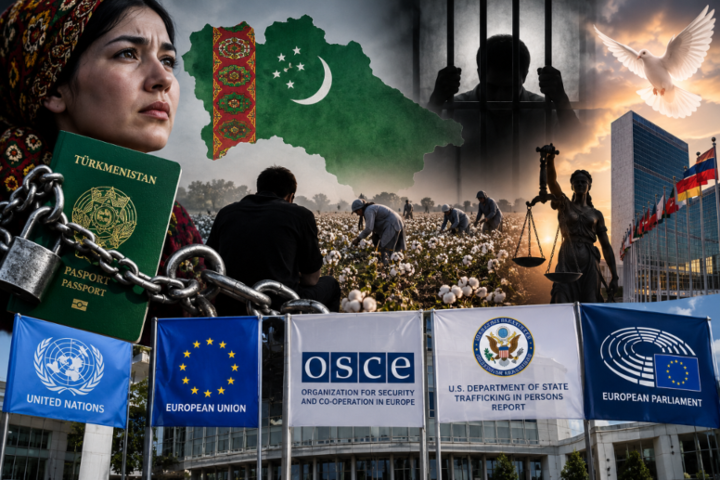
U.S. State Department Upgrades Turkmenistan’s Trafficking Ranking: DAYANÇ Demands an Independent Review 19 October 2026 | DAYANÇ Civil Human Rights Platform / Turkmenistan DAYANÇ Civil Human Rights Platform, together with the Democratic Choice of Turkmenistan (DWT), the Coordination Council of Democratic Forces of Turkmenistan, and representatives of independent Turkmen civil society, has issued a formal protest against the U.S. Department of State’s decision to upgrade Turkmenistan in its 2026 Trafficking in Persons (TIP) Report. The central question is simple: How can Turkmenistan be credited with progress while its citizens continue to face forced labor, passport restrictions, exploitation risks, and a lack of effective protection? In its 2026 report, the State Department upgraded Turkmenistan from the Tier 2 Watch List to Tier 2. In 2024, the country had been classified as Tier 3, the lowest ranking. DAYANÇ demands an independent reassessment based on verified improvements in the protection of victims, rather than government declarations or formal commitments. THE PASSPORT CRISIS: STATE POLICIES INCREASE VULNERABILITY TO EXPLOITATION One of the most serious problems remains Turkmenistan’s longstanding refusal or failure to provide accessible passport renewal services to its citizens abroad. Article 29(3) of Turkmenistan’s Law on Migration provides for the issuance and replacement of passports through diplomatic missions and consular offices. Nevertheless, citizens continue to report being unable to obtain valid passports without returning to Turkmenistan. The consequences are severe: loss of legal immigration status, inability to work lawfully, exposure to detention and deportation, and increased dependence on unregulated employment. A person deprived of valid travel documents becomes significantly more vulnerable to exploitative employers, dishonest intermediaries, and trafficking networks. Passport restrictions do not automatically constitute human trafficking. However, government policies that deprive citizens of documentation and lawful employment opportunities can create conditions in which exploitation becomes more likely. FORCED LABOR: INTERNATIONAL AGREEMENTS ARE NOT ENOUGH Turkmenistan has faced longstanding allegations of state-imposed forced labor, particularly during the cotton harvest. Teachers, healthcare professionals, and other public-sector employees have reportedly been pressured to participate in agricultural work under threats of dismissal or disciplinary consequences. The U.S. State Department’s 2024 TIP Report documented serious concerns about government-compelled forced labor, including the mobilization of public employees and the involvement of children in cotton harvesting. Signing agreements, adopting roadmaps, and conducting training sessions cannot substitute for demonstrable results. Meaningful progress requires independent monitoring, unrestricted access for observers, accountability for officials involved in coercion, and effective protection against retaliation. WOMEN AND CHILDREN: WHERE IS THE PROTECTION? DAYANÇ continues to receive complaints involving sexual violence, domestic abuse, intimidation, and failures by state institutions to protect women and children. Victims report obstacles to obtaining independent legal assistance, psychological support, emergency accommodation, and effective judicial remedies. Not every case of sexual violence or domestic abuse constitutes trafficking in persons. However, the absence of protection, economic dependence, and the inability to escape dangerous circumstances can significantly increase vulnerability to further exploitation. The effectiveness of anti-trafficking policies must be measured by whether victims can actually obtain safety, justice, and protection—not merely by official statistics. EXIT BANS AND THE SEPARATION OF FAMILIES Restrictions on freedom of movement remain another major concern. DAYANÇ has documented complaints involving citizens prevented from leaving Turkmenistan despite having spouses and children legally residing abroad. Particular attention must be given to Article 30(9) of Turkmenistan’s Law on Migration, which has been invoked in connection with restrictions affecting citizens who have allegedly violated the laws of foreign countries. These measures can lead to prolonged family separation and prevent access to employment, medical care, education, and international protection. Restricting lawful migration does not protect people from trafficking. It can instead push vulnerable individuals toward unsafe routes and exploitative intermediaries. TRANSNATIONAL REPRESSION AND EXPLOITATION RISKS Turkmen citizens abroad, including journalists, human rights defenders, political activists, and their relatives, have reported threats, intimidation, consular pressure, and risks associated with forced return. Such practices may undermine access to legal documentation, employment, personal security, and international protection. Although transnational repression does not automatically constitute human trafficking, it can contribute to the conditions that traffickers exploit. DAYANÇ also calls for preventive assessments of the potential recruitment of undocumented and economically vulnerable Turkmen citizens into criminal networks or armed conflicts. These are identified as potential risks requiring investigation and prevention, not as claims that specific cases of recruitment into armed conflicts have already been proven. WHAT DAYANÇ DEMANDS DAYANÇ and the joint signatories call on the U.S. Department of State and relevant international institutions to: 1. Conduct an urgent, independent reassessment of Turkmenistan’s 2026 TIP ranking and restore the country to Tier 3 if substantial progress cannot be independently verified. 2. Investigate how the passport crisis and migration restrictions increase vulnerability to forced labor and trafficking. 3. Require independent monitoring of forced labor, particularly in the cotton industry. 4. Assess the availability of shelters, legal assistance, psychological support, and effective protection for women, children, and trafficking victims. 5. Examine the impact of transnational repression, exit bans, and restrictions on family reunification. 6. Establish direct cooperation with independent Turkmen civil society organizations, victims, and witnesses. The State Department’s TIP methodology evaluates concrete government efforts to prevent trafficking, prosecute perpetrators, and protect victims. DAYANÇ therefore calls for the claimed progress to be tested against independently verified results. HUMAN RIGHTS MUST COME BEFORE DIPLOMATIC RECOGNITION An improved international ranking should reflect measurable improvements in people's lives. If citizens cannot obtain passports, workers remain vulnerable to coercion, victims of violence cannot obtain justice, and families are separated by arbitrary restrictions, claims of meaningful progress require serious scrutiny. DAYANÇ calls on the U.S. Department of State, the U.S. Congress, the European Union, the OSCE, the United Nations, and international human rights organizations to examine the evidence independently and engage directly with Turkmen civil society. The fight against human trafficking cannot be measured by the number of laws adopted or agreements signed. Its true measure is whether human beings are protected from coercion, exploitation, and abuse. Human rights must never become a matter of political convenience. OFFICIAL JOINT STATEMENT Registration No.: DAYANCH-TKM-OUT-2026-001 Date: 19 October 2026 Issued by: DAYANÇ Civil Human Rights Platform / Turkmenistan Diana Dadasheva — Founder and Chairperson, France Democratic Choice of Turkmenistan (DWT) Murat Klychevich Kurbanov — Leader Coordination Council of Democratic Forces of Turkmenistan Muhammed Devejinejad — Leader Representatives of Independent Turkmen Civil Society Official website: http://dayanchcivil.com/ U.S. Department of State — 2026 Trafficking in Persons Report: https://www.state.gov/reports/2026-trafficking-in-persons-report/turkmenistan/
As a foundation, every individual's fundamental
protect and develop their rights
we are working for.