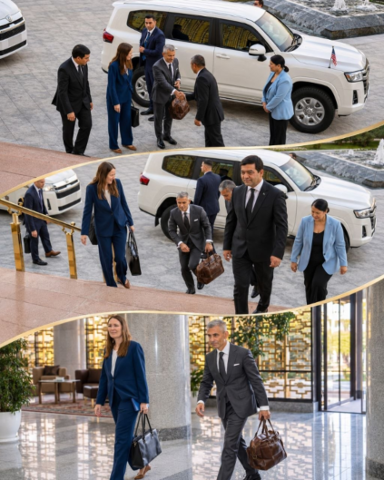
U.S. DIPLOMAT ARRIVES IN ASHGABAT AMID CONTROVERSY OVER THE STATE DEPARTMENT’S DECISION ON HUMAN TRAFFICKING 3 November 2026 S. Paul Kapur, U.S. Assistant Secretary of State for South and Central Asian Affairs, has arrived in Turkmenistan for an official visit. According to the U.S. Embassy in Ashgabat, the visit aims to further strengthen bilateral relations, expand business ties, promote energy cooperation, and enhance regional connectivity. However, this diplomatic engagement comes amid serious concerns regarding U.S. human rights policy toward Turkmenistan, particularly following the State Department’s decision to upgrade the country’s ranking in its 2026 Trafficking in Persons (TIP) Report. The decision prompted an official protest from independent Turkmen organizations. On 19 October 2026, the Human Rights Platform of the DAYANÇ Civil Movement – Turkmenistan, the Democratic Choice of Turkmenistan (DCT), and the Coordination Council of Democratic Forces of Turkmenistan (CCDFT) issued a joint statement, DAYANCH-TKM-OUT-2026-001, expressing their disagreement with the upgrade and calling for an objective reassessment of the situation. In their protest, the organizations highlighted continuing reports of the forced mobilization of public-sector employees, teachers, educational staff, and military personnel for cotton harvesting, the lack of effective and independent mechanisms to protect victims, restrictions on labour rights, and insufficient transparency in investigations into cases of exploitation. Particular attention was drawn to the situation of Turkmen migrant workers, who are especially vulnerable because of their own government's passport policies. Turkmen citizens living abroad face serious obstacles in obtaining or renewing their international passports through their country's diplomatic missions. Once their passports expire, many are unable to maintain lawful employment, renew residence permits, travel freely, or access effective legal protection. However, the consequences of these policies extend far beyond ordinary immigration difficulties. Without valid international passports or secure legal status, Turkmen citizens become easy targets for unscrupulous intermediaries, exploitative employers, and recruiters. Facing the threat of detention, deportation, unemployment, or loss of their livelihoods, individuals may be pressured into accepting dangerous working conditions or becoming dependent on people who promise to resolve their documentation problems. Of particular concern is the risk of coercive or deceptive recruitment of vulnerable migrants into armed conflicts, including Russia's war against Ukraine. The absence of valid identity and travel documents, fear of deportation, and dependence on employers or intermediaries create conditions in which vulnerable individuals can be more easily pressured into signing military contracts through deception, threats, or promises of legal residency. These risks require separate examination by international human rights mechanisms. Where the relevant legal elements are established, recruitment for the purpose of exploitation may fall within the international legal definition of trafficking in persons. Therefore, the international passport crisis is not merely an administrative issue. It is directly connected to personal security, the risk of labour exploitation, human trafficking, and coercive recruitment into armed conflicts. For these reasons, in their joint protest, DAYANÇ, DCT, and CCDFT urged the U.S. authorities to consider not only official statistics supplied by the Turkmen government but also the actual living conditions of citizens, documented reports of forced labour, the risks of migrant exploitation, inadequate protection of women and children, the lack of an independent judiciary, and the need for international monitoring. An upgrade in Turkmenistan's ranking in the State Department's report does not mean that human trafficking or forced labour has been eliminated. Nevertheless, such a decision may be presented by the Turkmen authorities as evidence of international recognition of their policies, despite the persistence of serious structural problems. Against this background, Paul Kapur's visit, which focuses on economic and energy interests, raises an important question: what place do the lives of ordinary citizens and the protection of fundamental human rights occupy in U.S.–Turkmen relations? Turkmenistan remains one of the world's most closed countries. For many years, international human rights organizations have documented restrictions on freedom of expression, movement, and association, persecution of government critics, the absence of an independent judiciary, and severe obstacles to the activities of civil society. Behind official statements about expanding cooperation are the lives of real people. The circumstances surrounding the alleged enforced disappearance of Alisher Sakhatov and Abdulla Orusov following events in Türkiye on 25 July 2025 still require an independent investigation. The cases of Maral Annayeva, Jeren Altyyeva, Leyla Kamalova, and Gülala Hasanova also raise serious concerns, with reports involving persecution, detention, intimidation, pressure, and threats to personal safety. At the same time, complaints continue to emerge concerning arbitrary restrictions on citizens' ability to leave Turkmenistan. Provisions of Articles 29(3) and 30(9) of Turkmenistan's migration legislation, concerning passport issuance and freedom of movement, raise serious questions regarding compliance with Article 12 of the International Covenant on Civil and Political Rights (ICCPR). The development of energy and trade cooperation between the United States and Turkmenistan is not, in itself, objectionable. However, economic partnerships with a state where systemic restrictions on human rights persist must be accompanied by meaningful attention to labour rights, the prevention of exploitation, transparency in government contracts, and the protection of civil society. The Human Rights Platform of the DAYANÇ Civil Movement – Turkmenistan calls on Assistant Secretary of State S. Paul Kapur to raise the issues of forced labour, migrant protection, the inability of Turkmen citizens to obtain or renew international passports abroad, the risks of coercive recruitment into armed conflicts, restrictions on freedom of movement, and politically motivated persecution during his visit. We also consider it essential that the U.S. Department of State review the joint protest submitted by DAYANÇ, DCT, and CCDFT on 19 October 2026, provide a reasoned response to the concerns raised, and ensure that independent Turkmen organizations have an opportunity to present their documented evidence and findings. Diplomatic negotiations should not be limited to energy, investment, and transport corridors. The United States, which has repeatedly affirmed its commitment to human rights, has an opportunity to place the protection of vulnerable individuals on the agenda of bilateral dialogue. Genuine positive developments in relations with Turkmenistan must be accompanied by tangible improvements in the lives of its people: an end to forced labour, effective protection of migrants against exploitation and coercive recruitment, the issuance and renewal of international passports for citizens abroad, the elimination of arbitrary restrictions on leaving the country, and the establishment of effective legal remedies. International cooperation should benefit not only government institutions and major economic partners, but above all, ordinary people. Turkmenistan is not merely a country of natural gas, investments, and strategic transport routes. It is home to millions of people entitled to freedom, security, human dignity, and protection from exploitation. Their lives and rights must not be left outside the closed doors of diplomatic negotiations.
As a foundation, every individual's fundamental
protect and develop their rights
we are working for.