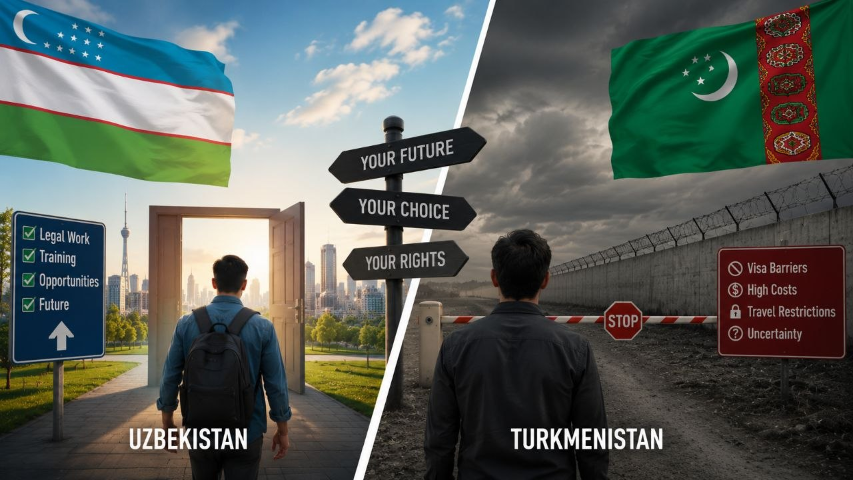
Two Neighboring Countries — Two Different Realities: How Uzbekistan and Turkmenistan Treat the Future of Their Citizens Two neighboring Central Asian countries. Two states with a shared historical background, similar socio-economic challenges, and significant levels of labor migration. Yet recent developments reveal fundamentally different approaches to one of the most important issues facing their citizens: the right to work, freedom of movement, and the opportunity to legally seek a decent livelihood abroad. While Uzbekistan is negotiating with foreign partners to create legal employment opportunities for its citizens, people from Turkmenistan are facing new visa barriers, financial bond requirements, and the consequences of their country’s long-standing isolation. The difference is not simply about U.S. immigration policy. The central question is: What does a state do for its citizens when doors begin to close? Uzbekistan: The State Seeks Legal Opportunities for Its Citizens On August 7, Uzbek media reported that Uzbekistan’s Migration Agency had reached an agreement with a U.S. company specializing in recruiting foreign workers for the agricultural sector. The initiative concerns the preparation and employment of Uzbek citizens for seasonal work in the United States under the H-2A visa program, which allows U.S. employers to temporarily hire foreign agricultural workers. What matters is not only the agreement itself, but also how the state intends to organize the participation of its citizens. According to the information published, the project provides for the development of training programs tailored to the needs of U.S. employers, English-language courses and vocational training, assessment of candidates’ practical skills, and subsequent certification. Transparent mechanisms for selecting workers are also expected to be introduced. Uzbekistan’s Migration Agency intends to prepare participants by informing them about U.S. labor laws and working conditions, while also overseeing their timely return to Uzbekistan after their contracts expire. In other words, the message is not simply: “Go abroad and figure it out for yourselves.” A government agency is effectively acting as an intermediary between citizens and the legal labor market: identifying opportunities, negotiating with partners, preparing workers, explaining the rules, and seeking to reduce the risks associated with irregular migration. Turkmenistan: A Very Different Picture At almost the same time, another development emerged. On August 3, 2026, the U.S. Department of State published the final rules governing its visa bond program. For nationals of certain designated countries applying for some B1/B2 visas, consular officers may require a bond of $10,000, $15,000, or $20,000. Turkmenistan is among the countries covered by this mechanism. Turkmenistan’s inclusion in such a program is neither a decision made by Ashgabat nor a measure imposed by the Turkmen government. It would therefore be inaccurate to hold Turkmenistan directly responsible for U.S. visa rules. But another question arises: Why is a citizen of Uzbekistan being offered a new legal pathway to employment abroad with support from their own government, while a citizen of Turkmenistan is largely left alone to navigate an increasingly difficult migration environment? This is where the comparison becomes particularly significant. It Is About More Than a U.S. Visa The problems faced by Turkmen citizens extend far beyond the cost of a U.S. visa bond. For many years, people have been leaving Turkmenistan in large numbers in search of employment and a more stable life abroad. At the same time, serious restrictions on freedom of movement persist within the country. Citizens face difficulties obtaining and renewing passports, while some individuals are prevented from leaving the country altogether. Turkmenistan’s isolation and the limited international mobility of its citizens further complicate the situation. This creates a paradox. People leave primarily because they do not see sufficient economic opportunities at home, yet state policies can simultaneously make it more difficult for them to leave legally, while failing to provide transparent government-supported programs for safe labor migration on a comparable scale. As a result, the space for legal opportunities becomes increasingly narrow. When Migration Policy Becomes a Human Rights Issue Labor migration is not merely an economic issue. It is also a matter of human dignity, the right to work, freedom of movement, and the responsibility of the state to create conditions in which citizens are not forced to choose between poverty at home and irregular status abroad. The International Covenant on Economic, Social and Cultural Rights recognizes the right of everyone to the opportunity to gain a living through work which they freely choose or accept. Article 12 of the International Covenant on Civil and Political Rights recognizes the right of everyone to leave any country, including their own, subject only to restrictions permitted under international law. Of course, these provisions do not mean that a government is required to secure a job in the United States or any other country for every citizen. But government policy matters. A state can establish legal pathways for labor migration, negotiate with employers, provide training, protect workers’ rights, and help prevent irregular migration. Or it can restrict the mobility of its own citizens and effectively leave them to find a way out on their own. Neighbors — but Different Approaches The comparison is particularly striking because these are two neighboring Central Asian states. Uzbekistan: a government migration agency negotiates with foreign partners, organizes vocational and language training, and establishes mechanisms for legal employment abroad. Turkmenistan: citizens face the consequences of international isolation, restrictions on mobility, and increasingly difficult conditions for entering certain countries, while comparable transparent mechanisms supporting legal labor migration remain insufficient. Uzbekistan should not be idealized. The existence of a single employment program does not mean that the country has no problems related to human rights, labor rights, or migration. But in this particular case, the difference is clear. One neighbor is attempting to transform migration from a largely spontaneous process into a regulated and legal form of employment. The other has spent years trying to control citizens’ very ability to leave. The Central Question: Where Is the State? Ultimately, the most important part of this story is not the United States. The U.S. government determines its own visa and immigration policies. But the governments of Uzbekistan and Turkmenistan determine how they respond to changing circumstances and how they protect the interests of their own citizens. When hundreds of thousands of people seek employment abroad, responsible public policy should focus not on creating additional obstacles, but on expanding safe and legal opportunities. People need valid passports, freedom of movement, information about their rights, access to vocational training, official employment contracts, and protection from exploitation. In the example described above, Uzbekistan is taking a step in precisely that direction. Turkmenistan, meanwhile, faces a much more fundamental question: Why must citizens of one of the region’s most resource-rich countries search abroad for opportunities to support their families — and why, instead of expanding their options, has their own government spent years restricting their freedom of choice? Two neighboring countries. Two different realities. One tells its citizens: We will look for legal opportunities for you. The other too often leaves its citizens to find their own way out of a dead end created by state policy. And it is precisely here that the line is drawn between migration policy alone and genuine state responsibility for the dignity, rights, and future of its people.
As a foundation, every individual's fundamental
protect and develop their rights
we are working for.