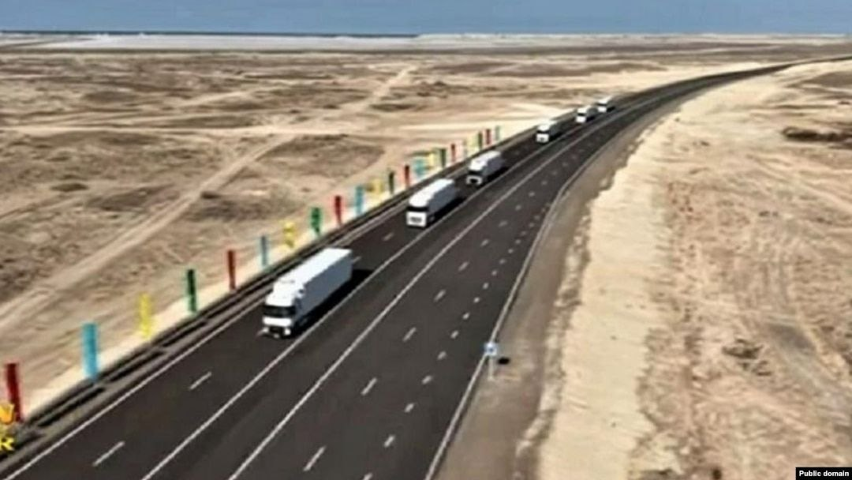
TURKMENISTAN OPENS A NEW ROUTE TO INTERNATIONAL TRANSIT: NEW HIGHWAYS AND OLD QUESTIONS ABOUT GOVERNMENT POLICY On 5 November 2026, Azattyq Asia reported the opening of a new 44-kilometre section of road in Turkmenistan, connecting the settlement of Garabogaz with the state border of Kazakhstan. The section forms part of the Turkmenbashi–Garabogaz–Kazakhstan border highway and the international North–South Transport Corridor. The opening ceremony took place on 4 November. President Serdar Berdimuhamedov officially launched the road via video link. According to the Turkmen media outlet Orient.tm, construction of the highway, with a total planned length of 207 kilometres, began in November 2025. Work on the remaining sections is still ongoing. On the same day, the President of Turkmenistan also participated in the groundbreaking ceremony for another major highway project: the Ashgabat–Dashoguz motorway, which is planned to extend for 550 kilometres. This highway is also expected to become part of the North–South Transport Corridor. TRANSPORT INFRASTRUCTURE AS A GEOPOLITICAL INSTRUMENT The North–South International Transport Corridor is a large-scale project whose founding agreement was signed by Russia, India and Iran on 12 September 2000. The agreement entered into force in May 2002. Its primary objective is to establish an alternative route for transporting goods between South Asia, the Persian Gulf countries, Russia and Europe, reducing transportation time and costs compared with traditional maritime routes through the Suez Canal. Turkmenistan's geographical location gives the country an important potential role in the development of regional transport infrastructure. Its borders with Iran, Kazakhstan and Uzbekistan, together with its access to the Caspian Sea, offer considerable opportunities for transit transportation, trade and economic cooperation. However, building roads alone does not automatically transform a country into a fully functioning international transport hub. This requires transparent customs procedures, predictable border-crossing regulations, efficient logistics, independent oversight mechanisms and equal conditions for all economic participants. ECONOMIC DEVELOPMENT AND THE PUBLIC INTEREST The development of transport infrastructure could generate additional transit revenues for Turkmenistan, create jobs and expand trade relations with neighbouring countries. But one fundamental question remains: to what extent will the benefits of these large-scale government projects be accessible to ordinary citizens? Economic development should not be measured solely by kilometres of roads constructed, the number of facilities inaugurated or the scale of official ceremonies. Its real indicators should include improvements in living standards, the creation of decent employment opportunities, regional development, access to public services and the expansion of economic opportunities for citizens. Transparency in public spending, the conditions of public tenders, construction costs and independent audits of infrastructure projects are particularly important. Society must be able to understand how such large-scale initiatives are financed and whether public resources are being used effectively. INFRASTRUCTURE CANNOT REPLACE HUMAN RIGHTS AND FREEDOMS Turkmenistan is seeking to strengthen its position in international transport and trade projects. This is a legitimate part of the country's economic policy. However, international integration must not be limited to the construction of highways. A modern economy needs not only roads, but also freedom of movement, property rights, an independent judiciary, access to information and compliance with international human rights obligations. In particular, freedom of movement, guaranteed under Article 12 of the International Covenant on Civil and Political Rights, is a fundamental human right. This issue is especially relevant in Turkmenistan because of persistent problems with the issuance and renewal of passports for citizens living abroad, restrictions on leaving the country and other administrative barriers that prevent people from exercising their right to cross international borders freely. This creates a striking contradiction: while the state invests in the development of international transport routes, it continues to maintain restrictions that prevent some of its own citizens from moving freely. International transport corridors should create opportunities not only for freight vehicles and major commercial enterprises, but also for people. DEVELOPMENT MUST BE MEASURED BY MORE THAN KILOMETRES The opening of the 44-kilometre road section leading to the Kazakh border and the launch of construction on the Ashgabat–Dashoguz highway are significant infrastructure developments for Turkmenistan. However, genuine modernisation of the country requires a much broader transformation. It cannot be achieved without transparent public institutions, government accountability, independent courts, protection of civil liberties and equal access to economic opportunities for the population. Turkmenistan has the potential to become an important transport bridge between Asia and Europe. But a country's international reputation is determined not only by its geographical position and the quality of its highways. Above all, it is determined by how the state treats its own citizens. Roads can connect countries and markets. But only respect for human dignity, rights and freedoms can connect a government with its people. HUMAN RIGHTS PLATFORM OF THE DAYANÇ CIVIL MOVEMENT / TURKMENISTAN
As a foundation, every individual's fundamental
protect and develop their rights
we are working for.