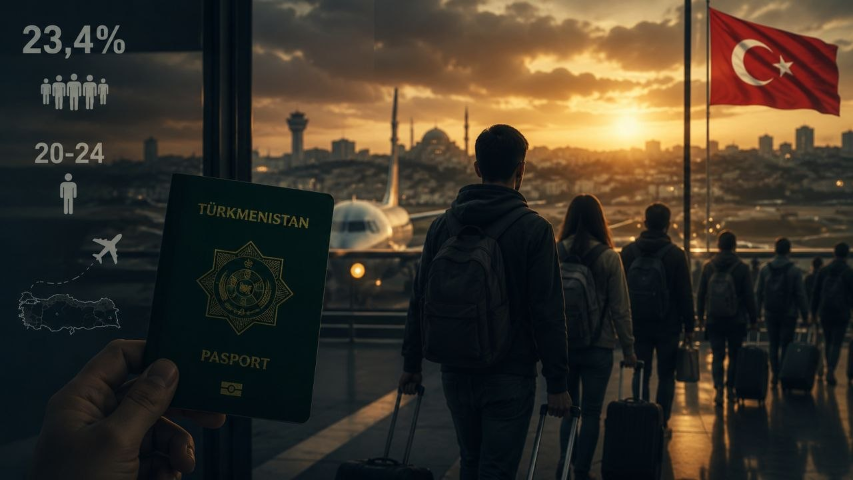
Turkmenistan Ranks First by Share of Migrants in Türkiye: What Lies Behind the Statistics? According to recently published statistics, citizens of Turkmenistan rank first among foreign nationals arriving in Türkiye, accounting for 23.4% of all foreign migrants. Of those who arrived, 56.6% are men and 43.4% are women, while the largest age group consists of young people aged 20–24, representing 16.3% of all migrants. At first glance, these figures may appear to reflect the close historical, cultural, and economic ties between Turkmenistan and Türkiye. However, behind these statistics lies a far more complex and troubling reality. For many years, Türkiye has been one of the primary destinations for citizens of Turkmenistan due to linguistic and cultural similarities, educational opportunities, and employment prospects. Yet a significant number of Turkmen citizens leave their country not only for economic reasons. Many are compelled to seek safety, freedom, and better opportunities abroad because of limited employment prospects, restrictions on fundamental rights and freedoms, the inability to express their opinions freely, and other systemic challenges. It is also noteworthy that this trend is not limited to Türkiye. According to previously published data, citizens of Turkmenistan have also ranked among the largest groups of foreign labor migrants in Belarus. When nationals of one country consistently make up one of the largest migrant populations in multiple countries, this points to a long-term pattern of large-scale outward migration rather than an isolated migration trend. Particularly alarming is the age profile of those leaving the country. The largest group of migrants is made up of young people between the ages of 20 and 24—individuals who would ordinarily be expected to pursue higher education, build families, contribute to economic development, and shape the future of their homeland. Instead, thousands are forced to seek opportunities abroad. In recent years, the situation of Turkmen citizens overseas—particularly in Türkiye—has become increasingly difficult. Many have faced the cancellation or non-renewal of residence permits, immigration detention, deportation proceedings, and significant obstacles to regularizing their legal status. International human rights organizations have repeatedly documented cases of transnational repression targeting citizens of Turkmenistan, including intimidation through family members, threats, forced returns, politically motivated persecution, and the misuse of migration and law enforcement mechanisms. Migration statistics should therefore be viewed not merely as demographic data but also as a reflection of internal developments within the country. The large-scale departure of young and economically active citizens is a serious indicator of deep-rooted social, economic, legal, and political challenges. Turkmenistan's international partners should pay attention not only to migration figures but also to the underlying reasons that compel people to leave their country. Sustainable solutions require genuine reforms, respect for human rights, improved living conditions, expanded civil liberties, an independent judiciary, and an end to the persecution of individuals for peacefully exercising their fundamental freedoms. Today, thousands of citizens of Turkmenistan continue to seek safety, freedom, and the opportunity to build dignified lives outside their homeland. The fact that Turkmenistan ranks first among foreign migrants in Türkiye and has also been among the leading sources of foreign labor migrants in Belarus should not be viewed as a success story. Rather, it should serve as a serious warning sign that demands urgent attention from both the authorities of Turkmenistan and the international community.
As a foundation, every individual's fundamental
protect and develop their rights
we are working for.