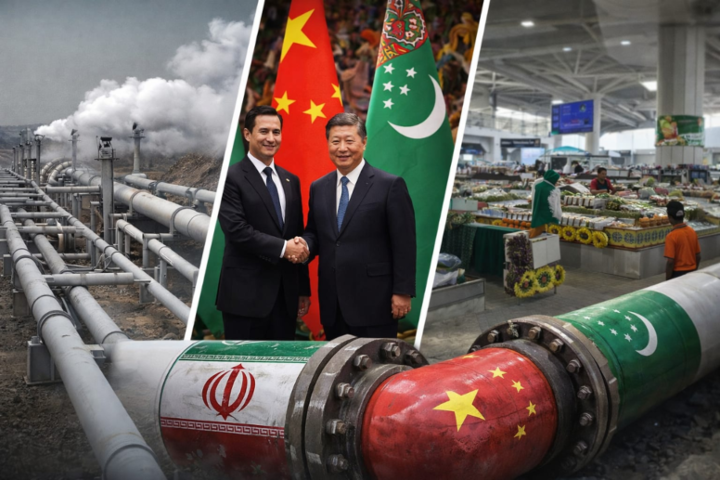
Despite possessing some of the largest natural gas reserves in the world, Turkmenistan today faces a paradox: resource wealth does not guarantee stability. As highlighted in an article by Azattyk Asia, the country’s core problem is not production, but export. The current export model relies on a limited number of routes, primarily through China and Iran. This makes Turkmenistan highly vulnerable to external crises—political, economic, or military. A key element of this system is gas swap agreements with Iran. Through these mechanisms, Turkmen gas is delivered to northern Iran, while equivalent volumes are transferred onward—toward Azerbaijan and Turkey. It was precisely this route that allowed Turkmenistan to enter the Turkish market for the first time in 2025. However, as expert Joseph Epstein points out, this very model is also its weakest link. “If Iranian infrastructure deteriorates or transit becomes impossible, the only significant export route left for Turkmenistan will be China—further deepening the dependency the country is trying to escape.” This highlights a fundamental issue: Turkmenistan does not fully control its export destiny. Any escalation around Iran directly translates into economic risk for the country. Moreover, Epstein identifies a broader systemic problem: “Every major export route from Central Asia passes through a country involved in conflict or under significant pressure—Russia, Iran, or regions influencing maritime routes. This is a systemic risk that cannot be solved by a single pipeline.” This means that even potential projects such as the Trans-Caspian Gas Pipeline are not a comprehensive solution. The issue is structural and requires a fundamental rethinking of export strategy. Against the backdrop of Europe’s energy crisis, the EU is actively seeking alternative gas suppliers. In theory, Turkmenistan could become part of this solution. However, according to expert estimates, realistic supply volumes would amount to only 5–15 billion cubic meters per year, insufficient to replace major volumes previously supplied by Russia or Qatar. Additional constraints stem from Turkmenistan’s domestic policies. The “delivery to the border” approach, which places the burden of infrastructure development on importers, remains a significant barrier to investment. As a result, a paradox emerges: the country has vast resources but limited control over their export; potential markets exist, but access to them is politically and logistically constrained; a geopolitical window of opportunity exists, but remains largely unused. At the same time, the current crisis could become a turning point. “This crisis represents a strategic turning point, but whether Central Asia can benefit from it depends on investment decisions made in the next 2–3 years,” Epstein emphasizes. Human Rights Dimension Amid these developments, a critical question remains: why are the citizens of Turkmenistan not being informed? Economic risks directly affect the population: rising food prices, potential shortages, declining living standards. Yet the authorities fail to provide transparent information, do not explain their strategy, and do not prepare society for possible consequences. This constitutes a direct violation of the right to information. Citizens have the right to know: what risks exist, what measures are being taken, how the state plans to protect the population. The lack of transparency amplifies not only economic risks, but also social instability. Conclusion Turkmenistan is not merely positioned between Iran, China, and Europe— it is trapped within its own export model. Without diversification of routes, transparent governance, and respect for citizens’ rights, the country risks becoming even more dependent on external actors. Source: Azattyk Asia — “Turkmenistan: Between Iran, China and Europe” 🔗 https://share.google/Czi3EXBDAD590HPQp�
As a foundation, every individual's fundamental
protect and develop their rights
we are working for.