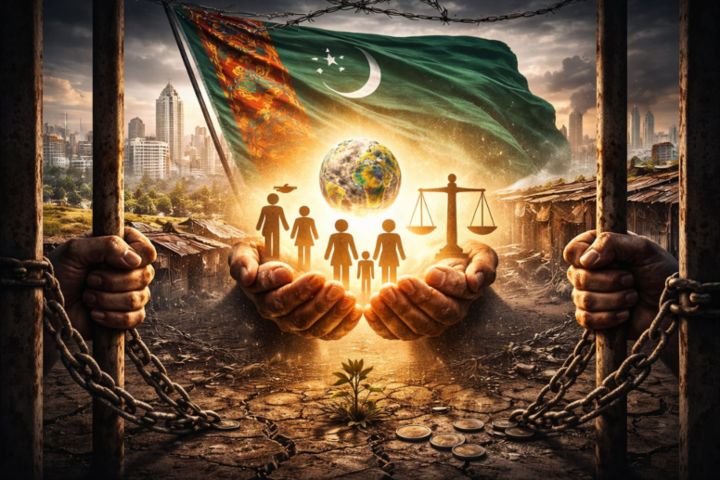
Turkmenistan remains one of the most closed countries in the world, where the official image of prosperity increasingly diverges from the reality in which its citizens live. An article published by The Diplomat draws attention to this gap, raising a question that has long remained on the margins of the global agenda: how reliable are development indicators if they conceal systemic inequality and restrictions on human rights? Formally, Turkmenistan demonstrates stability and economic progress. However, as emphasized in The Diplomat, these indicators do not reflect the real situation of the population. Official statistics fail to capture the scale of inequality, limited access to education and healthcare, and the everyday hardships faced by ordinary people. A particular concern is the use of international indicators such as the Human Development Index. In a context of limited transparency and data distortion, such metrics can create an illusion of well-being while overlooking deeper structural problems. As a result, the country may appear stable on paper while remaining vulnerable in reality. Analytical research published on Progress.online also highlights this gap between numbers and lived experience. It shows that economic indicators, including income per capita, often do not reflect the actual distribution of resources or the living standards of the majority. Concentration of wealth, a distorted exchange rate, and lack of transparency further deepen social inequality while concealing its true scale. In conditions of censorship and restricted access to information, independent sources become especially important. These include research, journalistic investigations, and testimonies from the diaspora, which help reveal aspects of reality that are absent from official narratives. The Diplomat also underlines that international organizations and governments face a choice: maintain diplomatic relations while ignoring problems, or speak openly about them. However, these approaches are not mutually exclusive. Engagement should not come at the expense of truth. Silence, in this context, risks becoming complicity. When external partners rely solely on distorted data, they may unintentionally contribute to the persistence of existing problems. Honest and open dialogue, by contrast, can build trust and support gradual change. Turkmenistan holds both regional and global significance, particularly due to its energy resources and strategic location. Yet issues such as human rights, social inequality, and sustainable development extend beyond national borders. Ignoring them has consequences not only domestically but also internationally. Attention to Turkmenistan also sends an important signal to its people — that their reality is seen and their rights matter. In a country where many cannot speak freely, international awareness becomes especially meaningful. The Dayanç Human Rights Platform emphasizes: sustainable development is impossible without transparency, and international cooperation cannot exist without honesty. Ignoring problems does not make them less significant — it only deepens the gap between official narratives and the lives of real people. Source: https://thediplomat.com/2025/04/how-turkmenistans-government-neglects-its-people-and-why-the-world-should-care/�
As a foundation, every individual's fundamental
protect and develop their rights
we are working for.