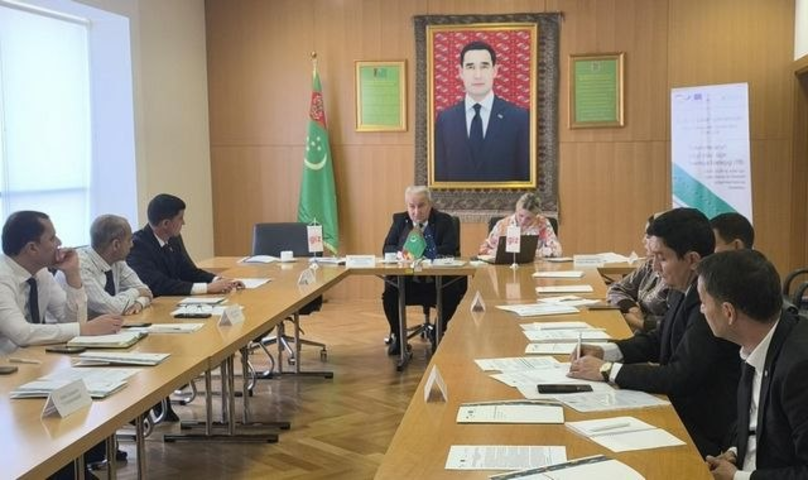
Turkmenistan and Methane: International Standards Are Being Discussed Today, While Oil and Gas Infrastructure Needs Modernisation Now On 1 October 2026, a consultation meeting on international standards and regulations for reducing methane emissions was held in Ashgabat. The discussions involved representatives of the Mejlis, the Ministry of Energy, the Ministry of Environmental Protection, and the state concerns Turkmengaz and Turkmennebit. The meeting took place within the framework of the project “European Union for Green Development of Turkmenistan: Policy Dialogue and Climate Action 2024–2029,” co-financed by the European Union and Germany’s Federal Foreign Office and implemented by GIZ. The participants discussed improvements to the regulatory framework and the application of international practices, including European requirements for reducing methane emissions in the energy sector. For Turkmenistan, however, this issue has a very practical dimension. International research and satellite observations have repeatedly detected significant methane emissions from the country’s oil and gas facilities, particularly in the Balkan region. Materials from the STOP Methane project published in 2025 and covered by Turkmen.news and Fergana were based on data from more than 3,000 methane plumes detected at approximately 2,000 oil and gas facilities worldwide. At individual facilities in Turkmenistan, recorded emission rates ranged from 3.7 to 10 tonnes of methane per hour. According to Fergana, Turkmen facilities occupied 17 of the 25 positions in the reviewed list of major oil and gas methane emission sources. Facilities in the areas of Esenguly and Balkanabat appeared particularly frequently. In November 2025, Turkmen.news also reported, citing an analysis by the environmental monitoring company Kayrros, that after a decline in 2023, Turkmenistan’s methane emissions increased by approximately 19% in 2024. At the same time, the Turkmen authorities reported reductions in methane emissions. This discrepancy once again demonstrates the importance of publishing underlying data and ensuring independent verification of official environmental reporting. One of the central issues is the condition of the country’s oil and gas infrastructure. A significant part of Turkmenistan’s oil and gas system was built decades ago. With infrastructure of this age, continuous maintenance and the timely replacement of pipelines, valves, compressors, shut-off equipment and other components are particularly important. Wear and tear, insufficient maintenance, outdated operating practices and the absence of modern continuous leak-detection systems can result in substantial gas losses. Analysts cited in publications concerning Turkmenistan have pointed to insufficient investment in maintenance and leak detection as possible contributing factors. This raises a fundamental question: what is the actual condition and level of deterioration of Turkmenistan’s oil and gas infrastructure? No comprehensive national audit of its technical condition has been made publicly available to the population. Citizens do not have access to a complete list of facilities requiring modernisation, a public timetable for replacing ageing equipment, or clear information about how much funding is allocated each year specifically to preventing methane leaks. When will the most deteriorated pipelines be replaced? When will all major oil and gas facilities be equipped with modern leak-detection systems? How many compressor stations, wells and other facilities have already been modernised? How many still require modernisation? The answers to these questions should be public. This is particularly important because Turkmenistan is a major producer and exporter of natural gas. Methane lost through leaks simultaneously represents atmospheric pollution, additional global warming and the loss of a valuable energy resource. Methane is one of the most powerful greenhouse gases. Over a 20-year period, its warming effect per unit of mass is more than 80 times greater than that of carbon dioxide. Methane traps heat in the atmosphere and contributes to rising global temperatures. The consequences directly affect people: periods of extreme heat and drought become more severe, while pressure on water resources and agriculture increases. For Turkmenistan, with its predominantly arid climate, these consequences are particularly significant. There is also a direct connection with air quality and public health. Methane participates in atmospheric chemical processes that contribute to the formation of ground-level ozone, a harmful air pollutant. Exposure to elevated concentrations of ground-level ozone is associated with respiratory irritation, coughing, breathing difficulties, reduced lung function, and the worsening of asthma and other respiratory diseases. Oil and gas emissions may also contain volatile organic compounds and other air pollutants. The issue of oil and gas leaks therefore cannot be viewed solely as a matter of meeting international climate commitments. It is also a question of the health of people living near industrial facilities. And this raises another serious issue: the lack of sufficient publicly available environmental information for the population. Why should citizens have to learn about major emissions occurring within their own country from foreign media reports and international satellite studies? Where is the national open-access monitoring system? Where are the regularly published air-quality data for oil- and gas-producing regions? Where is the information about major detected leaks, their duration and the volumes of methane released? Where is the information showing when a particular leak was repaired and whether follow-up measurements confirmed that the problem had actually been resolved? People have the right to know what kind of air they are breathing. This is particularly important for residents of the Balkan region and communities located near oil and gas extraction, processing and transportation facilities. Environmental transparency does not mean publishing general statements about achievements. It means providing access to measurable data. If the government reports that emissions have been reduced by a certain percentage, it should publish the baseline, the methodology used for the calculation, the list of facilities monitored and the measurement results. If a major leak occurs, the public should know its location, scale, duration, cause and whether it has been successfully repaired. This is why cooperation with the European Union, Germany and GIZ should focus not only on improving the regulatory framework. Turkmenistan needs real modernisation of its oil and gas infrastructure. Modern Leak Detection and Repair (LDAR) systems are needed, together with equipment upgrades, independent measurements, comparisons between government data and satellite monitoring, and open publication of the results. Where international funding and technical assistance are involved, there should be concrete performance indicators: how many facilities have been inspected, how many emission sources have been detected, how many leaks have been repaired, what equipment has been replaced, how much has been invested in modernisation, and how much emissions have actually decreased as a result. The 1 October meeting may become part of such a process. But the people of Turkmenistan need to know not only which international standards were discussed, but also when those standards will begin to change conditions at the country’s actual oil and gas facilities. When will comprehensive modernisation of ageing infrastructure begin? What are the timetable and budget? Which facilities will be modernised first? When will environmental monitoring results become publicly accessible? When will citizens be able to see reliable data on air quality in their own regions? Methane reduction should be measured not by the number of international meetings held or documents adopted, but by the number of leaks repaired, facilities modernised and the actual reduction in emissions. Turkmenistan possesses vast natural gas reserves. But alongside the economic value of these resources comes a responsibility for how they are extracted and transported, and for the impact of these activities on the climate, the environment and human health. The people of Turkmenistan have the right to receive full and transparent information about this.
As a foundation, every individual's fundamental
protect and develop their rights
we are working for.