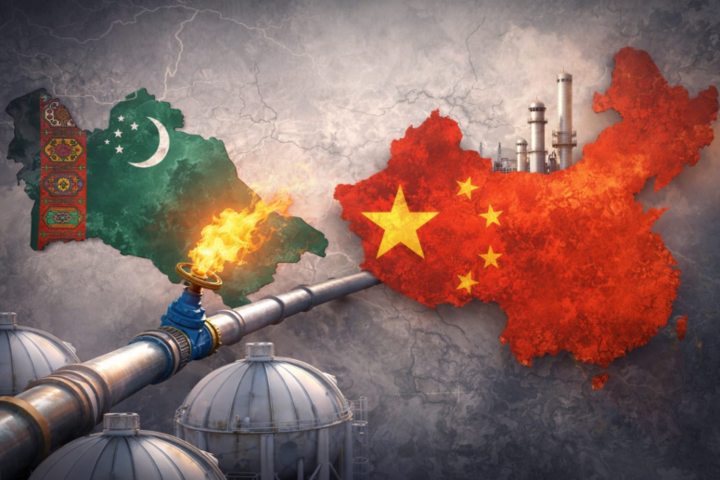
Recent statements and agreements between Turkmenistan and the People’s Republic of China indicate a deepening strategic partnership, particularly in the energy sector. According to the independent outlet Turkmen.news, China plans to build facilities in Turkmenistan capable of producing up to 10 billion cubic meters of gas per year. Source: 🔗 https://turkmen.news/2026/03/23/kitay-postroit-v-turkmenistane-obekty-dlya-dobychi-10-mlrd-kubometrov-gaza-v-god/� At the same time, media narratives (including TURANNEWS TV) point to a clear political signal of alignment with China, including explicit support for the “One China” policy, which effectively denies the recognition of Taiwan as a separate entity. ⚠️ This Is No Longer Just Economics While many countries formally cooperate with China, Turkmenistan’s case shows a concerning trend: 👉 concentration of gas exports toward a single partner — China 👉 dependence on Chinese technologies and infrastructure 👉 lack of market diversification 📊 Current indicators: trade turnover is around $9–10 billion annually the main export is natural gas to China a significant share of infrastructure is implemented with Chinese involvement 📉 A Dependency Model Is Emerging The economic formula is simple: raw materials → export to one country → import of technology and loans This is a classic model where a country risks becoming a resource appendage, gradually losing: economic independence bargaining power the ability to pursue an independent foreign policy ⚖️ Neutrality Under Question Turkmenistan officially maintains a status of permanent neutrality, recognized internationally. However, a key question arises: 👉 can a country remain neutral if its economy and foreign policy are effectively tied to a single global power center? Neutrality is not a declaration. It is the ability to maintain balance and independence. 🚨 Risks for Citizens’ Rights Economic dependence directly impacts human rights: lack of transparency in international agreements limited access to information for citizens absence of public oversight prioritization of state interests over citizens’ needs In such conditions, there is also an increase in: ❗ restrictions on freedom of speech ❗ absence of independent media ❗ pressure on civil activists 🧭 What Comes Next? If current trends continue: ➡ neutrality may become merely symbolic ➡ room for foreign policy maneuver will shrink ➡ economic dependence will deepen ❗ Position of “DAYANÇ” The Human Rights Platform of the Civil Movement “DAYANÇ” / Turkmenistan believes: economic cooperation must not turn into dependence foreign policy must remain balanced citizens have the right to know the terms of international agreements national development must serve the people, not a narrow ruling circle 📌 Sources: Turkmen.news 🔗 https://turkmen.news/2026/03/23/kitay-postroit-v-turkmenistane-obekty-dlya-dobychi-10-mlrd-kubometrov-gaza-v-god/� TURANNEWS TV (analytical material on neutrality and China)
As a foundation, every individual's fundamental
protect and develop their rights
we are working for.