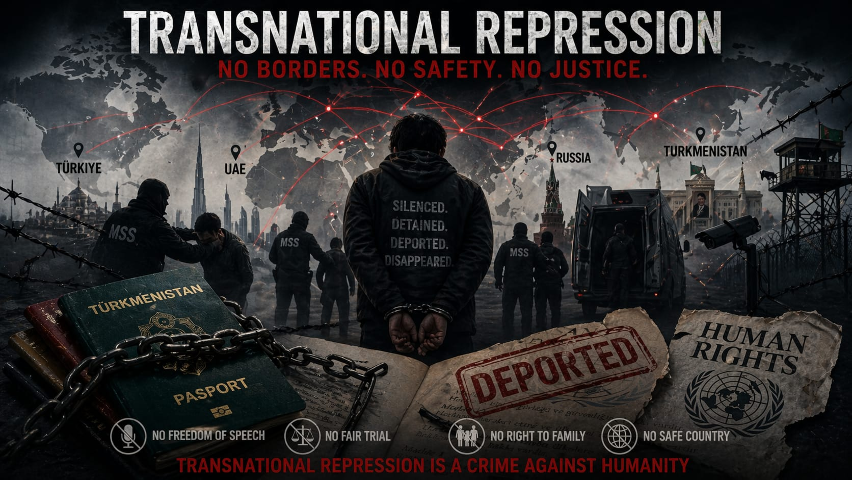
TRANSNATIONAL TERROR WITHOUT BORDERS Today, borders no longer protect. A passport no longer guarantees safety. And international law increasingly remains only on paper. The story of Maral Annaeva and her two minor children, forcibly deported from Dubai to Turkmenistan, is not just a tragedy of one family. It is a symptom of a far more dangerous phenomenon — a systemic policy of transnational repression carried out by the authorities of Turkmenistan. A woman fleeing domestic violence found no protection — neither in her own country nor abroad. Moreover, false accusations were brought against her through diplomatic channels. These accusations collapsed within two days — but that was enough to trigger the mechanism of persecution. Within 24 hours of her release — she was detained again. Allegedly through Interpol channels. And then deported back to the country she had fled. Today, we do not know where Maral is. We do not know what is happening to her children. We do not know whether they are alive or safe. But we do know — this is not случайность. WHEN NOT ONLY PEOPLE DISAPPEAR, BUT ALSO EVIDENCE On July 24, 2025, activists Alisher Sahatov and Abdulla Orusov disappeared in Türkiye after leaving a deportation center in Edirne. For months, their lawyer was unable to obtain access to CCTV recordings. The response from the prosecutor’s office was simple and alarming: the footage is stored for only six months. This is not just a technical detail. It is a possible mechanism for concealing the truth. When not only people disappear, but also evidence — this is no longer negligence. It is a system. THE GEOGRAPHY OF FEAR Türkiye. Russia. UAE. Different countries — the same pattern. Merdan Muhammedov. Farhad Meymankuliyev. Rovshen Klychev. Serdar Durdalyyev. Maksat Baymyradov. Dowran Imamov. Perhat Genjiev. Jumasapar Dedebayev. Azat Isakov. Malikberdy Allamyradov. Saddam Gulamov. This is not a list. This is a map of repression. Many of them have already received long prison sentences. Many have been subjected to ill-treatment. And none of these cases has received adequate international response. Meanwhile, Umida Bekjanova has been held for nearly a year in a deportation center in Türkiye, awaiting a decision that could cost her freedom. EUROPE DOES NOT ALWAYS MEAN SAFETY Even in Europe, citizens of Turkmenistan do not always receive protection. We continue to receive appeals from individuals stranded in Germany — without documents, without legal status, and without the ability to effectively apply for asylum or protection. They cannot move forward. They cannot return. And they cannot live legally. This represents a new dimension of the crisis — where a person is physically in a safe country, but legally remains unprotected. And again — the cause is the same: lack of documents, inability to obtain them, and the absence of flexible protection mechanisms. INTERPOL AS A TOOL OF PRESSURE Mechanisms designed to combat crime are being transformed into tools of persecution. When international systems are used not to pursue criminals, but to target victims, this undermines trust in the entire global security system. This is no longer a problem of one country. It is a global challenge. WITHOUT DOCUMENTS — WITHOUT RIGHTS Thousands of citizens of Turkmenistan abroad remain without valid passports. Despite the fact that the law explicitly provides for their issuance through diplomatic missions (Article 29, paragraph 3 of the Law on Migration), in practice passports are not issued at all. Without documents, a person becomes invisible: without the right to protection, without the ability to regularize their status, without access to asylum. This is not bureaucracy. This is a tool of control and pressure. WHEN PROTECTION FAILS Even international mechanisms fail. UNHCR does not accept applications from individuals without legal status. Legal status cannot be obtained without documents. And documents cannot be obtained due to state policy. A closed circle — with a human being at its center, left without protection. WHAT MUST BE DONE NOW Today, what is needed is not statements, but action: — the creation of emergency crisis centers for protection — the establishment of a “humanitarian corridor” for evacuation — revision of relocation procedures — prioritization of women and children — dedicated mechanisms for individuals without documents — investigation into the misuse of Interpol — international monitoring of the fate of deported individuals SILENCE IS COMPLICITY Every uninvestigated case is a signal. Every ignored appeal is permission to continue. The story of Maral Annaeva is a warning. The case of Sahatov and Orusov is an alarm. The stories of dozens of others form a pattern. Now, they are joined by those stranded in Europe — alive, but deprived of rights. If there is no response today — tomorrow there will be more. And then the question will no longer be who is next. But whether anyone is still safe. Website: https://www.dayanchcivil.com/� Sources: https://tmhelsinki.org/ru/article/dc7908c0-0ea2-4843-9b0a-f7cac4aea913� https://tmhelsinki.org/ru/article/14c30318-f4f1-4363-b687-38795c86591a� https://youtu.be/sE3yaT79Yvc?si=Qs_1daVBFZIEulG2�
As a foundation, every individual's fundamental
protect and develop their rights
we are working for.