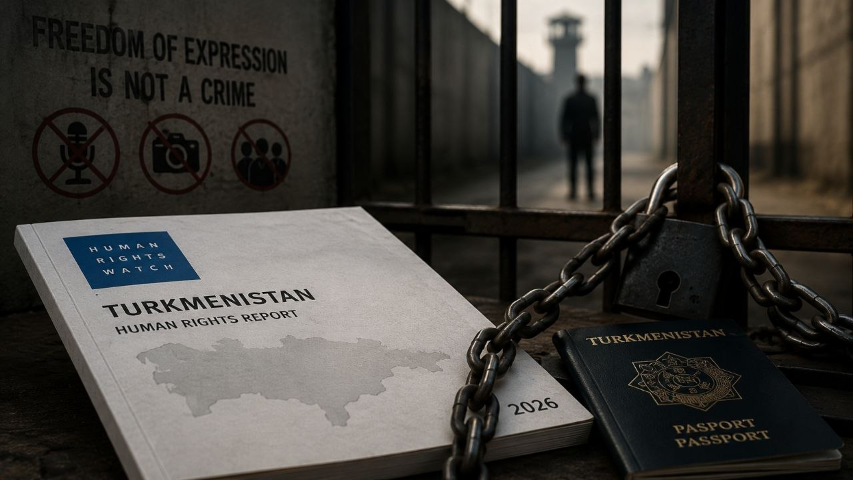
Transnational Repression in Turkmenistan: An Analysis of Human Rights Watch’s New Report and Its Significance for the International Community Analytical Article In June 2026, the international human rights organization Human Rights Watch published its comprehensive report, “Lives Destroyed for Speaking Out: Turkmen Activists at Home and in Exile.” This report is one of the most significant international assessments of the human rights situation in Turkmenistan in recent years. Its importance lies not only in documenting individual cases of persecution, but also in demonstrating that these abuses are part of a comprehensive and coordinated system of state repression that extends far beyond the borders of Turkmenistan. The report shows that the persecution of independent journalists, bloggers, lawyers, human rights defenders, and civic activists is not a collection of isolated incidents. Rather, it reflects a systematic state policy aimed at silencing all forms of peaceful dissent. This system relies on politically motivated prosecutions, arbitrary detention, long-term surveillance, intimidation of family members, restrictions on freedom of movement, denial of consular services, enforced disappearances, transnational repression, and the misuse of migration procedures. By presenting these abuses as interconnected elements of a single policy, Human Rights Watch demonstrates that the situation in Turkmenistan is no longer solely a domestic issue. It has become an international human rights crisis requiring a coordinated response from governments, international organizations, and civil society. Repression as State Policy One of the report’s central conclusions is that there is virtually no space for freedom of expression in Turkmenistan. Independent journalists, bloggers, lawyers, human rights defenders, civic activists, and ordinary citizens who peacefully express their opinions or criticize government policies face retaliation. Human Rights Watch emphasizes that the authorities routinely portray peaceful civic engagement as a threat to national security. In practice, the distinction between peaceful criticism, civic activism, and criminal conduct has been deliberately erased. The report also highlights that persecution does not end when a prison sentence expires. Former political prisoners often remain under constant surveillance, face arbitrary travel restrictions, experience barriers to employment, and continue to live under the threat of renewed prosecution. Punishment therefore becomes indefinite, functioning as a permanent mechanism of intimidation and control. Transnational Repression Beyond Turkmenistan's Borders A central focus of the report is the growing use of transnational repression. Human Rights Watch concludes that the persecution of Turkmen activists now extends well beyond the country's borders. Citizens who have fled Turkmenistan continue to face intimidation, threats of deportation, abuse of immigration procedures, denial of passport services, pressure exerted through relatives remaining in Turkmenistan, and other forms of cross-border persecution. The report expresses particular concern over the enforced disappearances of Alisher Sakhatov and Abdulla Oruzov following their detention in Türkiye. Human Rights Watch identifies these cases as among the most alarming examples of transnational repression and calls on the Turkish authorities to conduct a prompt, independent, thorough, and transparent investigation capable of establishing the full circumstances of their disappearance and holding those responsible accountable. The report also highlights the case of Umidajan Bekjanova, whose peaceful civic activities abroad continue under the constant threat of deportation, illustrating that exile does not necessarily provide protection from repression. Political Prisoners and Persecuted Activists Rather than relying solely on statistics, the report places individual human stories at its center. Among those highlighted are human rights defender Mansur Mingelov, who documented torture and ill-treatment; civic activist Murat Dushomov, who criticized the government's denial of the COVID-19 pandemic; journalist Nurgeldy Khalykov; lawyer and civic activist Pyragamberdi Allaberdyev; independent journalist Soltan Achilova; bloggers Saddam Gulamov and Mälikberdi Allamuradov; and disappeared activists Alisher Sakhatov and Abdulla Oruzov. Together, these cases demonstrate that state repression takes many forms—from politically motivated imprisonment and administrative restrictions to forced return, enforced disappearance, and long-term intimidation. Passport Denial as a Tool of Political Repression One of the report's most significant findings is its recognition that the refusal to issue or renew passports for Turkmen citizens abroad is not merely an administrative problem but a deliberate instrument of political repression. This conclusion carries particular legal significance. Article 29(3) of the Law of Turkmenistan "On Migration" obliges Turkmen diplomatic missions and consular offices to issue and renew passports and other identity documents for citizens residing abroad. In practice, however, countless Turkmen citizens have been denied these services for years. As a result, many lose their legal status, are unable to renew residence permits, work legally, access healthcare, register the birth of their children, marry, or exercise other fundamental rights. The report reinforces the conclusion that passports have become instruments of political coercion rather than documents guaranteeing citizenship rights. Arbitrary Exit Bans and Violations of Freedom of Movement The report also draws attention to arbitrary restrictions on the right to leave Turkmenistan. Particular concern surrounds the application of Article 30(9) of the Law of Turkmenistan "On Migration," which enables authorities to impose travel bans without transparent procedures or effective judicial oversight. These restrictions have reportedly affected journalists, human rights defenders, civic activists, former political prisoners, and their family members. Such practices are incompatible with Article 12 of the International Covenant on Civil and Political Rights, which guarantees every person the right to leave any country, including their own, and to return to their own country. They also conflict with Article 13 of the Universal Declaration of Human Rights, which guarantees freedom of movement, and undermine the internationally recognized right to family life and family reunification. Moreover, the systematic use of Article 30(9) as a tool of political control appears inconsistent with the Constitution of Turkmenistan, which guarantees fundamental rights and freedoms and recognizes the state's international legal obligations. International Legal Obligations The findings presented by Human Rights Watch raise serious concerns regarding Turkmenistan's compliance with numerous international legal commitments. These include obligations under the Universal Declaration of Human Rights, the International Covenant on Civil and Political Rights, the International Covenant on Economic, Social and Cultural Rights, the Convention against Torture, and the Vienna Convention on Consular Relations. The report also emphasizes the importance of the principle of non-refoulement, which prohibits returning individuals to countries where they face torture, political persecution, or other serious human rights violations. Accordingly, Human Rights Watch stresses that protecting Turkmen citizens is not solely the responsibility of Turkmenistan but also of the states in which they reside. Recommendations of Human Rights Watch The report concludes with detailed recommendations addressed to three principal groups: the Government of Turkmenistan, receiving states, and Turkmenistan's international partners. Recommendations to the Government of Turkmenistan Human Rights Watch calls on the Turkmen authorities to immediately and unconditionally release everyone imprisoned solely for peacefully exercising their right to freedom of expression; overturn politically motivated convictions; end the persecution of activists, journalists, and their family members; abolish arbitrary travel bans; cease surveillance and intimidation; ensure that diplomatic missions fully perform their consular responsibilities, including the timely issuance and renewal of passports in accordance with Article 29(3) of the Law "On Migration"; and stop using migration legislation—particularly Article 30(9)—as a political instrument to restrict freedom of movement. Recommendations to Türkiye, the Russian Federation, and Other Receiving States Human Rights Watch urges receiving countries to strictly uphold the principle of non-refoulement by refraining from deporting individuals who face torture, political persecution, arbitrary detention, or unfair trials. The organization calls on governments to carefully examine all extradition and deportation requests submitted by Turkmen authorities for possible political motivation. The report also recommends that states establish temporary or alternative documentation mechanisms for individuals unable to obtain passports because Turkmen authorities refuse to fulfill their consular obligations, thereby preventing people from becoming undocumented through no fault of their own. Specific Recommendations to Türkiye Human Rights Watch calls on the Turkish authorities to conduct a prompt, independent, thorough, and transparent investigation into the disappearances of Alisher Sakhatov and Abdulla Oruzov, establish the facts, and ensure accountability for those responsible. The report also urges Türkiye to ensure that national security-related restriction codes are applied only where supported by credible evidence, accompanied by effective judicial oversight and procedural safeguards, and never used as an automatic basis for canceling residence permits, denying international protection, or deporting individuals. Recommendations to Turkmenistan's International Partners Human Rights Watch encourages democratic governments, international organizations, and other international partners to place human rights at the center of their engagement with Turkmenistan. The organization recommends linking the development of bilateral relations to measurable improvements in the country's human rights record, including the release of politically imprisoned activists and the end of reprisals against their families. It further urges international partners to insist that Turkmenistan fulfill its consular obligations by issuing and renewing passports for citizens abroad and to continue providing sustained financial and technical support to independent media, civil society organizations, and human rights defenders both inside Turkmenistan and in exile. Conclusion The Human Rights Watch report demonstrates that repression in Turkmenistan is not limited to politically motivated imprisonment. It is a multidimensional system that includes arbitrary restrictions on freedom of movement, denial of consular services, pressure on family members, transnational repression, enforced disappearances, and the misuse of administrative and migration mechanisms to silence peaceful dissent. Perhaps the report's most significant contribution is its recognition that passport denial, arbitrary exit bans, and transnational repression are no longer merely domestic administrative matters. They constitute serious human rights issues governed by international law and requiring an international response. The report ultimately makes clear that protecting the rights of Turkmen citizens requires coordinated action by the Government of Turkmenistan, receiving states, and the international community. Only such a comprehensive approach offers a realistic path toward dismantling a system of repression that has long extended beyond national borders. --- Read the full Human Rights Watch report: https://www.hrw.org/feature/2026/06/24/lives-destroyed-for-speaking-out-turkmen-activists-at-home-and-in-exile/the
As a foundation, every individual's fundamental
protect and develop their rights
we are working for.