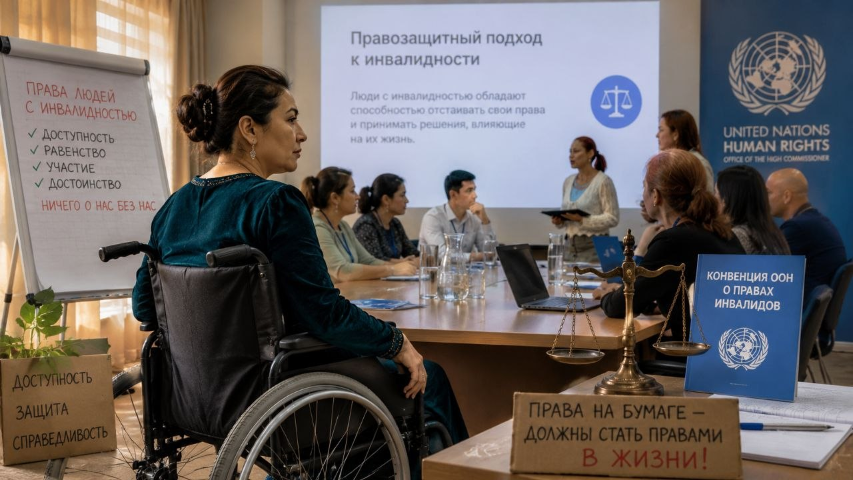
The Real Situation of the Rights of Persons with Disabilities in Turkmenistan: Between UN Workshops and Reality The Dayanç Human Rights Platform / Turkmenistan has taken note of two recent initiatives organized by the United Nations Human Rights Office for Central Asia in cooperation with UNICEF Turkmenistan concerning the rights of persons with disabilities. The first publication describes a two-day advocacy and communication workshop held in Ashgabat under the principle "Nothing About Us Without Us." The event brought together representatives of civil society, activists, bloggers, and content creators to discuss the participation of persons with disabilities in decision-making, inclusive communication, and rights-based advocacy. Official publication: https://www.facebook.com/share/p/1Nw1jjFEVY/ The second publication reports on a training workshop for journalists, content creators, and government press officers, focusing on rights-based media coverage of persons with disabilities in accordance with the United Nations Convention on the Rights of Persons with Disabilities (CRPD). Participants discussed the use of inclusive language, combating stereotypes, and ensuring that persons with disabilities are portrayed as rights holders rather than passive recipients of charity. Official publication: https://www.facebook.com/share/1CGpRuss2m/ The Dayanç Human Rights Platform / Turkmenistan welcomes every genuine effort by the United Nations to promote and protect the rights of persons with disabilities. Raising awareness, improving public discourse, and encouraging inclusive communication are important objectives. However, these initiatives inevitably raise a fundamental question: How can discussions about inclusion take place while the daily reality faced by persons with disabilities in Turkmenistan continues to be marked by systemic discrimination, poverty, lack of legal protection, and fear? Unfortunately, the reality presents a very different picture. Persons with disabilities remain among the most vulnerable and least protected groups in Turkmenistan. One need only look at the level of disability pensions, which are so low that they often fail to cover even the most basic necessities of life. Many families struggle to survive, unable to afford essential medicines, rehabilitation services, medical treatment, or adequate care. Sadly, these are not isolated cases. For many years, the Dayanç Human Rights Platform / Turkmenistan has documented serious human rights violations affecting persons with disabilities and their families. One such case is that of Rozygul Mamekova, the mother of two children with disabilities, who spent years unsuccessfully seeking justice after her family's only source of income—two hectares of agricultural land—was unlawfully transferred to another person. Despite repeatedly appealing to local authorities, the courts, and the Administration of the President of Turkmenistan, she was unable to obtain a fair resolution. When Rozygul, together with other women, travelled to Ashgabat to personally submit her complaint to the President, she was detained by police instead of having her complaint considered. Rather than responding to her legitimate grievances, the authorities chose intimidation and repression. Another striking example is the case of Raul Khodzhaniyazov, an orphan who, after leaving the orphanage, was effectively abandoned by the state. Raul is the sole caregiver for his brother with a disability. Despite numerous appeals to state authorities, he has been unable to obtain the housing guaranteed by law or adequate social assistance. His story demonstrates the systemic failure to protect orphans and families caring for persons with disabilities. Particularly tragic is the case of Nurmurat Khalmyradov, a man with a disability who publicly spoke about corruption, extremely low disability benefits, the authorities' refusal to provide the housing to which he was legally entitled, and the degrading treatment experienced by persons with disabilities. He survived on a monthly disability pension of approximately 1,400 Turkmen manats, most of which was spent on rent. Despite his disability and his large family, he was unable to obtain meaningful state support. Following his public statements demanding justice, Nurmurat Khalmyradov and his wife were reportedly detained by law enforcement officers. According to available information, he was subjected to severe ill-treatment, threats, and psychological pressure. Shortly afterward, Nurmurat Khalmyradov died. His death has become a tragic symbol of how dangerous it can be in Turkmenistan for a person with a disability to speak openly in defence of their rights. These stories have one thing in common: None of these people asked for privileges. They simply demanded that the rights already guaranteed under Turkmen legislation and international human rights treaties be respected. Against this background, the Dayanç Human Rights Platform asks the following questions: Are these workshops and awareness programmes accessible to people living in rural and remote regions of Turkmenistan? Are there independent crisis centres providing assistance to persons with disabilities and their families? Do persons with disabilities have genuine access to employment without discrimination? Are there safe and confidential hotlines through which victims can report human rights violations? Are there any independent civil society organizations inside Turkmenistan capable of protecting the rights of persons with disabilities without fear of persecution? Who is truly listening to the voices of persons with disabilities in Turkmenistan today? Unfortunately, the answer remains painfully clear: Virtually no one. Systematic human rights violations cannot be remedied through seminars, workshops, conferences, or public awareness campaigns alone. As long as independent institutions are absent, freedom of expression is restricted, victims cannot safely seek justice, and civil society remains under strict state control, such initiatives risk becoming little more than well-intentioned declarations. The Dayanç Human Rights Platform / Turkmenistan respectfully calls upon the United Nations Human Rights Office, UNICEF, other UN agencies, international organizations, and the Government of Turkmenistan to move beyond discussions and take concrete action. Meaningful progress requires independent monitoring of the human rights situation, genuine cooperation with independent civil society, effective legal remedies, adequate disability pensions, accessible healthcare and rehabilitation services, crisis centres, safe complaint mechanisms, equal access to education and employment, and guarantees that persons with disabilities can defend their rights without fear of retaliation. Persons with disabilities do not need symbolic statements or ceremonial meetings. They need justice, protection, dignity, equal opportunities, and the full enjoyment of the rights guaranteed under the Convention on the Rights of Persons with Disabilities and other international human rights instruments. The time has come not merely to speak about inclusion, but to fundamentally reform the system. Only real action—not words—will ensure that persons with disabilities in Turkmenistan can live with dignity, equality, and freedom.
As a foundation, every individual's fundamental
protect and develop their rights
we are working for.