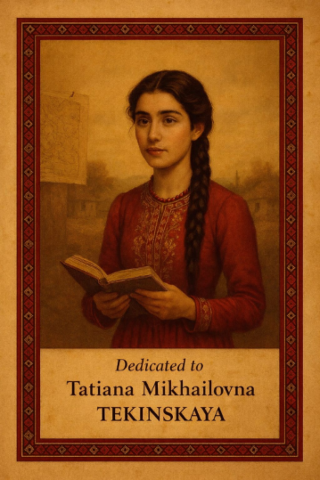
Tatiana Tekinskaya — The Fate of a Woman Ahead of Her Time On the Occasion of International Women’s Day On the eve of International Women’s Day, it is important to remember not only globally recognized female figures, but also the women whose lives became part of the history of their own people. Among them is Tatiana Mikhailovna Tekinskaya — Nurjamal, one of the first Turkmen women to receive higher education and dedicate her life to education and enlightenment. Her story is a story of strength, tragedy, and service. A Child Lost in War The future teacher was born in 1877 into a Turkmen family — the daughter of Nurali and Annabegen. Her name was Nurjamal. In January 1881, during the assault on the fortress of Geok-Tepe, the three-year-old girl was separated from her parents amid the chaos and tragedy of the battle. According to historical accounts, she was found among the ruins and taken to a Russian military field hospital. There are also accounts suggesting that General Mikhail Skobelev noticed the crying child and ordered that she be brought to the medical camp. The girl was given a new name — Tatiana, in honor of St. Tatiana’s Day (January 12 in the old calendar, January 25 in the modern calendar). She received the patronymic Mikhailovna after her godfather, General Skobelev. Thus began a new life. The Path to Education After the military hospital, the child was sent to Moscow, where she was raised in the Nikolaev Orphanage. Later she received her education at the Elizabeth Institute for Noble Maidens, one of the most prestigious educational institutions of the Russian Empire. This path was extraordinary for a woman of that era — especially for a girl who had once lived in a Turkmen aul. After graduating from the institute, Tatiana Tekinskaya became a teacher. She later married and lived for some time in Kharkiv, where her husband worked as an engineer at a sugar factory. There she also taught at a women’s gymnasium and became the mother of three daughters — Elizaveta, Alina, and Sofia. However, her life was not defined only by family. Her true calling was education. Returning to Her Homeland Later, Tatiana Tekinskaya returned to Turkmenistan. In Ashgabat she taught at a gymnasium and actively advocated for the development of education. She petitioned authorities to open one-class schools in the settlements of Artyk, Kaakhka, and Serakhs, understanding how vital literacy was for the future of her people. During this period she gave birth to a daughter, Gulsoltan. Later she married Orazguly Chekidjev, a railway worker, and in 1912 they had another daughter — Annagul. It was during these years that people began to call her Artykgul — “The Flower of Artyk,” linking her name to the development of education in that region. Trials and Final Years The turbulent events of the early twentieth century also affected her life. Due to the threat of arrest, she was forced to leave Turkmenistan and move to the Kyiv Governorate. In the town of Kamenka, she continued her teaching work — first in a seven-year school, and later in a gymnasium. In 1917, she gave birth to her son Yarmuhammed. In 1924, Tatiana Mikhailovna was invited to the First Congress of Teachers of Turkmenistan, held in Poltoratsk (now Ashgabat). During the journey home she fell seriously ill. Upon arrival in Ashgabat she was taken to a railway hospital where she underwent surgery. Sadly, she died three days later. Some sources mention typhus as the cause of death, while others suggest peritonitis following a ruptured appendix. She was buried in Ashgabat, in the district known as Khitrovka. The Return of a Name For many years, the fate of this remarkable woman remained largely unknown. Later her story was studied by Anatoly Mikhailovich Byalkin, a native of the Turkmen SSR (born in 1932 in Merv). His research helped restore many details of Tatiana Tekinskaya’s life. The research also established a connection between Tatiana Mikhailovna and the family of Nurali and Annabegen, who had lost their daughter Nurjamal during the events at Geok-Tepe. After the tragedy, they had two more children — Saparmammet (1882) and Ogulnur (1886). Historical sources also raise the question of a possible DNA analysis, which could definitively confirm the biological relationship between the descendants of Nurali and Annabegen and the descendants of Tatiana Mikhailovna Tekinskaya. A Symbol of Women’s Strength The life of Tatiana Tekinskaya is not only a historical story. It is a symbol. A symbol of a woman who survived tragedy, received an education, and devoted her life to serving others. Her story reminds us of the importance of: the right to education, women’s participation in public life, and respect for human dignity. Memory and the Future On the eve of International Women’s Day, we remember Tatiana Tekinskaya as a woman who was far ahead of her time. Her life reminds us that the development of any society is impossible without the education of women and respect for their rights and opportunities. By preserving the memory of such people, we preserve the connection between generations and build a future in which every girl has the opportunity to realize her potential. Human Rights Platform of the Civic Movement “DAYANÇ” / Turkmenistan
As a foundation, every individual's fundamental
protect and develop their rights
we are working for.