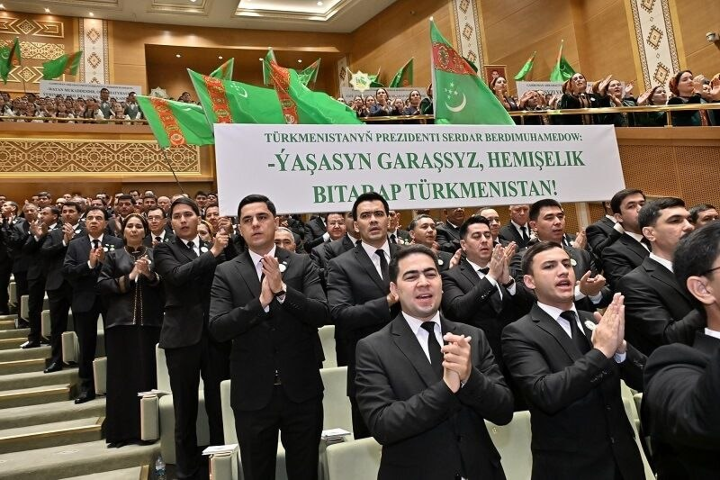
“Strengthening” Social Protection That People Do Not See: What Lies Behind the Promises Made at the Halk Maslahaty Following the Halk Maslahaty session, Turkmen state media reported new socio-economic plans: by the end of 2026, the authorities intend to create around 5,300 jobs, utilize more than 41.2 billion manats in capital investment, continue the construction of industrial and social facilities, and lay the foundations for 50 health houses and rural health centers. Official reports also refer to programs allegedly aimed at “strengthening the social protection of citizens.” But this very wording raises one of the main questions. What exactly are the authorities planning to “strengthen”? According to appeals and testimonies received by Dayanç, people do not see a functioning social support system capable of protecting a family in the event of loss of income, unemployment, or serious financial hardship. Citizens are not aware of accessible regular social payments or assistance programs that would genuinely help a person or family survive a financial crisis. Therefore, before speaking about “strengthening social protection,” the authorities should explain to the public: What specific programs exist? Who is entitled to them? Where can people apply? What payments are provided? What are their amounts? And how many citizens actually receive such assistance? If such a system truly exists, the state should have no difficulty publishing this information. If, however, citizens barely encounter such mechanisms in their everyday lives, then the discussion should not begin with “strengthening” social protection, but rather with creating an accessible and transparent system of social protection in the first place. You cannot strengthen something that people do not experience in their daily lives. 5,300 jobs — but how much will they pay? The second fundamental question concerns the announcement that approximately 5,300 new jobs will be created. The number of vacancies alone says little about living standards. Far more important is another question: What will the salaries be? According to reports and comments from citizens, many people earn approximately 1,000 to 5,000 manats per month. At the same time, citizens say that such incomes are insufficient to adequately cover basic monthly expenses, including food, clothing, medicines, transport, utilities, and ordinary household needs. During discussions of social problems, citizens described a more acceptable level of income as approximately 10,000 to 20,000 manats per month, on the condition that higher salaries are not accompanied by another increase in the prices of food and essential goods. That is why the announcement of 5,300 jobs should be accompanied by much more important information: What will the salaries be for these jobs? A job that does not provide enough income to support a family does not solve poverty simply because another employment figure has been added to an official report. It is the purchasing power of wages, rather than the number of jobs created, that shows whether people’s lives have actually improved. If there are so many jobs, why do citizens leave the country to work abroad? The comments beneath the publications are also revealing. One user essentially asks a simple question: if state television constantly shows new construction projects, enterprises, and economic development, why do citizens of Turkmenistan continue to seek work outside the country? This is not merely a rhetorical question. If thousands of jobs are being created, enterprises are being built, and tens of billions of manats are being invested, the result should be reflected in people’s ability to find decent, adequately paid work at home, rather than being forced to leave the country in search of an income. This is precisely where official statistics should be compared with the real situation of ordinary families. 50 new healthcare facilities — but what will be inside them? It has also been announced that the foundations of 50 health houses and rural health centers will be laid, alongside plans for hospitals and oncology facilities. Any expansion of accessible healthcare is necessary. But the number of buildings alone says nothing about the quality of the healthcare system. Citizens need answers to other questions: when will these facilities be completed, how many doctors and medical workers will be employed there, where will specialists be trained, what equipment will be available, which medical services will be provided free of charge, and how accessible will these institutions actually be to people living in the regions? A completed building is not yet healthcare. The real right to health begins when a person can see a doctor in time, undergo necessary examinations, obtain medicines, and receive treatment regardless of their financial situation. Construction continues, while people wait years for housing Housing is another serious issue. Against the backdrop of constant announcements about new state construction projects, citizens report waiting for housing for many years. According to information received from members of the public, some families remain on housing waiting lists for years and even decades. That is why society needs concrete figures: How many citizens are currently on housing waiting lists? How many families received housing in 2025 and 2026? What criteria are used for allocation? How long does a person wait for an apartment on average? If the state is capable of announcing dozens of major new construction projects every year, it is reasonable to ask why the housing problems of ordinary families remain unresolved. This issue is even more important because housing affordability is directly linked to income. For a family earning only a few thousand manats per month, discussions about modern new housing mean little if the cost of that housing is completely beyond the reach of the family budget. 41.2 billion manats: society needs transparency Another major figure cited in the published materials is more than 41.2 billion manats in capital investment. With such large amounts of public spending, public oversight becomes especially important. Citizens’ comments include allegations of inflated construction costs, kickbacks, and non-transparent use of public funds. Without independent verification, such allegations cannot be presented as established facts. However, the very existence of such suspicions demonstrates why public spending must be as transparent as possible. Society needs to know who receives state construction contracts, how contractors are selected, whether tenders are publicly announced, what the estimated cost of each project is, whether that cost changes during construction, and who independently audits the spending. Public funds are not an abstract possession of officials. The way those funds are used directly affects the state’s ability to finance schools, healthcare, housing, pensions, and social support. Economic growth should be visible in people’s wallets State media report expected economic growth of approximately 6.3%. But economic growth has meaning for ordinary people only when it is reflected in their daily lives. If the economy is growing, it is reasonable to ask: Have real incomes increased? Can families buy essential food without constantly cutting back? Has housing become more affordable? Are pensions and social benefits sufficient? Has access to healthcare improved? Has the need to leave the country in search of work decreased? These are the questions citizens are waiting to have answered. People have repeatedly raised the issue of increasing wages, pensions, and social payments. In public discussions, an income level of 10,000 to 20,000 manats has been mentioned as a reasonable benchmark, without a simultaneous increase in the prices of essential food and basic goods. That is why, after the high-profile statements made at the Halk Maslahaty, the main question remains unchanged: When will tens of billions of manats in investment, thousands of new jobs, the construction of healthcare facilities, and statements about social protection begin to be reflected not only in state reports, but in the real lives of ordinary families? And there is one more question, perhaps the simplest of all: If social protection truly exists, show people where it is, how they can access it, and what real assistance it provides. If citizens do not see it and do not receive it, then a functioning system must first be created before the authorities can speak of “strengthening” it.
As a foundation, every individual's fundamental
protect and develop their rights
we are working for.