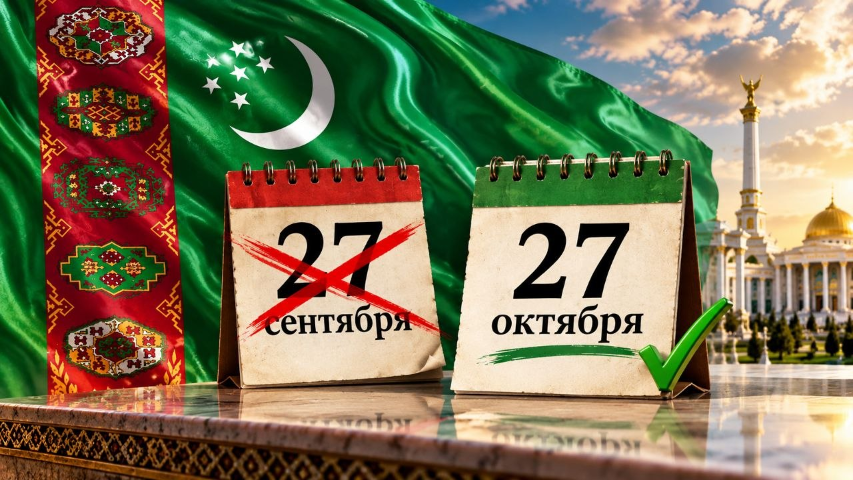
Rewritten Independence: How Turkmenistan’s History Is Being Reshaped to Serve Those in Power Turkmenistan is marking the 35th anniversary of its independence. Yet even the history of the country’s most important national holiday has been altered over time. For decades, Independence Day was celebrated on 27 October, commemorating the events of 1991, when Turkmenistan became an independent state. The official celebration was later moved to 27 September. The historical context, however, remains unchanged. At the time Turkmenistan gained independence, the country was led by Saparmurat Niyazov. It was during his presidency that the first years of the independent state unfolded, its state institutions were established, and Turkmenistan’s permanent neutrality was subsequently recognized internationally in 1995. Any assessment of Niyazov’s rule can and should take into account the authoritarian political system established under his leadership, the personality cult, and numerous human rights violations. But critically assessing his rule does not require rewriting the historical chronology. Turkmenistan gained independence and developed its policy of permanent neutrality long before Gurbanguly Berdimuhamedov came to power. The decision to change the date of the country’s main national holiday therefore inevitably raises a question: why was it necessary to alter a tradition that had existed since the first years of independence? When a political system seeks to associate virtually every achievement of the state with the current leadership, the line between the history of the country and the history of a particular ruling family gradually becomes blurred. National holidays, anniversaries, and state symbols begin to serve not only as a means of preserving national memory, but also as instruments for shaping an officially preferred version of the past. History, however, cannot be changed by an administrative decision. 27 October 1991 remains part of the history of Turkmenistan’s independence, regardless of the date on which official celebrations are held today. Likewise, the events associated with the establishment of the independent state and the recognition of its permanent neutrality cannot simply be transferred to another political era. The history of Turkmenistan belongs neither to Niyazov, nor to the Berdimuhamedovs, nor to any other political figure. It belongs to the people of Turkmenistan. Respect for independence begins, among other things, with respect for the country’s own history — without rewriting it to serve the interests of those currently in power.
As a foundation, every individual's fundamental
protect and develop their rights
we are working for.