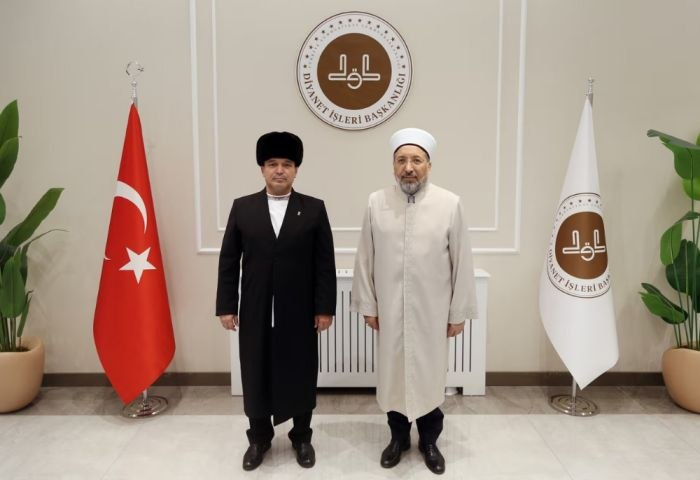
RELIGIOUS DIPLOMACY AMID PERSECUTION: WHY IS TÜRKİYE DISCUSSING ISLAMIC EDUCATION WITH A STATE WHERE MEN ARE FORCED TO SHAVE THEIR BEARDS? 3 November 2026 Human Rights Platform of the DAYANÇ Civil Movement / Turkmenistan On 2 November 2026, Professor Safi Arpaguş, President of Türkiye’s Presidency of Religious Affairs (Diyanet), received a delegation from Turkmenistan headed by Yalkap Hojagulyyev, Chief Imam of the Arkadagyň ruhy metjidi Mosque. According to a report published by Business Turkmenistan on 3 November, the parties discussed religious education, student training, scholarship programmes, the exchange of religious literature, and the expansion of cooperation between relevant institutions. An official photograph. Religious representatives. Discussions about Islamic values, historical heritage, and cultural unity. Yet a fundamental question arises: how credible can discussions about religious education be with representatives of a state where religious life itself is subject to strict government control? A country where men reportedly face pressure for wearing beards. Where independent religious activities are restricted. Where women and girls have reportedly been subjected to humiliating examinations. Where loyalty to the authorities often takes precedence over freedom of conscience. And why do international partners discuss religious cooperation without publicly addressing the rights of believers? BEARDS AS AN OBJECT OF STATE CONTROL One of the most revealing examples of interference by the Turkmen authorities in citizens’ private and religious lives is the long-standing pattern of reported campaigns against men wearing beards. Radio Azatlyk and other independent sources have reported, over the years, demands that men shave their beards, inspections of their appearance, pressure from law enforcement authorities, and restrictions affecting students, public-sector employees, and other citizens. Such reports are particularly disturbing in a country where Islam occupies an important place in society’s cultural and spiritual life. For many Muslim men, wearing a beard carries religious significance and is regarded as following the Sunnah of the Prophet Muhammad. Although Islamic schools of jurisprudence differ in their interpretation of whether wearing a beard is obligatory, the state must not arbitrarily impose its own standards of acceptable religious appearance on citizens. This exposes a fundamental contradiction. How can a government send official delegations to Türkiye to discuss Islamic education while men inside its own country reportedly face pressure over an aspect of their appearance associated with their religious beliefs? Why does a state that publicly celebrates Islamic heritage impose restrictions on individual expressions of religious identity? Are Islamic traditions acceptable only when they remain under government control? This is not merely a question of personal appearance. It concerns freedom of conscience, personal autonomy, and the limits of state interference in private life. Wearing a beard must never, in itself, become grounds for police harassment or arbitrary punishment. The state has no authority to determine a person's degree of religious devotion by their appearance. STATE CONTROL OVER MOSQUES AND CLERGY Turkmenistan is officially a secular state. However, secularism does not grant the authorities the right to control the religious beliefs of the population. International observers have repeatedly documented government control over religious organisations, the registration of religious communities, religious literature, and religious education. For many years, the United States Commission on International Religious Freedom (USCIRF) has recommended that Turkmenistan be designated a Country of Particular Concern because of particularly severe violations of religious freedom. Reports by the United States Department of State have also examined restrictions on religious activities, obstacles faced by unregistered religious communities, and government interference in religious life. Against this background, a fundamental question must be asked: how independent are Turkmenistan’s officially recognised religious representatives? Can they openly criticise injustice? Can they defend citizens who have suffered abuses at the hands of law enforcement agencies? Can they speak out against restrictions on religious freedom without fearing consequences? Or must their public activities remain within the boundaries established by the political leadership? Religious service must not become an extension of the state administration. RESTRICTIONS ON RELIGIOUS LITERATURE AND INDEPENDENT EDUCATION Restrictions affecting religious materials deserve particular attention. International reports have documented government control over the importation, distribution, and use of religious literature, as well as restrictions on independent religious education. For this reason, plans to exchange religious literature between Türkiye and Turkmenistan raise additional questions. Will ordinary believers have unrestricted access to these materials? Will citizens be able to study Islamic texts independently of state institutions? Will students be permitted to express independent religious opinions? Or will access to religious knowledge remain a privilege reserved for institutions approved by the authorities? A system in which the government determines who may teach religion, which interpretations are acceptable, and which forms of religious practice are permitted cannot be regarded as providing genuine freedom of religious education. WOMEN AND GIRLS: VIOLATIONS OF BODILY INTEGRITY Another serious contradiction between official rhetoric about spiritual values and reports concerning the situation in Turkmenistan involves the treatment of women and girls. Independent media outlets have reported cases of forced gynaecological examinations and so-called virginity testing. Such practices have no scientific basis. The World Health Organization (WHO), UN Women, and the Office of the United Nations High Commissioner for Human Rights (OHCHR) have called for their elimination. Non-consensual intimate examinations violate bodily integrity, privacy, and human dignity. Depending on the circumstances, they may amount to cruel, inhuman, or degrading treatment. How can officials speak about moral education while girls are reportedly subjected to such invasive practices? Why are moral standards imposed on women while officials who abuse their authority are not consistently held accountable? Why do religious representatives not publicly raise the issue of protecting women and minors? No tradition, religion, or government policy can justify forced interference with a person's body. VICTIMS OF VIOLENCE AND THE INFLUENCE OF POWERFUL OFFICIALS Reports of sexual violence, abuses of authority, and possible pressure on victims also require urgent attention. The DAYANÇ Human Rights Platform documents complaints submitted by citizens, including the case of Jeren Altyyeva and her minor daughter. Allegations of violence, unlawful deprivation of liberty, intimidation of relatives, and suspected protection of alleged perpetrators by influential individuals must be examined by independent investigative and judicial authorities. We do not presume the criminal guilt of any individual without due process and a lawful determination of responsibility. Nevertheless, the absence of transparent investigations and effective protection for victims raises serious human rights concerns. If a state claims to uphold morality, its first responsibility is to protect people from violence rather than allow conditions in which impunity can flourish. Family ties to senior officials must never provide immunity from accountability. WHEN FEAR OF THE BERDIMUHAMEDOV FAMILY OVERSHADOWS FREEDOM OF CONSCIENCE For decades, political power in Turkmenistan has remained highly concentrated, while independent human rights organisations have documented systematic restrictions on freedom of expression, association, and peaceful assembly. Under such conditions, citizens may fear not only openly criticising the government but also engaging in independent civic or religious activities. This raises a painful moral question. In a country where a substantial majority of the population identifies as Muslim, should people be made to fear the Berdimuhamedov family more than they fear Allah? Does religious faith require unquestioning obedience to political leaders? Should religious authority serve to reinforce a personality cult? Genuine respect for religion is impossible without respect for individual conscience. No one should be required to demonstrate political loyalty merely to pray peacefully, study religion, or follow their beliefs. TRANSNATIONAL REPRESSION: TÜRKİYE'S RESPONSIBILITY Cooperation with Turkmenistan cannot be considered separately from the situation of Turkmen citizens living abroad. This is particularly relevant to Türkiye, which hosts Turkmen nationals, including individuals who fear political persecution. Human rights defenders have reported threats against activists, intimidation of their relatives, difficulties obtaining or renewing passports, and cases of forced return to Turkmenistan. The circumstances surrounding the reported enforced disappearances of Alisher Sakhadov and Abdulla Orusov are of particular concern and require an independent investigation and clarification of their fate and whereabouts. Compliance with the principle of non-refoulement must remain an essential component of Türkiye's relations with Turkmenistan. Under Article 3 of the Convention against Torture, no State Party may expel, return, or extradite a person to another state where there are substantial grounds for believing that the person would be in danger of being subjected to torture. Religious cooperation does not release states from their international human rights obligations. On the contrary, shared cultural and religious ties should provide an additional reason to protect human dignity and personal safety. QUESTIONS TO DIYANET PRESIDENT SAFI ARPAGUŞ The DAYANÇ Human Rights Platform calls upon the leadership of Türkiye's Presidency of Religious Affairs to publicly address the following questions. 1. Was the issue of freedom of religion or belief in Turkmenistan raised during the meeting held on 2 November 2026? 2. Is Diyanet aware of reports that men in Turkmenistan have been pressured or forced to shave their beards, as well as other restrictions on religious expression? 3. Were issues concerning government control over religious leaders, religious literature, and independent religious education discussed? 4. What safeguards will ensure that educational cooperation programmes are free from political discrimination and arbitrary restrictions on students? 5. Were concerns raised regarding the protection of women and girls against forced intimate examinations and other practices that violate human dignity? 6. Is Diyanet prepared to facilitate dialogue on compliance with international standards concerning freedom of religion or belief in Turkmenistan? 7. Will Turkish religious institutions take into account documented concerns and allegations of transnational repression affecting Turkmen citizens? We are not calling for an end to religious dialogue between the peoples of Türkiye and Turkmenistan. We are calling for that dialogue to extend beyond official photographs and institutional agreements. CONCLUSION One cannot credibly promote freedom of Islamic education while ignoring reports of men being persecuted for wearing beards. One cannot speak of spiritual values while turning a blind eye to forced virginity testing and violations of the dignity of women and girls. One cannot invoke morality without demanding protection and justice for victims of violence. One cannot claim to uphold religious freedom while independent religious communities face government control and access to religious knowledge remains restricted. One cannot celebrate brotherhood between nations while ignoring the fate of individuals subjected to political persecution and transnational repression. We therefore address a simple question to Türkiye's religious institutions: Are you cooperating to protect faith and human dignity, or are you merely maintaining relations with state institutions whose human rights practices have been repeatedly criticised internationally? The construction of mosques, the establishment of religious schools, and the organisation of official delegations do not, by themselves, demonstrate respect for religious freedom. The true measure of religious freedom is whether individuals can practise their faith without fear. Including the freedom to wear a beard in accordance with their beliefs. To pray freely. To study religious texts. To protect women and children from violence. And to speak openly against injustice. The Human Rights Platform of the DAYANÇ Civil Movement / Turkmenistan calls upon the leadership of Diyanet and Turkmenistan's international partners to incorporate freedom of religion or belief, women's rights, child protection, and the prevention of transnational repression into the agenda of bilateral cooperation. Religious diplomacy must not become a means of legitimising political control over believers. Faith must not be subordinated to political power. The state has a duty to respect every individual's freedom of conscience. Diana Dadasheva Chair Human Rights Platform of the DAYANÇ Civil Movement / Turkmenistan France Lala Abdyrahmanova Representative of DAYANÇ Türkiye Website: dayanchcivil.com Email: dayanch.civil@gmail.com REFERENCES AND SOURCES FOR FURTHER VERIFICATION 1. Business Turkmenistan, 3 November 2026 — “Turkmen Delegation Discusses Cooperation in Religious Education in Türkiye.” Source: business.com.tm. 2. Radio Azatlyk — Independent reporting on restrictions affecting religious practices, men's beards, personal appearance, and women's rights in Turkmenistan. https://www.azathabar.com/ 3. United States Commission on International Religious Freedom (USCIRF) — Annual reports and recommendations concerning religious freedom in Turkmenistan. https://www.uscirf.gov/ 4. United States Department of State — 2023 Report on International Religious Freedom: Turkmenistan. https://www.state.gov/reports/2023-report-on-international-religious-freedom/turkmenistan/ 5. Human Rights Watch — Turkmenistan country reporting. https://www.hrw.org/europe/central-asia/turkmenistan 6. World Health Organization, UN Women, and OHCHR — United Nations agencies' call to eliminate virginity testing, 17 October 2018. https://www.who.int/news/item/17-10-2018-united-nations-agencies-call-for-ban-on-virginity-testing 7. Forum 18 — Reporting on freedom of religion or belief in Turkmenistan and Central Asia. https://www.forum18.org/ 8. Universal Declaration of Human Rights — Articles 5, 12, and 18. 9. International Covenant on Civil and Political Rights — Articles 7, 17, and 18. 10. Convention against Torture and Other Cruel, Inhuman or Degrading Treatment or Punishment — Article 3. 11. Convention on the Rights of the Child — Articles 16, 19, and 34. 12. Convention on the Elimination of All Forms of Discrimination against Women (CEDAW).
As a foundation, every individual's fundamental
protect and develop their rights
we are working for.