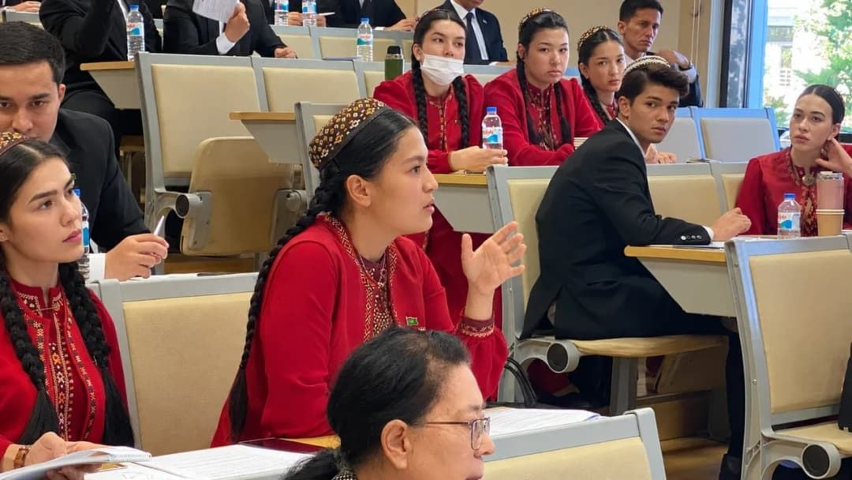
OSCE Trains Future Lawyers in Turkmenistan in International Law: A Positive Step, but Who Will Ensure Its Practical Implementation? From 12 to 14 October 2026, an OSCE training course on international human rights law and international humanitarian law was held in Ashgabat, Turkmenistan. According to Turkmenportal, the event was organized by the OSCE at the International University for the Humanities and Development. The training brought together 50 students and lecturers from the law faculties of the International University for the Humanities and Development, the Institute of International Relations of the Ministry of Foreign Affairs of Turkmenistan, and the Institute of the Ministry of Internal Affairs. International experts from Austria delivered lectures covering international human rights law, international humanitarian law, international criminal law, refugee protection, the prevention of torture, and the protection of women, children, and other vulnerable groups. William Leaf, Head of the OSCE Centre in Ashgabat, emphasized the importance of the knowledge gained for participants’ future professional activities and their understanding of international obligations. The Dayanç Civil Human Rights Platform / Turkmenistan welcomes such educational initiatives. However, we consider it essential to highlight the fundamental contradiction between studying international human rights standards and their practical implementation. International Standards and the Reality of Human Rights in Turkmenistan For many years, human rights organizations have reported systematic human rights violations in Turkmenistan. Among the most serious concerns are restrictions on freedom of movement, travel bans, obstacles to obtaining and renewing passports abroad, pressure on activists’ relatives, the lack of an independent judiciary, and the absence of effective mechanisms for protecting citizens’ rights. Particular concern has been raised regarding reports of torture, arbitrary detention, the situation of political prisoners, and inadequate protection for women and children experiencing domestic violence and other forms of abuse. Many victims face a lack of accessible shelters, independent complaint mechanisms, and guarantees of protection against further violence. At the same time, independent international monitoring of the human rights situation in Turkmenistan remains severely restricted. This raises a legitimate question: How can future legal professionals effectively apply international human rights standards when the country lacks the necessary safeguards for independent monitoring and accountability? Education Without Independent Monitoring Is Not Enough Undoubtedly, introducing young professionals to international law is an important step. It is particularly significant that representatives of educational institutions affiliated with Turkmenistan’s Ministry of Foreign Affairs and Ministry of Internal Affairs participated in the training. However, education in international legal standards must be accompanied by their genuine implementation within government institutions, law enforcement agencies, and the judicial system. International obligations cannot be considered effectively implemented when citizens lack meaningful opportunities to defend their rights and allegations of violations are not subject to independent and impartial investigations. International seminars cannot replace independent monitoring, institutional transparency, and accountability for human rights violations. What Role Should the OSCE Play? We believe that cooperation between the OSCE and Turkmenistan should extend beyond educational programmes and include practical measures aimed at improving the human rights situation. In particular, the following measures are necessary: Establish independent monitoring of human rights compliance in Turkmenistan. Ensure access for international human rights monitoring mechanisms to places of detention. Guarantee effective and independent investigations into allegations of torture, violence, and arbitrary detention. Provide meaningful protection for women, children, and other vulnerable groups. Establish independent mechanisms for examining citizens’ complaints and ensure protection against retaliation. Monitor Turkmenistan’s compliance with its international obligations and publicly assess measurable progress. It is particularly important that international organizations have opportunities to obtain information not only from government institutions but also directly from victims, independent human rights defenders, and representatives of civil society. Without such access, it is impossible to develop a comprehensive and objective understanding of the human rights situation. A Positive Step, but Still Insufficient Grounds for Optimism The Dayanç Civil Human Rights Platform / Turkmenistan welcomes the OSCE’s efforts to introduce future Turkmen legal professionals to international human rights standards. We hope that the knowledge acquired will help a new generation of professionals better understand the importance of human dignity, the rule of law, and the state's international obligations. However, longstanding human rights concerns demonstrate that educational initiatives alone are insufficient. Until independent monitoring mechanisms are established, international observers are granted meaningful access, and effective protection for victims is guaranteed, it remains premature to speak of systemic improvements. International cooperation should be assessed not merely by the number of seminars conducted, professionals trained, or official statements issued, but above all by tangible results for ordinary citizens. Human rights must be protected not only in university lectures and at international conferences, but also in police stations, courtrooms, detention facilities, government institutions, and the everyday lives of every citizen of Turkmenistan. Dayanç Civil Human Rights Platform / Turkmenistan 🌐 http://dayanchcivil.com/ Source: Turkmenportal — Law Students in Turkmenistan Complete OSCE Course on Humanitarian Law
As a foundation, every individual's fundamental
protect and develop their rights
we are working for.