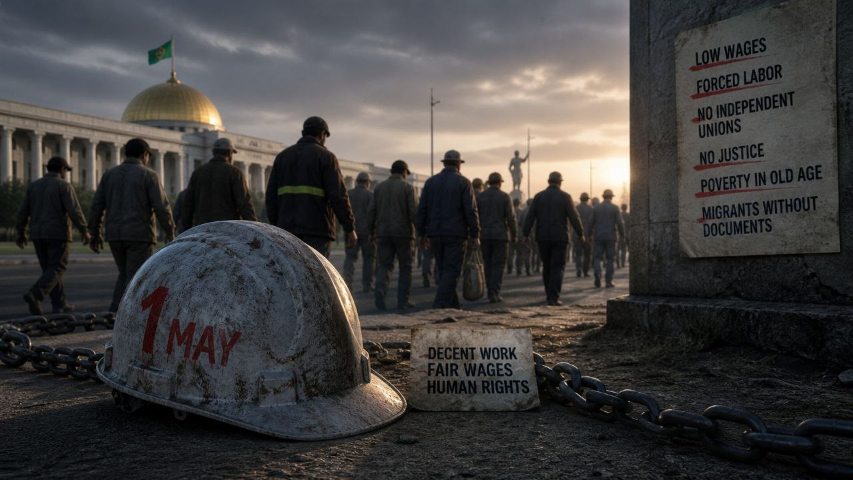
May 1 Without Celebration: Why Workers in Turkmenistan Cannot Mark Labor Day Today, the world observes International Workers’ Day — a day of solidarity with workers and of the struggle for decent work, fair wages, safe working conditions, and respect for the dignity of labor. However, for the citizens of Turkmenistan, this day has long ceased to be a holiday. It is impossible to celebrate Labor Day where workers’ rights are systematically violated, and where human labor itself is devalued by the state. Humiliatingly Low Wages In Turkmenistan, the wages of millions of citizens are not merely low — they are insufficient and degrading for a dignified life. In many regions of the country, workers’ incomes: do not cover basic food expenses; do not allow access to proper medical treatment; do not provide the means to support a family; leave no possibility for savings or personal development. Chronically low wages have become one of the principal causes of: widespread corruption at all levels; forced labor migration; growth of the shadow economy; erosion of the value of honest work, where obtaining decent employment often requires bribery or personal connections. Forced Labor Under the Guise of “Public Duty” Thousands of public sector employees in Turkmenistan are annually subjected to: forced participation in mass state events; mandatory involvement in cotton harvesting campaigns; mobilization for public works and staged government events; requirements to participate in official activities at their own expense. Refusal often results in: threats of dismissal; loss of bonuses; administrative harassment; inclusion on informal “unreliable” lists. This constitutes a direct violation of fundamental labor rights and international prohibitions on forced labor. Trade Unions Without Independence There are no genuine independent trade unions in the country. All trade union structures: are effectively controlled by the state; do not protect workers from employer abuse; do not conduct genuine collective bargaining; cannot organize strikes or provide meaningful legal defense for workers. As a result, workers in Turkmenistan remain alone against the system. Lack of Employment and Regional Discrimination Particularly severe conditions persist in: small towns; rural areas; remote regions. There: jobs are scarce or nonexistent; enterprises are closed or function only nominally; young people are forced to leave; access to employment often depends on bribery, personal connections, or political loyalty. Yet conditions in major cities differ only in scale: employment opportunities are still reserved primarily for the well-connected rather than qualified professionals. No Independent Courts, No Protection for Workers Even when labor rights are violated, citizens of Turkmenistan are effectively deprived of any meaningful legal remedy. The reason is simple: there is no independent judiciary in the country. Courts: do not protect workers from unlawful dismissal; do not ensure restoration of violated rights; do not adjudicate labor disputes impartially; function primarily in the interests of the state and affiliated structures. Retirement as a Form of Poverty After decades of labor, citizens of Turkmenistan face a new reality — poverty in old age. Many pensioners: cannot afford medication; are forced to economize on food; forgo necessary treatment; continue working in advanced age; depend entirely on support from children and relatives. A dignified retirement is unattainable for many in Turkmenistan. The Particular Vulnerability of Labor Migrants The plight of Turkmen labor migrants abroad remains a separate and acute crisis. Thousands of Turkmen citizens are unable to obtain or renew passports through Turkmen diplomatic missions abroad. Although Article 29(3) of the Migration Law of Turkmenistan guarantees citizens the right to obtain documentation through diplomatic and consular institutions, this provision is systematically ignored in practice. Responsibility for this lies with: the Ministry of Foreign Affairs of Turkmenistan; the State Migration Service of Turkmenistan; Turkmen diplomatic missions abroad. Consequences of Document Deprivation for Migrants Depriving citizens of documentation abroad leads to severe consequences, including: inability to work legally; risk of detention and deportation; inability to obtain residence permits or asylum; inability to register the birth of children; restricted access to healthcare and education; inability to enter into formal employment contracts; financial and legal exploitation by employers; increased dependence on intermediaries and criminal networks; heightened vulnerability to human trafficking and labor exploitation; family separation due to inability to regularize immigration status; constant fear of detention at any moment. The state is effectively stripping its own citizens of legal personhood beyond its borders. May 1 Is Not a Holiday, but a Reminder In the twenty-first century, it is unacceptable for a state to: degrade the dignity of labor; exploit public sector employees; condemn pensioners to poverty; deprive migrants of documentation; eliminate independent mechanisms for worker protection. For these reasons, we cannot congratulate the workers of Turkmenistan today. Because their labor is: not valued; not protected; not fairly compensated; not rewarded with dignity in retirement. Address to the Workers of Turkmenistan We address all working citizens of Turkmenistan: Your labor has value. Your dignity must not depend on loyalty to those in power. Your rights are not privileges — they are the foundation of a civilized society. As long as working people in Turkmenistan remain without rights, May 1 cannot be considered a celebration in the country. Human Rights Platform of the Civil Movement “Dayanç / Turkmenistan” Your Rights Are Our Duty 🌐 https://www.dayanchcivil.com/�
As a foundation, every individual's fundamental
protect and develop their rights
we are working for.