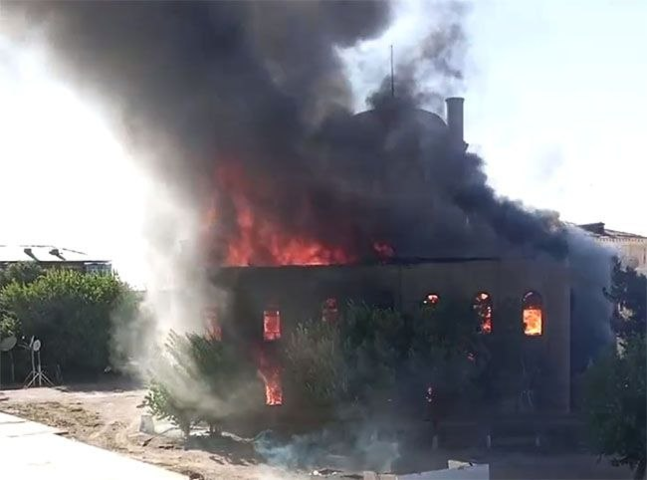
Historic Landmark Damaged by Fire in Turkmenabat: Why Are the Authorities Silent About the Cause? In early August 2026, a historic building in Turkmenabat was seriously damaged by fire. The building, which formerly housed the Lebap Museum of History and Local Lore, dates back to the late 19th–early 20th century and was originally built as a mosque. Footage of the fire circulated on social media, showing flames engulfing the interior of the building and thick black smoke rising above it. The incident was also reported by the independent media outlet turkmen.news. Yet several days after the fire, the public still has no clear answers to the most basic questions: When exactly did the fire occur? What caused it? How badly was the building damaged? Is an investigation being conducted? And most importantly: Why is information about an incident involving a historic landmark effectively being withheld from the public? A Monument to the History of Old Chardzhou The building was constructed around the turn of the 20th century, when present-day Turkmenabat was known as Chardzhou. According to available information, it was originally a mosque, reportedly built with the involvement of Iranian craftsmen. The building was distinguished by its characteristic brick architecture, arches, small towers, and minaret, and represented one of the surviving examples of the city’s historic architecture. Beginning in 1967, the building housed the Lebap Museum of History and Local Lore. Its collections included historical objects donated by local residents, as well as archaeological finds associated, among other things, with ancient Amul and the history of Chardzhou. In 2011, the museum was relocated to a new building, but the old structure retained its historical and architectural significance. The Building Had Already Been Under Threat Of particular concern is the fact that problems surrounding the site began long before the fire. As turkmen.news previously reported, attempts had been made to begin construction near the historic building. Local residents opposed these plans, fearing that construction work could damage the old foundations and walls. Nevertheless, construction of apartment buildings began nearby in 2021. Now the historic structure has suffered serious fire damage. According to reports from Turkmenabat, representatives of the local administration appeared at the site after the fire, construction materials were delivered, and some work has apparently begun. But this raises further questions. Who assessed the condition of the monument? What is the official extent of the damage? What exactly is currently being done to the building? Is there a professional conservation and restoration plan? Who is supervising the work? A historic monument cannot be repaired in the same way as an ordinary administrative building. Why Is the Public Being Denied Information? The lack of transparency surrounding the incident is particularly troubling. According to turkmen.news, social media posts about the fire disappeared shortly after being published, while users reported that people were deleting them “under pressure.” If the fire was caused by an ordinary technical malfunction or accident, why can the authorities not say so openly? If an investigation is underway, why has no information about it been made public? If the authorities intend to restore the historic building, why has the public not been shown a restoration plan? What exactly prevents the Turkmen authorities from openly telling citizens what happened to part of their own historical and cultural heritage? We do not claim that the fire was deliberate. Without the results of an independent investigation, such a conclusion cannot be made. However, the years-long disputes surrounding the site, followed by the fire and the absence of transparent official information, inevitably raise questions that the state authorities have a responsibility to answer. Appeal to the Authorities of Turkmenistan The Human Rights Platform of the Dayanç / Turkmenistan Civil Movement calls on the authorities of Turkmenistan and the local authorities of Lebap Region to ensure full transparency regarding the incident. We call on the authorities to: 1. Publicly disclose the exact date and established circumstances of the fire; 2. Conduct an objective investigation into the cause of the fire and publish its findings; 3. Provide information on the extent of the damage to the historic building; 4. Prevent the destruction, demolition, or arbitrary alteration of the surviving parts of the monument; 5. Involve qualified specialists in architecture, history, conservation, and restoration in the recovery process; 6. Publish the proposed restoration plan and project documentation; 7. End any pressure on citizens, journalists, and social media users who share information, photographs, or video footage of the incident. The public has the right to know what happened to this historic landmark and what the state intends to do to preserve it. Appeal to UNESCO and the International Community The Human Rights Platform of the Dayanç / Turkmenistan Civil Movement also draws the attention of UNESCO and international organizations working to protect cultural heritage to what has happened in Turkmenabat. We call on international bodies to request information from the Turkmen authorities regarding the condition of the historic building and the measures being taken to preserve it. Even if this particular building is not designated as a UNESCO World Heritage property, the preservation of historical and cultural heritage remains a responsibility of the state, and the loss of such structures means the irreversible disappearance of part of the country’s history. Turkmenistan actively presents the country’s ancient history and culture to the international community. But preserving cultural heritage is not limited to holding international conferences, opening new museums, or organizing official ceremonies. It begins with protecting the historic buildings that still survive. A fire can be extinguished. Walls can potentially be restored. But if a historic monument is lost or altered beyond recognition, its authenticity cannot be recovered. What is needed now is not silence or the concealment of information, but answers, a transparent investigation, and professional preservation of the monument.
As a foundation, every individual's fundamental
protect and develop their rights
we are working for.