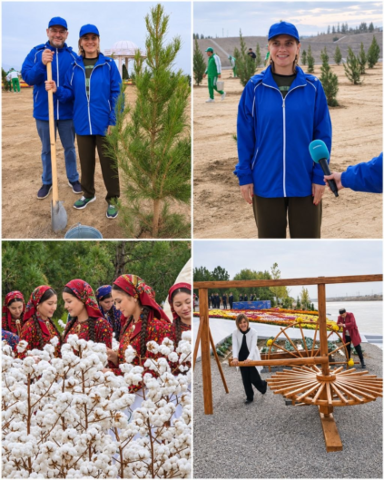
HARVEST CELEBRATIONS AMID FORCED LABOUR: WHAT REMAINS HIDDEN BEHIND DIPLOMATIC CEREMONIES IN TURKMENISTAN? 10 November 2026 Analytical Article by the Human Rights Platform of the DAYANÇ Civil Movement — Turkmenistan The French Embassy in Turkmenistan recently reported that French Ambassador Alena Grand and Luc Devigne, Head of the European Union Delegation in Ashgabat, participated in a campaign to plant three million trees under the auspices of President Serdar Berdimuhamedov. The diplomats also attended the Harvest Festival, celebrating the work of Turkmen farmers. Environmental initiatives and respect for agricultural traditions deserve support. However, behind these official celebrations lie serious concerns: forced cotton harvesting, compulsory financial contributions, child labour, farmers’ economic dependence on the state, and the lack of effective protection for their rights. On 10 November 2026, The Times of Central Asia published an article reporting that forced labour persists in Turkmenistan’s cotton industry despite ongoing discussions between the authorities and international organisations on labour reforms. This raises a fundamental question: why are agricultural achievements publicly celebrated through international diplomacy while the conditions faced by the people responsible for those achievements receive far less attention? FORCED COTTON HARVESTING AND COMPULSORY FINANCIAL CONTRIBUTIONS According to independent investigations by Turkmen.news, Chronicles of Turkmenistan and the international Cotton Campaign coalition, teachers, doctors, nurses, public-sector employees and municipal workers continue to be mobilised for cotton harvesting. Reports from 2026 also describe the involvement of military conscripts. In certain districts of the Mary and Lebap regions, soldiers were reportedly required to meet daily quotas of 40–50 kilograms of cotton. Meanwhile, public-sector employees who are unwilling or unable to work in the cotton fields are often reportedly required to pay for replacement workers. The Times of Central Asia provides specific examples from 2026: 1. In the Dashoguz region, oil and gas sector employees reportedly paid approximately $19 per month, despite earning around $110. 2. Employees of one bank reportedly paid approximately $3.50 three times a week. 3. School employees in Turkmenabat reportedly contributed approximately $1.50 up to ten times a month. These dollar equivalents were calculated using the unofficial exchange rate. In practice, workers face a difficult choice: participate in cotton harvesting or surrender part of their wages to avoid being sent to the fields. Where work is demanded under the threat of a penalty and without voluntary consent, such practices may constitute forced labour under International Labour Organization (ILO) Convention No. 29. CHILDREN IN COTTON FIELDS: ALARMING MONITORING FINDINGS Despite official measures to prevent child labour, international observers continue to report the presence of minors in Turkmenistan’s cotton fields. According to findings from the ILO’s 2025 monitoring activities, as reported by The Times of Central Asia: 1. Children were observed during 38% of visits to cotton fields, compared with 23% in 2024. 2. Among surveyed farmers, 34% reported the presence of children in the fields, compared with 17% the previous year. 3. In the Dashoguz region, children were observed in 59% of the fields visited. The ILO cautioned that these findings were not statistically representative of the entire country. Furthermore, the presence of children in cotton fields does not automatically establish that prohibited child labour has occurred. Nevertheless, these findings warrant thorough investigation, particularly in light of independent reports concerning children being involved in manual cotton picking. Economic interests and state production targets cannot justify violations of children's rights to education, health and protection from economic exploitation. DAYHAN FARMERS: STATE QUOTAS, DEBT AND THE RISK OF LOSING LAND Farmers themselves face equally serious challenges. Although Turkmen legislation provides for a degree of autonomy for dayhan (peasant farming) enterprises, farmers reportedly remain subject to state procurement quotas, administrative supervision and restrictions on their ability to manage and sell their produce independently. Materials published by Chronicles of Turkmenistan concerning cotton production contracts for 2025 highlight the need for closer examination of the contractual arrangements between agricultural associations and land tenants. Cotton procurement prices are set by the state, while deductions are made from farmers' payments for agricultural inputs and services. According to information cited by The Times of Central Asia, some farmers received approximately half the initially calculated value of their cotton after these deductions. At the same time, producers bear the risks of crop failure, water shortages, pest infestations and inadequate access to agricultural machinery. In 2026, farmers in the Mary region reportedly experienced a decline in yields from 3–3.5 tonnes per hectare to 1–1.5 tonnes per hectare, according to Turkmen.news. Despite these losses, state procurement targets reportedly remained unchanged. Particular concern arises from reports of threats to terminate land leases when production obligations are not fulfilled, as well as allegations of administrative interference in decisions concerning crops. Reports of forced crop destruction require documentary evidence and independent verification. Farmers must have guaranteed rights to obtain copies of their contracts, receive transparent payments, challenge arbitrary decisions affecting their land, and seek effective judicial remedies. INTERNATIONAL LABOUR ORGANIZATION: REFORMS UNDER DISCUSSION, BUT VIOLATIONS PERSIST Turkmenistan has been expanding its cooperation with the International Labour Organization. According to published reports, a joint ILO–European Union programme covering 2026–2027 was launched to prevent forced and child labour in cotton production. However, monitoring findings continue to raise serious concerns. According to data cited by The Times of Central Asia, interference was reported during 35% of field visits and 34% of visits to government institutions. In June 2026, the International Labour Conference Committee on the Application of Standards again examined Turkmenistan’s compliance with ILO Convention No. 105 on the Abolition of Forced Labour and called for an end to the forced mobilisation of workers and a review of mandatory cotton production quotas. International cooperation should therefore be assessed not merely by the number of consultations held, but by measurable improvements in workers' actual conditions. FRANCE AND THE EUROPEAN UNION: WHERE ARE HUMAN RIGHTS IN THE DIPLOMATIC AGENDA? The issue of forced labour in Turkmenistan has already prompted international action. Since 18 May 2018, US Customs and Border Protection has maintained a Withhold Release Order concerning cotton from Turkmenistan and products made wholly or partly from it, as part of measures addressing forced labour. The European Union has also adopted Regulation (EU) 2024/3015, prohibiting products made with forced labour from being placed or made available on the EU market. Its principal provisions are scheduled to apply from 14 December 2027. At the same time, France and the European Union continue to develop diplomatic, economic and environmental cooperation with Turkmenistan. Participation in the Harvest Festival does not, in itself, imply approval of human rights violations. Nevertheless, it raises legitimate questions. Did French Ambassador Alena Grand and EU Delegation Head Luc Devigne raise the issue of forced cotton harvesting with the Turkmen authorities? Were compulsory financial contributions, child labour, the use of military conscripts, farmers' rights and the risk of losing agricultural land discussed? How do European diplomats assess reports from international monitors concerning interference with cotton harvest monitoring activities? The DAYANÇ Human Rights Platform does not rule out the possibility that these matters have been addressed in confidential diplomatic discussions. However, it believes that the human rights dimension of international cooperation should receive greater public attention. DAYANÇ'S POSITION AND RECOMMENDATIONS The Human Rights Platform of the DAYANÇ Civil Movement — Turkmenistan calls upon the French Embassy, the European Union Delegation, the International Labour Organization and other relevant institutions to: 1. Seek an end to the forced mobilisation of citizens for cotton harvesting, including public-sector employees and military conscripts. 2. Support independent investigations into compulsory financial contributions and other forms of economic coercion imposed on workers. 3. Ensure independent monitoring and effective enforcement of prohibitions on forced and child labour. 4. Raise concerns about the protection of dayhan farmers against arbitrary termination of land leases, opaque procurement payments and unreasonable production obligations. 5. Support investigations into allegations of unlawful land seizures and forced destruction of agricultural crops. 6. Promote unrestricted and safe access for independent monitors, journalists and human rights defenders seeking information about working conditions. 7. Ensure that labour rights and the situation of agricultural producers are consistently addressed in international negotiations with Turkmenistan. CONCLUSION Planting three million trees and celebrating the harvest may be meaningful initiatives. However, sustainable agricultural development is impossible without respect for the rights of the people who work the land. Behind official reports of millions of tonnes of cotton stand teachers, doctors, military conscripts, agricultural workers, dayhan farmers and their families. Their work deserves more than ceremonial speeches. It deserves fair remuneration, safe working conditions, freedom from coercion and effective legal protection. The DAYANÇ Human Rights Platform therefore addresses a fundamental question to representatives of France and the European Union: WHEN YOU CELEBRATE THE HARVEST IN TURKMENISTAN, DO YOU HEAR THE VOICES OF THE PEOPLE WHO GREW IT? Genuine respect for farmers begins not with diplomatic ceremonies, but with the recognition of their dignity and the protection of their rights. HUMAN RIGHTS PLATFORM OF THE DAYANÇ CIVIL MOVEMENT / TURKMENISTAN Chairperson: Diana Dadasheva France www.dayanchcivil.com dayanch.civil@gmail.com SOURCES AND REFERENCES 1. The Times of Central Asia, 10 November 2026. “Turkmenistan Cotton Harvest: Forced Labor Persists Amid Reform Talks.” https://timesca.com/turkmenistan-cotton-harvest-forced-labor-persists-amid-reform-talks/ 2. Turkmen.news, 22 October 2026. Report on the mobilisation of public-sector employees and military conscripts for cotton harvesting. https://turkmen.news/2026/10/22/v-turkmenistane-hlopkouborochnuyu-kampaniyu-vyvozyat-na-sebe-byudzhetniki-i-soldaty-srochniki/ 3. Eurasianet, 15 May 2026. Report on the continued use of forced labour in Turkmenistan’s cotton industry. https://share.google/pV09X9cVeKuNWrk94 4. Cotton Campaign. Cotton harvest monitoring reports and documentation of forced labour. https://www.cottoncampaign.org/ 5. Chronicles of Turkmenistan. Report on cotton production contracts between farmers and agricultural associations for 2025. https://share.google/qOV0yz0tFFiVPcaU1 6. International Labour Organization. Monitoring activities, international labour standards and supervisory procedures. https://www.ilo.org/ 7. Business & Human Rights Resource Centre, 29 May 2025. Report concerning child labour in Turkmenistan’s cotton industry. https://share.google/uQnUaymIU6JsJQOxD 8. Regulation (EU) 2024/3015 on prohibiting products made with forced labour on the Union market.
As a foundation, every individual's fundamental
protect and develop their rights
we are working for.