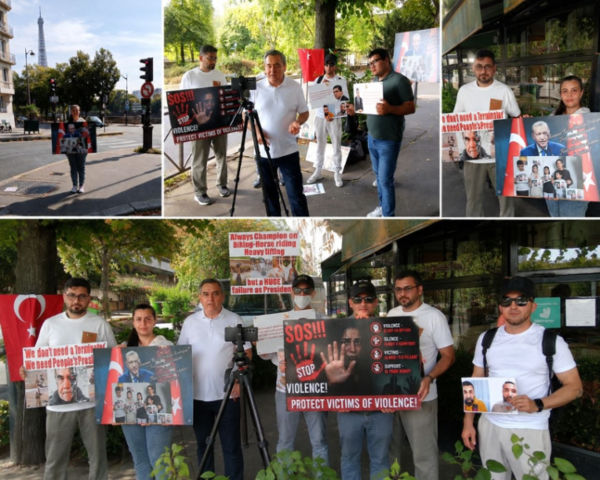
FROM DETENTIONS AND FORCED RETURNS TO ENFORCED DISAPPEARANCES: PROTEST OUTSIDE THE TURKISH EMBASSY IN PARIS On 3 August 2026, a protest was held outside the Embassy of the Republic of Türkiye in Paris, organized jointly by the socio-political organization Democratic Choice of Turkmenistan (DCT), led by Murat Kurbanov, and the Human Rights Platform of the Dayanç Civil Movement / Turkmenistan, led by Diana Dadasheva. The protest took place from 10:00 a.m. to 12:00 noon, Paris time. Three important issues were raised during the protest. The first was a reminder of how transnational repression against Turkmen citizens began on the territory of Türkiye: from the events of 1 August 2021 and the subsequent targeting and detention of individual activists to the forced return of Turkmen citizens. The second concerned the fate of Alisher Sakhatov and Abdulla Orusov, whose case represents an even more serious alleged form of transnational repression — enforced disappearance. The third concerned the case of Jeren Altyyeva and her minor daughter, Ogulnur Pelvanova, which raises serious questions about whether family and official connections may be affecting the victims’ ability to obtain justice. 1 AUGUST 2021: REMEMBERING HOW TRANSNATIONAL REPRESSION BEGAN One of the central themes of the protest was a reminder of the events of 1 August 2021 — one of the key starting points of transnational repression against Turkmen activists on the territory of Türkiye. On that day, Turkmen citizens attempted to hold a peaceful protest outside their country’s consulate in Istanbul. They sought to exercise their rights to freedom of expression and peaceful assembly. Instead of having those rights protected, they were met with detentions. Today, however, it is particularly important to remember not only what happened on that day, but what began to happen afterwards. The problem did not end with the events of 1 August. On the contrary, Turkmen activists in Türkiye who openly criticized the policies of the Turkmen authorities began to be targeted and detained one by one. Among the activists affected by this developing pattern of persecution were Farhad Meymankuliyev, Merdan Muhammedov and other Turkmen citizens known for their public civic and political activities. Further detentions followed. People were placed in removal centres. This was followed by forced returns of Turkmen citizens, despite the risks of persecution they could face upon return to their home country. This distinction is critically important. It was no longer merely a question of a possible threat of deportation. People were actually detained, placed in removal centres and forcibly returned. We consider such cases to constitute violations of the fundamental international principle of non-refoulement, which prohibits states from returning individuals to a country where they may face persecution, torture, cruel or inhuman treatment, or other serious human rights violations. This is how repression originating in Turkmenistan began to extend beyond the country’s borders. People who had left Turkmenistan hoping to escape the reach of its repressive system continued to face consequences for their political and civic activities abroad. This is why we do not remember the events of 1 August 2021 merely as an isolated episode from the past. We are reminding the public of how it all began. First came the detention of participants in a peaceful protest. Then individual activists began to be targeted and detained one by one. This was followed by removal centres and forced returns, despite the risks of persecution in Turkmenistan and the international principle of non-refoulement. Several years later, we encountered an even more serious phenomenon — the enforced disappearance of people. ALISHER SAKHATOV AND ABDULLA ORUSOV: FROM FORCED RETURNS TO DISAPPEARANCES The case of Alisher Sakhatov and Abdulla Orusov occurred considerably later than the events of 2021. However, the broader pattern of escalation cannot be ignored. Whereas earlier cases involved the detention of activists, removal centres and forced returns, the case of Sakhatov and Orusov raises an even more serious issue — enforced disappearance. Since their disappearance in Türkiye, their families, relatives, activists and human rights defenders have continued to demand that the authorities establish what happened to them and where they are. The central question remains unanswered: WHERE IS ALISHER SAKHATOV? WHERE IS ABDULLA ORUSOV? We call on the Republic of Türkiye to conduct a full, independent, effective and transparent investigation into the circumstances of their disappearance. Their fate and whereabouts must be established. All individuals involved in decisions and events preceding their disappearance must be identified. All available evidence must be located, preserved and examined. And if the responsibility of particular individuals is established, they must be held accountable regardless of their position, rank or influence. “DO WE REALLY HAVE TO WAIT SIX YEARS TOO?” During the protest, we also recalled the case of Gülistan Doku. For six years, her family has asked one question: “Where is Gülistan?” For six years, her relatives have demanded truth and justice. Now, years later, the investigation has once again seen developments: reports have emerged of new evidence and investigative measures, and efforts are again being made to establish the circumstances surrounding her disappearance. This is why, outside the Turkish Embassy in Paris, we asked a direct question: Do we really have to wait six years too? Six years for the truth to be established? Six years for evidence to be found? Six years to identify everyone involved? Six years before the families finally receive an answer? We do not want the cases of Alisher Sakhatov and Abdulla Orusov to become yet another years-long wait for justice. Do not make us wait six years. The state must act now. Establish their fate. Find and preserve the evidence. Identify everyone involved. Conduct an independent investigation. Hold those responsible accountable if their responsibility is established. JEREN ALTYYEVA AND OGULNUR PELVANOVA: WHEN FAMILY CONNECTIONS MAY PROVE STRONGER THAN THE LAW The third issue raised during the protest concerned the case of Jeren Altyyeva and her minor daughter, Ogulnur Pelvanova. The mother is demanding an investigation into allegations of violence against her child. However, according to the victims, instead of an effective investigation and adequate protection, they themselves are being subjected to pressure. During the protest, we drew attention to family connections that have been reported to our Human Rights Platform. According to the information provided to us: Sahi and Hudayberdi are brothers. Sahi is the father of Gulshat Mammedova, who serves as the Häkim of the city of Arkadag. Hudayberdi is the father of Hursoltan. Hursoltan is the mother of Mesgen Akmammedov. This raises a serious question: Could family connections with a high-ranking official have any bearing on why the victims have been unable to secure an effective investigation? We are not claiming that Gulshat Mammedova interfered in the investigation. However, it is the responsibility of the state to determine whether anyone has used her name, official position, family connections or administrative influence. If these family connections have nothing to do with what is happening, this should be demonstrated through an independent and transparent investigation. If, however, anyone has used a family name, official position or influence to shield relatives from accountability, such actions must receive an appropriate legal assessment. We demand: PROTECT JEREN ALTYYEVA AND OGULNUR PELVANOVA! END THE PRESSURE! INVESTIGATE THE ALLEGATIONS OF VIOLENCE! INVESTIGATE THE POSSIBLE USE OF FAMILY AND OFFICIAL CONNECTIONS! And our central question to the authorities of Turkmenistan remains: WHO IS STRONGER BEFORE THE LAW — A CHILD WHO MAY HAVE SUFFERED VIOLENCE, OR INFLUENTIAL FAMILY CONNECTIONS? The law must apply equally to everyone. Family connections must not provide immunity. Public office must not become a shield against justice. THE TURKISH EMBASSY IN PARIS REFUSED TO ACCEPT OUR LETTER During the protest, we intended to deliver a written appeal directly to representatives of the Embassy of the Republic of Türkiye in Paris. Communication with the Embassy was established through representatives of the French security services present at the protest. Initially, we proposed that Murat Kurbanov and Diana Dadasheva enter the Embassy in order to deliver the appeal. The Embassy refused to receive them. We then proposed a compromise: Diana Dadasheva alone would enter the Embassy solely to deliver the written appeal. The Embassy also rejected this proposal. As a result, the Embassy of the Republic of Türkiye in Paris refused to accept our written appeal. We consider it important to place this fact on the public record. We came to the Embassy peacefully. We did not seek to disrupt the work of the diplomatic mission. We wanted to deliver an official letter raising issues concerning transnational repression and the fate of people who disappeared after being held within Türkiye’s migration system. But refusing to accept a letter does not make the questions it raises disappear. A letter can be refused. The problem it describes cannot be made to disappear by refusing to accept it. FROM 1 AUGUST 2021 TO ENFORCED DISAPPEARANCES This is the sequence of events we sought to highlight in Paris on 3 August. First came the detention of participants in a peaceful protest. Then individual activists began to be targeted and detained one by one. This was followed by removal centres and the forced return of Turkmen citizens, in what we consider to be violations of the principle of non-refoulement. Later came the disappearance of Alisher Sakhatov and Abdulla Orusov. This is the escalation to which we are seeking to draw attention. Transnational repression does not emerge in a single day. It develops when initial violations are not effectively investigated and do not receive an adequate legal response. That is why we call for scrutiny not only of individual incidents but of the entire sequence of events. How did it begin? Who were the first people to be targeted and detained? Who made the decisions that led to forced returns? Why did the principle of non-refoulement fail to protect people who feared persecution upon return? And how did we ultimately reach a situation in which we are now searching for people who have disappeared? These questions require answers. OUR APPEAL TO THE REPUBLIC OF TÜRKIYE We call upon the President of the Republic of Türkiye, the Ministry of the Interior, the Ministry of Foreign Affairs, the Ministry of Justice, prosecutors and all other competent authorities to: investigate allegations of transnational repression against Turkmen citizens on the territory of Türkiye; provide a legal assessment of cases involving the forced return of Turkmen citizens and examine compliance with the international principle of non-refoulement; establish who made the decisions that resulted in people being returned to a state where they could face persecution; re-examine the events that marked the beginning of this dangerous practice and establish all circumstances surrounding the persecution of Turkmen activists; and conduct a full and independent investigation into the disappearance of Alisher Sakhatov and Abdulla Orusov. We also once again call on the authorities of Turkmenistan to ensure the safety of Jeren Altyyeva and Ogulnur Pelvanova, end any pressure against them, and conduct an independent investigation into the allegations of violence and the possible use of administrative or family connections. THE PROTEST HAS ENDED — THE QUESTIONS REMAIN The protest outside the Turkish Embassy in Paris ended at 12:00 noon on 3 August 2026. But the questions that brought us to the Embassy remain unanswered. We reminded the public of how transnational repression began. We recalled those who were detained and forcibly returned. We demanded an investigation into how this practice was allowed to develop further. And we once again demanded that the fate of two disappeared men be established. Freedom of expression is not a crime. Peaceful protest is not a crime. Human rights work is not a crime. Impunity for yesterday’s violations must not create new victims today. WHERE IS ALISHER SAKHATOV? WHERE IS ABDULLA ORUSOV? We demand answers. --- FULL VIDEO OF THE PROTEST The full recording of the protest held outside the Embassy of the Republic of Türkiye in Paris on 3 August 2026 is available here: https://www.youtube.com/live/J520mxEn5WE?is=uh6tfNTWwTa2KGTi Human Rights Platform of the Dayanç Civil Movement / Turkmenistan Democratic Choice of Turkmenistan (DCT)
As a foundation, every individual's fundamental
protect and develop their rights
we are working for.