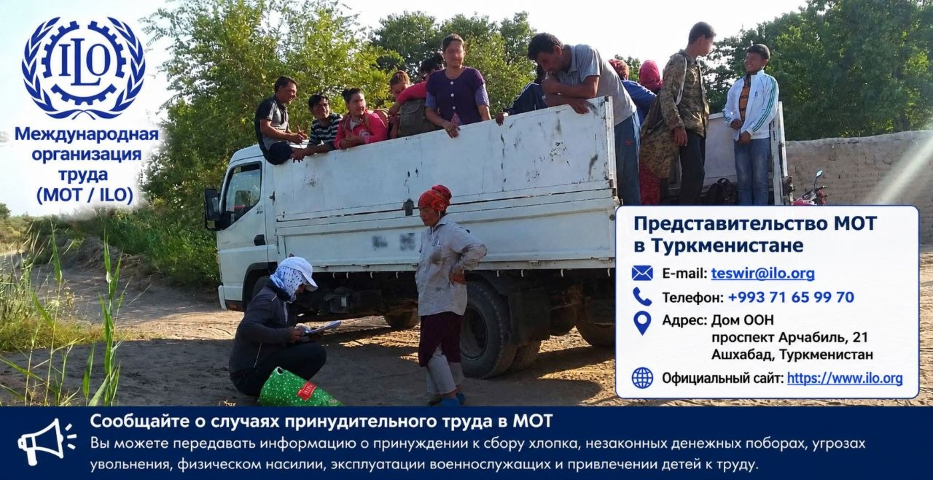
DAYANÇ — HUMAN RIGHTS PLATFORM OF THE DAYANÇ CIVIL MOVEMENT / TURKMENISTAN 23 October 2026 FORCED LABOUR IN TURKMENISTAN: SOLDIERS IN COTTON FIELDS, EXTORTION OF MONEY FROM TEACHERS, KINDERGARTENS WITHOUT EDUCATORS, AND CHILDREN DEPRIVED OF EDUCATION The Human Rights Platform of the DAYANÇ Civil Movement / Turkmenistan (DAYANÇ) expresses serious concern over the continued practice of forced labour during the 2026 cotton-harvesting campaign. Reports by Radio Azatlyk, the independent news outlet Turkmen.news, publications by Progres.online, and information obtained directly by DAYANÇ indicate widespread violations of citizens' labour and social rights. Military conscripts, teachers, kindergarten educators, support staff, and other employees of state institutions are being mobilised for cotton harvesting. Citizens are forced either to work without pay or to make payments to avoid participating in the campaign. The consequences of this practice affect not only workers but also children, who are left without adequate education and preschool supervision. 1. RADIO AZATLYK: COERCION OF PUBLIC-SECTOR EMPLOYEES AND MILITARY PERSONNEL In September 2026, Radio Azatlyk reported the forced mobilisation of employees of state institutions for cotton harvesting in the Balkan region. According to the broadcaster's sources, public-sector employees were given two options: go to the cotton fields themselves or pay between 100 and 200 manats for hired cotton pickers. Meanwhile, hired workers were reportedly paid approximately 40–50 manats per day. According to sources, buses taken out of regular passenger service were used to transport people to the fields, creating additional difficulties for the population. Radio Azatlyk also reported that military conscripts were being deployed for agricultural work. Reports published in September stated that soldiers in the Ahal and Balkan regions were forced to collect up to 50 kilograms of cotton daily. Harsh living conditions, inadequate sanitation facilities, and restrictions affecting food and personal hygiene were also reported. As early as August, Radio Azatlyk reported that soldiers were being deployed to weed cotton fields in extreme heat. According to sources, military personnel drank water from irrigation canals, after which some became ill and required medical assistance. Such conditions pose a direct threat to the health of military personnel. 2. CHILDREN FORCED TO WORK INSTEAD OF ATTENDING SCHOOL On 4 September 2026, Radio Azatlyk reported on the problem of child labour in the Mary region. According to the broadcaster, some schoolchildren in Bayramaly, Turkmengala, and Yoloten miss classes because they are forced to participate in agricultural work, collect cotton, or tend livestock. Severe financial hardship faced by families is cited as one of the reasons. DAYANÇ emphasises that economic poverty does not relieve the state of its obligation to protect children from exploitation and ensure access to education. The use of child labour that interferes with school attendance violates Turkmenistan's international obligations. 3. TURKMEN.NEWS: SOLDIERS PUNISHED FOR FAILING TO MEET COTTON-HARVESTING QUOTAS On 22 October 2026, Turkmen.news published an investigation into forced labour in the Mary, Lebap, Dashoguz, and Ahal regions. The testimonies concerning military personnel are particularly alarming. According to the publication, soldiers are assigned daily cotton-harvesting quotas of up to 50 kilograms. According to sources, failure to meet these quotas results in punishments, including: — assignment to heavy labour at a concrete production plant; — demands to pay 50 manats; — physical violence, including punches to the face. At the same time, according to sources, the payments allegedly earned for harvested cotton are not given to the soldiers but are withheld by their commanders. Soldiers also complain of inadequate food and shortages of drinking water. Particularly revealing is the report that military personnel are instructed to hide among cotton plants when inspectors appear or when a helicopter carrying the country's leadership may fly overhead. If these testimonies are confirmed, they would indicate not only forced labour but also attempts to conceal it from external observation. 4. TEACHERS PAY FOR COTTON HARVESTING OUT OF THEIR OWN SALARIES According to the Turkmen.news investigation, education workers in the Dashoguz region are being forced to finance the employment of hired cotton pickers. At one school, teachers are charged eight manats for each teaching hour. With a workload of 24 hours per week, the amount reaches 192 manats. Other schools reportedly practise collective fundraising, with different groups of teachers taking turns paying for hired cotton pickers. Teachers who refuse to pay face pressure from school management and colleagues. According to the publication, teachers at School No. 6 in the Altyn Asyr district of the Ahal region are required to pay five manats daily. The collection of money reportedly began in August and is expected to continue until December. Employees who refuse to pay are subjected to additional inspections. The investigation names school principal Muhammet Atayev, deputy principal Tirkish Hojamgulyev, and district governor Guvanchgeldy Myradov. According to the publication's sources, the collections are organised with the involvement of school management and on the instructions of higher authorities. These reports should be independently investigated while respecting the rights of all individuals mentioned. 5. DAYANÇ'S OWN SOURCE: KINDERGARTENS LEFT WITHOUT EDUCATORS The DAYANÇ Human Rights Platform has received additional information directly from its own source. According to the source, the forced mobilisation of kindergarten educators and childcare assistants for cotton harvesting is seriously disrupting the operation of certain preschool institutions in Turkmenistan. Parents complain that kindergarten staff ask them, whenever possible, not to bring their children to kindergarten. The reason is a shortage of personnel. When educators and childcare assistants are sent to cotton fields, groups left without staff are merged with other groups. As a result, more than 20 children are placed in a single group under the supervision of the remaining employees. According to the source, educators are physically unable to give every child the necessary attention. DAYANÇ considers this situation particularly dangerous. Young children require constant supervision, assistance, and safe conditions while attending preschool institutions. The forced deployment of kindergarten employees for cotton harvesting creates additional risks to children's safety and well-being. Parents should not have to keep their children at home simply because the state has sent educators to perform agricultural work. DAYANÇ demands an end to this practice and the uninterrupted operation of preschool institutions. The identity of the source is not disclosed for security reasons. 6. FARMERS OPERATE AT A LOSS The Turkmen.news investigation also highlights the difficult situation faced by agricultural producers. Farmers report shortages of water, machinery, fertilisers, and other essential resources. According to sources, some state-provided resources do not reach agricultural producers. A shortage of machinery forces tenant farmers to pay inflated prices for mechanised agricultural work. In 2026, agricultural pests caused additional damage to crops. One farmer reported that his family harvested less than two tonnes of cotton from five hectares of land. At a procurement price of 5,000 manats per tonne, the family's income may amount to less than 10,000 manats after an extended period of hard labour. Farmers also report that the actual weight of delivered cotton is understated and that other irregularities occur during crop procurement. These circumstances require independent investigation, including into possible abuses in the distribution of state resources. 7. TURKMENISTAN'S INTERNATIONAL OBLIGATIONS Turkmenistan has ratified major international conventions aimed at eliminating forced labour. In particular: ILO Convention No. 29 concerning Forced or Compulsory Labour. ILO Convention No. 105 concerning the Abolition of Forced Labour. ILO Convention No. 138 concerning Minimum Age for Admission to Employment. ILO Convention No. 182 concerning the Worst Forms of Child Labour. The deployment of military personnel for ordinary agricultural work cannot automatically be justified by the exception provided for work of a purely military character. Forcing citizens to harvest cotton under threats of punishment, financial penalties, or administrative pressure displays characteristics of forced labour within the meaning of Convention No. 29. DAYANÇ considers independent monitoring involving the International Labour Organization necessary. 8. DAYANÇ'S APPEAL TO THE AUTHORITIES OF TURKMENISTAN AND THE INTERNATIONAL COMMUNITY DAYANÇ demands an immediate end to forced labour in the cotton sector. In particular, the following measures are necessary: 1. End the use of military conscripts in cotton fields. 2. Prohibit compulsory financial collections from teachers, kindergarten educators, and other public-sector employees. 3. Ensure the proper functioning of kindergartens and protect children from the consequences of staff shortages. 4. Investigate reports of physical violence against military personnel. 5. End all forms of pressure on employees who refuse to participate in the cotton-harvesting campaign. 6. Ensure that independent ILO observers have unrestricted access to agricultural workplaces. 7. Investigate reports of abuses in the distribution of agricultural resources and cotton procurement. 8. Ensure protection for citizens and witnesses who report forced labour. 9. HOW TO REPORT FORCED LABOUR TO THE INTERNATIONAL LABOUR ORGANIZATION DAYANÇ reminds citizens of Turkmenistan that they can submit information about forced labour to the International Labour Organization (ILO). Contact details of the ILO representation in Turkmenistan: Email: teswir@ilo.org Telephone: +993 71 65 99 70 Address: UN House, 21 Archabil Avenue, Ashgabat, Turkmenistan Official ILO website: https://www.ilo.org Citizens may report forced cotton harvesting, unlawful financial collections, threats of dismissal, physical violence, exploitation of military personnel, and the use of child labour. It is important to understand that submitting information to the ILO does not automatically initiate a formal complaint procedure. Such procedures are governed by specific international mechanisms. Where there is a risk of persecution or retaliation, caution should be exercised when submitting personal information and evidence. CONCLUSION The cotton-harvesting campaign in Turkmenistan continues to be accompanied by reports of violations of fundamental human rights. Military personnel work in cotton fields instead of performing their primary duties. Teachers are forced to surrender part of their salaries. Educators and childcare assistants are taken away from kindergartens, leaving children without adequate supervision. Schoolchildren from low-income families miss classes to perform agricultural work. Farmers face shortages of resources and difficult economic conditions. Taken together, these reports demonstrate the need not merely for isolated inspections but for a systematic, independent investigation into the organisation of cotton production in Turkmenistan. DAYANÇ calls on the International Labour Organization, international human rights organisations, and diplomatic missions to pay particular attention to the situation of military personnel, education workers, and children. No government cotton-harvesting target can justify forced labour, violence, exploitation, or violations of children's rights. SOURCES 1. Turkmen.news, 22 October 2026. “In Turkmenistan, the Cotton-Harvesting Campaign Is Being Sustained by Public-Sector Employees and Military Conscripts.” https://turkmen.news/2026/10/22/v-turkmenistane-hlopkouborochnuyu-kampaniyu-vyvozyat-na-sebe-byudzhetniki-i-soldaty-srochniki/ 2. Progres.online — Publication on forced labour during the cotton-harvesting campaign. https://x.com/OnlineProgres/status/2113292387887821195 3. Radio Azatlyk / Azatlyk Radiosy. Reports published in August and September 2026 on the deployment of military personnel for agricultural work, forced cotton harvesting in the Balkan region, the situation of schoolchildren in the Mary region, and violations of public-sector employees' labour rights. Official website: https://www.azathabar.com/ 4. DAYANÇ's Own Source. Testimonies concerning the deployment of kindergarten educators and childcare assistants for cotton harvesting, the merging of kindergarten groups, and complaints from parents. The identity of the source is protected. 5. International Labour Organization (ILO). Conventions Nos. 29, 105, 138, and 182. https://www.ilo.org DAYANÇ — HUMAN RIGHTS PLATFORM OF THE DAYANÇ CIVIL MOVEMENT / TURKMENISTAN Official website: http://dayanchcivil.com/
As a foundation, every individual's fundamental
protect and develop their rights
we are working for.