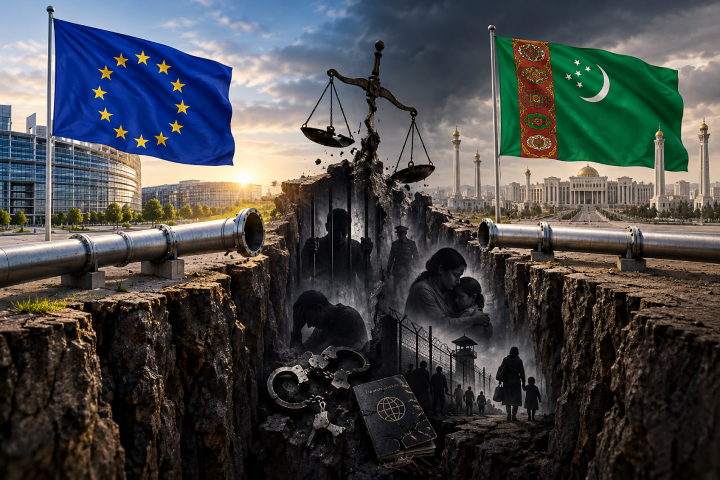
DAYANÇ — HUMAN RIGHTS PLATFORM OF THE DAYANÇ CIVIL MOVEMENT / TURKMENISTAN 25 October 2026 # EUROPE WANTS TURKMEN GAS. BUT AT WHAT COST? AS LONG AS REPRESSION AND HUMAN RIGHTS VIOLATIONS CONTINUE IN TURKMENISTAN, LET THE PIPELINE REMAIN ON PAPER! On 23 October 2026, RTVI published an article entitled “Turkmenistan Is Ready to Supply Gas to Europe: Why the 300-Kilometre Pipeline Across the Caspian Sea Remains on Paper.” According to the publication, Maksat Babayev, Chairman of the Turkmengaz State Concern, confirmed Turkmenistan's readiness to participate in the Trans-Caspian Gas Pipeline project, which envisages natural gas supplies to Europe through the Caspian Sea, Azerbaijan, Georgia, and Türkiye. The project involves the construction of an approximately 300-kilometre underwater gas pipeline, with an initially planned annual capacity of up to 30 billion cubic metres of natural gas. Türkiye is also interested in implementing this strategic energy route. However, construction of the pipeline has not yet begun. Issues concerning financing, gas transportation, long-term commercial guarantees, environmental requirements, and the obligations of participating parties remain unresolved. DAYANÇ — Human Rights Platform of the Dayanç Civil Movement / Turkmenistan believes that another issue of fundamental importance must be added to this list: respect for fundamental human rights. Can a state be considered a reliable strategic partner when it lacks an independent judiciary, continues to engage in political and transnational repression, restricts freedom of movement, leaves women and children effectively defenceless against violence and abuse, and operates an economy characterised by a dual exchange-rate system? Why do European policymakers discuss pipeline security in detail while failing to give equal attention to the security of human beings? Why are new international transportation routes being planned for Turkmenistan's natural resources while its citizens continue to face exit bans, refusals to issue documents, and obstacles to family reunification? DAYANÇ does not oppose Turkmenistan's economic development. However, we firmly believe that strategic cooperation must not provide unconditional political and financial advantages to state institutions in the absence of genuine progress in human rights. ## 1. THE ABSENCE OF AN INDEPENDENT JUDICIARY: HOW CAN SUCH A STATE BE CONSIDERED A RELIABLE PARTNER? One of Turkmenistan's fundamental problems is the absence of a genuinely independent judicial system. Citizens whose rights have been violated lack sufficient guarantees that their complaints will be examined impartially, particularly when the proceedings concern the actions of state institutions. DAYANÇ documents cases involving individuals who have repeatedly appealed to law enforcement agencies, administrative bodies, and courts without obtaining effective protection. Some cases involve the failure to enforce court judgments, the absence of independent investigations into complaints, and the inability to hold public officials accountable. The absence of an independent judiciary is not only a human rights problem but also a matter of international economic reliability. If a citizen cannot secure the enforcement of a court judgment, what guarantees will an international investor receive? Who will ensure the independent resolution of disputes arising from multibillion-dollar energy contracts? The European Union must demand genuine judicial independence, an end to executive interference in judicial proceedings, the independence of the legal profession, and the establishment of effective mechanisms for protecting citizens. Without an independent judiciary, the rule of law cannot be fully guaranteed. ## 2. THE DUAL US DOLLAR EXCHANGE RATE: CAN AN OPAQUE ECONOMY PROVIDE THE FOUNDATION FOR A RELIABLE PARTNERSHIP? Turkmenistan has maintained a dual exchange-rate system for many years. The official exchange rate is 3.5 Turkmen manats per US dollar, while the value of the dollar on the unofficial market is significantly higher. Ordinary citizens and entrepreneurs face restrictions on access to foreign currency at the official exchange rate. This situation affects the population's purchasing power, international trade, business activities, and citizens' economic opportunities. When discussing multibillion-dollar energy contracts, the European Union must raise fundamental questions. At what exchange rate will domestic expenses be calculated? Who will have access to foreign currency revenues? How will financial flows be monitored? Where will the additional billions of dollars generated by gas exports be directed? Why does a state possessing enormous natural resources fail to ensure transparent and equal access to foreign currency transactions for its population? The dual exchange-rate system, currency conversion restrictions, and the lack of transparency in public finances raise serious concerns about the predictability of Turkmenistan's economy. A state's reliability is determined not only by its natural gas reserves but also by financial transparency, judicial independence, and compliance with international obligations. ## 3. TRANSNATIONAL REPRESSION: THE CASE OF ALISHER SAKHATOV AND ABDULLA ORUSOV One of the most alarming cases concerns Turkmen activists Alisher Sakhatov and Abdulla Orusov. According to Human Rights Watch, the whereabouts of both activists have remained unknown since 24 July 2025, following reports that they had been released from a Turkish deportation centre. Their relatives and human rights defenders are seeking an investigation into their enforced disappearance. The circumstances surrounding their disappearance raise serious concerns about possible transnational repression. Gullala Hasanova is seeking clarification of Alisher Sakhatov's fate and protection of the interests of four children. DAYANÇ provides human rights support in this case. The primary responsibility for conducting an effective investigation into the disappearance of individuals on Turkish territory lies with the competent Turkish authorities. It is necessary to establish the fate and whereabouts of both men, investigate the circumstances of their reported release, and examine the possible involvement of state institutions or other individuals. The European Union must not exclude this case from its agenda in negotiations with Türkiye and Turkmenistan. The security of international energy routes cannot be discussed while questions concerning the fate of disappeared persons remain unanswered. ## 4. MARAL ANNAYEVA: FORCED RETURN TO TURKMENISTAN AND THE DEMAND FOR IMMEDIATE SAFE EVACUATION TO A THIRD COUNTRY DAYANÇ is particularly concerned about the case of Turkmen citizen Maral Annayeva and her two minor daughters. On 15 April 2026, Maral Annayeva and her children were forcibly returned from Dubai, United Arab Emirates, to Turkmenistan at the request of the Turkmen authorities. Before her forced return, Maral Annayeva had publicly reported domestic violence, threats, persecution, and unsuccessful attempts to obtain justice through Turkmenistan's law enforcement and judicial institutions. According to independent sources, her return involved international law enforcement mechanisms. These circumstances raise serious questions about the possible misuse of international police cooperation mechanisms and compliance with the principle of non-refoulement. Maral Annayeva is already in Turkmenistan. Therefore, the issue is no longer preventing her deportation from the UAE, but ensuring her safety, protecting her minor daughters, and organising the family's safe departure from Turkmenistan. DAYANÇ believes that expressions of concern alone are insufficient. A woman who publicly reported violence and the absence of state protection must not be left without effective international assistance mechanisms following her forced return. DAYANÇ demands: 1. Protection for Maral Annayeva and her daughters against persecution, threats, politically motivated detention, and all forms of intimidation or pressure. 2. Access for Maral Annayeva to an independent lawyer, medical assistance, and international protection mechanisms. 3. The organisation of safe humanitarian evacuation for Maral Annayeva and her two minor daughters from Turkmenistan to a safe third country. 4. Assistance from competent international organisations and governments in obtaining the necessary travel documents, humanitarian visas, and entry permits. 5. Guarantees that the family will have the right to apply for international protection after arriving in a safe country. 6. An independent investigation into the circumstances of their forced return from the UAE and allegations of possible misuse of international law enforcement mechanisms. 7. The prevention of any actions that could expose the woman and her children to additional danger during the preparation and implementation of their evacuation. DAYANÇ calls on the European Union, the governments of EU Member States, the Office of the United Nations High Commissioner for Refugees (UNHCR), and relevant international human rights mechanisms to consider providing immediate assistance with the family's safe humanitarian relocation. DAYANÇ's objective is not merely to establish the circumstances of what happened, but to achieve a concrete outcome: the safe evacuation of Maral Annayeva and her two minor daughters to a third country where they can obtain effective protection. The case of Maral Annayeva demonstrates that transnational repression and the failure to protect women can have consequences even after a citizen has left their country. ## 5. THE YUSUBOV FAMILY CASE: PRESSURE ON RELATIVES OF CIVIL SOCIETY ACTIVISTS DAYANÇ is documenting the case of A. Yusubov, who encountered obstacles when attempting to leave Turkmenistan. The case is being examined in the context of the civic and political activities of his brother, B. Yusubov. Restricting a citizen's freedom of movement because of the activities of family members constitutes an unacceptable form of collective pressure. No individual should face persecution because of the political beliefs or peaceful civic activities of their relatives. The European Union must demand an end to pressure against relatives of activists, the removal of arbitrary exit bans, and the establishment of mechanisms for independent examination of such violations. ## 6. APPROXIMATELY 20 APPLICATIONS FOR SAFE EVACUATION: BEHIND EVERY DOCUMENT IS A HUMAN LIFE DAYANÇ has received approximately 20 applications from individuals and families seeking assistance with safe evacuation and international protection because of persecution, threats, and the risk of forced return. The applicants include women with minor children, civil society activists, and individuals who fear politically motivated persecution. In certain cases, humanitarian visas, travel documents recognised by receiving states, and assistance with safe relocation are necessary. These are not abstract statistics. Every application represents the life of a person who fears for their safety, freedom, or the future of their children. The European Union must develop accessible mechanisms for international protection, humanitarian evacuation, and family reunification. Particular attention should be given to applicants who are already in Turkmenistan and require safe departure to third countries. Confidentiality, individual risk assessments, and protection against further persecution must be guaranteed. ## 7. WOMEN AND CHILDREN IN TURKMENISTAN REMAIN COMPLETELY DEFENCELESS DAYANÇ emphasises that women and children facing violence, threats, and abuses of authority are effectively left completely defenceless against those violating their rights. This is not simply a matter of shortcomings in social assistance. The fundamental problem is the absence of effective, independent protection mechanisms capable of guaranteeing victims' safety and holding perpetrators accountable. The case of Jeren Altyyeva and her 12-year-old daughter, Ogulnur Pelvanova, deserves particular attention. DAYANÇ has received reports of pressure against the family, their home being surrounded, intervention by security forces, and the disruption of essential utility services. This case raises a fundamental question: where can a woman turn for protection when the very institutions responsible for ensuring her safety are themselves the subject of complaints? We demand the adoption of comprehensive legislation against domestic and gender-based violence, the establishment of independent crisis centres, safe shelters, emergency protection mechanisms, and effective investigations into violations. The European Union must insist on genuine protection for women and children rather than limiting itself to positive assessments of official government programmes. ## 8. PASSPORTS AND FREEDOM OF MOVEMENT: WHY CAN GAS CROSS BORDERS WHILE CITIZENS CANNOT? Turkmen citizens living abroad continue to face serious obstacles when applying for or renewing international passports. The expiration of travel documents can deprive individuals of the ability to reside and work legally abroad, travel internationally, or reunite with their families. DAYANÇ demands the provision of passport services through diplomatic missions and consular offices in accordance with Article 29(3) of Turkmenistan's Law on Migration. Citizens must not be forced to return to their country of origin solely to obtain a new passport. The organisation also demands the repeal of Article 30(1)(9) of the Law on Migration and the removal of other provisions that allow arbitrary restrictions on citizens' departure from the country. Freedom of movement, the right to return to one's country, effective judicial review of restrictions, and family reunification must be guaranteed. Why should natural gas benefit from new international transportation routes while Turkmen citizens continue to face exit bans and remain unable to see their own children? Economic resources cannot be considered more important than human freedom. ## 9. MASS LABOUR MIGRATION: WHY ARE CITIZENS LEAVING A GAS-RICH COUNTRY? Turkmenistan possesses enormous natural gas reserves, yet substantial numbers of its citizens continue to seek employment and economic opportunities abroad. People leave their country in search of decent wages, employment, and stable living conditions. Many migrant workers face exploitation, difficulties obtaining documents, a lack of effective consular support, and prolonged separation from their families. Why do revenues from natural resources fail to provide sufficient employment opportunities and a decent standard of living? The European Union must assess the consequences of energy cooperation not only in terms of export revenues but also through real improvements in the population's well-being. ## 10. FORCED LABOUR: WHO BENEFITS FROM THE COUNTRY'S NATURAL WEALTH? Independent sources continue to document the forced mobilisation of citizens for cotton-harvesting campaigns, administrative pressure on public-sector employees, and associated compulsory financial contributions. DAYANÇ demands the complete elimination of forced labour and the establishment of independent international monitoring. At the same time, the European Union must raise the issue of transparency in the distribution of revenues from natural gas sales. Public revenues must support healthcare, education, social assistance, infrastructure development, and improvements in living conditions. Economic cooperation must not reinforce opaque systems of governance or create additional opportunities for abuses to go unpunished. ## 11. A STATE THAT DOES NOT LISTEN TO ITS OWN CITIZENS Turkmenistan lacks effective, independent mechanisms for communication and feedback between state institutions and society. Citizens face restrictions on freedom of expression, independent journalism, and civic activities. Complaints and appeals do not always result in effective investigations into violations. The absence of independent public oversight contributes to impunity, corruption risks, and the growing distance between state authorities and the population. The European Union must demand freedom of expression, the ability of independent organisations to operate, protection for complainants against persecution, and genuine accountability of state institutions. A state that does not listen to its own citizens cannot expect unconditional trust from international partners. ## 12. ENVIRONMENTAL SECURITY OF THE CASPIAN SEA The implementation of the Trans-Caspian Gas Pipeline project raises not only economic and political questions but also environmental obligations for the participating states. The construction of an underwater pipeline must be accompanied by an independent environmental impact assessment, transparent project documentation, and public access to information. The rights of communities living in the Caspian region must be taken into account during decision-making. Commercial interests cannot be given unconditional priority over environmental protection. ## 13. WHAT MUST THE EUROPEAN UNION DEMAND? DAYANÇ calls on the European Commission, the European External Action Service, the European Parliament, the Council of the European Union, and the governments of EU Member States to establish mandatory human rights conditions for deepening energy cooperation with Turkmenistan. These conditions must include: 1. An end to politically motivated repression. 2. The complete cessation of transnational persecution of citizens and pressure against their relatives. 3. The release of all individuals deprived of their liberty solely for the peaceful exercise of fundamental rights. 4. Independent investigations into enforced disappearances, including the case of Alisher Sakhatov and Abdulla Orusov, with Türkiye fulfilling its obligations to investigate disappearances occurring on its territory. 5. The organisation of safe humanitarian evacuation for Maral Annayeva and her two minor daughters from Turkmenistan to a safe third country, including the provision of necessary travel documents, humanitarian visas, and access to international protection procedures. 6. An end to pressure against relatives of civil society activists, including the circumstances documented in the Yusubov family case. 7. The establishment of accessible mechanisms for humanitarian visas, safe evacuation, international protection, and family reunification for other applicants facing persecution. 8. Genuine judicial independence and effective protection of citizens against abuses of state power. 9. The adoption of comprehensive legislation protecting women and children against violence. 10. The establishment of independent crisis centres, shelters, and emergency assistance services. 11. Guaranteed issuance and renewal of international passports through Turkmenistan's diplomatic missions. 12. The repeal of Article 30(1)(9) of Turkmenistan's Law on Migration and the review of other legal grounds permitting arbitrary exit restrictions. 13. The protection of freedom of movement and the right to family reunification. 14. Protection of migrant workers and the elimination of forced labour. 15. Transparency in currency policy, public finances, and revenues from natural gas exports. 16. The establishment of independent public oversight mechanisms and effective procedures for examining citizens' complaints. 17. Guarantees of freedom of expression, independent journalism, and the activities of civil society organisations. 18. Access for independent international human rights monitors. 19. Independent environmental assessments of major energy projects. 20. The permanent participation of independent Turkmen human rights organisations and civil society representatives in consultations with European institutions. Each requirement must be accompanied by concrete deadlines, measurable indicators, and independent assessments of implementation. The European Union must provide for the possibility of suspending specific forms of political and financial support for expanded cooperation in the event of serious non-compliance with these obligations. ## 14. EUROPE MUST LISTEN NOT ONLY TO TURKMEN OFFICIALS BUT ALSO TO THE PEOPLE THEMSELVES DAYANÇ calls on European institutions to include independent human rights defenders, journalists, civil society representatives, members of the Turkmen diaspora, and victims of human rights violations in discussions about future cooperation. A country's future cannot be discussed exclusively with its official government representatives. A permanent and secure mechanism for engagement is necessary to enable the submission of documented cases, discussion of systemic violations, and receipt of substantive responses. Without the participation of independent civil society, energy agreements risk ignoring the interests of the people whose lives are directly affected by government decisions. ## CONCLUSION: UNTIL HUMAN RIGHTS ARE RESPECTED, LET THE PIPELINE REMAIN ON PAPER! The European Union seeks to strengthen energy security and diversify its sources of natural gas supply. Turkmenistan seeks access to new markets and increased revenues from the export of natural resources. However, human beings must remain at the centre of all strategic agreements. Behind discussions of multibillion-dollar investments are real human lives. Alisher Sakhatov and Abdulla Orusov — a case of enforced disappearance requiring clarification of their fate and whereabouts. Maral Annayeva — a woman forcibly returned from the United Arab Emirates to Turkmenistan on 15 April 2026 together with her two minor daughters. DAYANÇ demands that the family's safety be ensured and that their humanitarian evacuation from Turkmenistan to a safe third country be organised so that they can obtain international protection. The Yusubov family — a case illustrating pressure against relatives of civil society activists and restrictions on freedom of movement. Jeren Altyyeva and her 12-year-old daughter, Ogulnur Pelvanova — a case raising serious questions about the safety of women and children and the accountability of state institutions. Approximately 20 applications held by DAYANÇ — requests from people who need assistance with safe evacuation and international protection. These problems are compounded by the absence of independent justice, political prisoners, mass labour migration, forced labour, the dual US dollar exchange rate, opaque public finances, restrictions on freedom of expression, passport-related difficulties, and separated families. Are all these issues less important than the construction of 300 kilometres of gas pipeline? Can energy security justify diplomatic silence concerning human lives? Can a state without independent courts, effective protection of citizens, and a transparent financial system expect unconditional benefits from strategic partnership? DAYANÇ believes that the European Union must place human rights at the centre of its negotiations with Turkmenistan. We do not oppose international trade or economic development. However, we oppose the unconditional expansion of strategic cooperation while citizens' fundamental rights remain without effective guarantees. OUR POSITION IS CLEAR: UNTIL POLITICAL AND TRANSNATIONAL REPRESSION ENDS, POLITICAL PRISONERS ARE RELEASED, INDEPENDENT JUSTICE IS ESTABLISHED, EFFECTIVE MECHANISMS FOR THE PROTECTION OF WOMEN AND CHILDREN ARE INTRODUCED, FREEDOM OF MOVEMENT AND THE RIGHT TO FAMILY REUNIFICATION ARE RESTORED, TRANSPARENCY IN PUBLIC FINANCES IS ENSURED, AND EFFECTIVE MECHANISMS FOR THE PROTECTION OF HUMAN RIGHTS ARE ESTABLISHED, THE TRANS-CASPIAN GAS PIPELINE MUST REMAIN ON PAPER. WE SEPARATELY DEMAND THE SAFE HUMANITARIAN EVACUATION OF MARAL ANNAYEVA AND HER TWO MINOR DAUGHTERS FROM TURKMENISTAN TO A SAFE THIRD COUNTRY. The European Union should refrain from providing political and financial support for advancing the project until concrete, independently verified improvements in human rights have been achieved. Human rights must not become a bargaining chip. Human dignity cannot be exchanged for natural gas. The safety of women and children must not be sacrificed for commercial interests. Citizens' freedom cannot be regarded as less important than the freedom of energy resources to cross international borders. EUROPE NEEDS GAS. BUT THE PEOPLE OF TURKMENISTAN NEED FREEDOM, JUSTICE, SAFETY, AND A DIGNIFIED LIFE. NOT A SINGLE CUBIC METRE OF NATURAL GAS IS WORTH MORE THAN A HUMAN LIFE OR FUNDAMENTAL HUMAN RIGHTS. UNTIL THESE DEMANDS ARE MET, LET THE PIPELINE REMAIN ON PAPER! --- DAYANÇ — HUMAN RIGHTS PLATFORM OF THE DAYANÇ CIVIL MOVEMENT / TURKMENISTAN Diana Dadasheva — Chairperson, France Lala Abdirahmanova — DAYANÇ Representative, Türkiye Official website: http://dayanchcivil.com/ SOURCES 1. RTVI, 23 October 2026. “Turkmenistan Is Ready to Supply Gas to Europe: Why the 300-Kilometre Pipeline Across the Caspian Sea Remains on Paper.” https://rtvi.com/news/turkmenistan-gotov-postavlyat-gaz-v-evropu-pochemu-300-kilometrovyj-gazoprovod-cherez-kaspij-ostaetsya-na-bumage/ 2. European External Action Service. 18th EU–Turkmenistan Human Rights Dialogue, 22 June 2026. https://www.eeas.europa.eu/eeas/eu-turkmenistan-18th-human-rights-dialogue_en 3. Human Rights Watch. “A Year Since Two Turkmen Activists Disappeared,” July 2026. https://www.hrw.org/news/2026/07/20/a-year-since-two-turkmen-activists-disappeared 4. Turkmen.news, 16 April 2026. Report on the forced return from the UAE to Turkmenistan of a woman who had complained about her husband, a member of the security services. https://turkmen.news/2026/04/16/iz-oae-v-turkmenistan-ekstradirovali-jenshinu-zhalovavshuyusa-na-muzha-silovika/ 5. CIVICUS Monitor. Reports on domestic and transnational repression in Turkmenistan, including the forced return of Maral Annayeva. https://monitor.civicus.org/explore/tightening-digital-controls-and-domestic-and-transnational-repression/ 6. Human Rights Watch. World Report 2026: Turkmenistan. https://www.hrw.org/world-report/2026/country-chapters/turkmenistan 7. OECD. Building a Competitive Investment Landscape in Turkmenistan. https://www.oecd.org/en/publications/building-a-competitive-investment-landscape-in-turkmenistan_84f62768-en.html 8. Turkmenistan's Law on Migration, Articles 29 and 30. 9. Treaty on European Union, Articles 2 and 21. 10. International Covenant on Civil and Political Rights. 11. United Nations Convention against Torture. 12. Convention on the Elimination of All Forms of Discrimination against Women. 13. United Nations Convention on the Rights of the Child. 14. International Labour Organization Conventions No. 29 and No. 105. 15. Materials and registered applications held by DAYANÇ concerning political persecution, transnational repression, the protection of women and children, humanitarian evacuation, and freedom of movement.
As a foundation, every individual's fundamental
protect and develop their rights
we are working for.