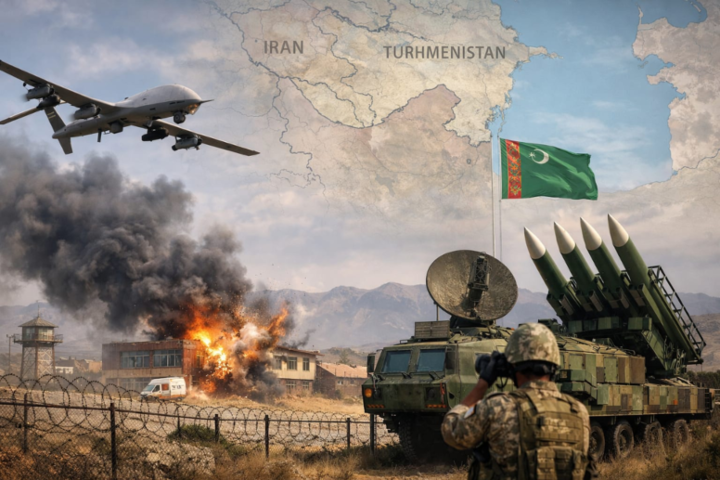
Drones Know No Borders: Is Turkmenistan’s Air Defense System Prepared? On March 5, during daytime hours, unmanned aerial vehicles reportedly launched from the territory of Iran attacked facilities in the Nakhchivan Autonomous Republic of Azerbaijan. According to official information, one of the drones fell on the terminal building of Nakhchivan International Airport, while another landed near a school building in the village of Shakirabad. As a result of the attack, the airport building sustained damage and two civilians were injured. The Ministry of Foreign Affairs of Azerbaijan strongly condemned the incident, emphasizing that such actions contradict the norms and principles of international law and contribute to increased tension in the region. Baku demanded that Iran provide explanations for the incident as soon as possible and take the necessary measures to prevent similar situations in the future. The Iranian ambassador to Azerbaijan, Mostafa Damirchul, was summoned to the Ministry of Foreign Affairs, where a formal protest was expressed and an official note of protest was handed over. This incident once again demonstrates the dangers of modern warfare, where unmanned technologies can cross state borders within minutes. Drones do not recognize state borders, they do not take into account diplomatic statements, and they do not respect the status of neutrality. In this regard, the Human Rights Platform of the Civic Movement “DAYANÇ” / Turkmenistan considers it necessary to raise an important question to the authorities of Turkmenistan. Turkmenistan shares a border with Iran and is located in a region of growing geopolitical tension. In circumstances where unmanned aerial vehicles are capable of covering long distances and striking civilian infrastructure, an important question arises: How prepared is Turkmenistan’s air defense system to respond to such threats? Society has the right to know: whether an effective system exists for detecting and intercepting unmanned aerial vehicles; whether airspace monitoring is being conducted along the southern border; whether there is an action plan to protect civilian infrastructure and the population. The safety of citizens is one of the fundamental responsibilities of any state. In a time of increasing regional instability, the authorities must ensure transparency, the readiness of security services, and timely communication with the population regarding potential risks. The Human Rights Platform of the Civic Movement “DAYANÇ” / Turkmenistan emphasizes: State neutrality is not protection against drone threats. Real protection can only come from preparedness, responsibility, and an effective security system.
As a foundation, every individual's fundamental
protect and develop their rights
we are working for.