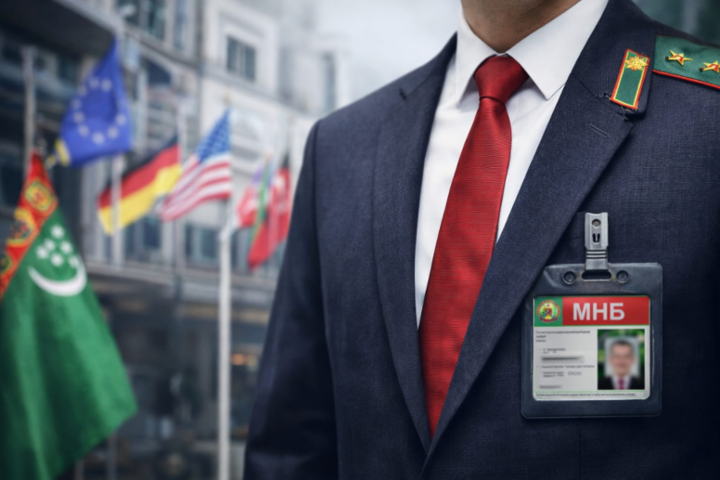
Recent reports from independent sources indicate that personnel changes within the Ministry of Foreign Affairs of Turkmenistan reveal a troubling pattern. According to the independent media outlet Turkmen.news, many employees serving in Turkmenistan’s diplomatic missions abroad are not career diplomats but career officers of the Ministry of National Security (MNS). These appointments reportedly include positions in a number of countries, including the United States, France, Iran, Afghanistan, India, Pakistan, China, Japan, Turkey, Saudi Arabia, Ukraine and others. As a result, Turkmenistan’s diplomatic network increasingly appears to function as an extended security and intelligence structure operating abroad. “Diplomats in Uniform” One of the most prominent figures mentioned in this context is Vepa Hajiyev, who served for many years as Deputy Minister of Foreign Affairs and, according to sources, holds the rank of general in the Ministry of National Security. Sources indicate that Hajiyev was involved in coordinating actions of security agencies in matters related to: persecution of activists monitoring journalists restricting citizens’ ability to travel abroad pressure against critics of the regime. Within the diplomatic system, such officials are often informally referred to as “ambassadors in uniform.” Why Diplomacy Came Under Security Control The roots of this policy can be traced back to 2002, when a political crisis and allegations of an assassination attempt against then-president Saparmurat Niyazov led to a massive consolidation of power within security institutions. Following those events, according to various reports, security officers were gradually embedded across nearly all state institutions, including: ministries migration services the prosecutor’s office state television diplomatic missions abroad. Many of these individuals formally appear as civilian officials while simultaneously maintaining status as officers of the MNS reserve. What Is the Purpose? There has never been an official explanation for such practices. However, observers suggest several possible objectives. 1. Control over the diaspora Millions of Turkmen citizens live and work abroad. Authorities appear determined to monitor their activities and prevent political mobilization. 2. Surveillance of activists and human rights defenders Independent journalists, bloggers and civic activists often report intimidation and pressure. 3. Intelligence gathering Diplomatic missions are commonly used by states for intelligence purposes. However, when intelligence work begins to dominate diplomacy, serious concerns arise. 4. Internal control over the bureaucracy Placing security officers within civilian structures allows authorities to monitor state institutions and officials themselves. And Where Is Diplomacy? Meanwhile, ordinary citizens of Turkmenistan living abroad face far more practical problems. Obtaining a new passport, renewing documents, or receiving assistance from embassies often becomes an extremely difficult process. Perhaps because diplomatic missions appear to have other priorities — such as monitoring the political views and activities of their own compatriots. A Police State? When security officers simultaneously serve as diplomats, journalists, officials and advisers within state institutions, a legitimate question arises: Where does the state end and where does the system of total control begin? If diplomacy is used primarily to monitor and pressure one’s own citizens abroad, it ceases to function as foreign policy. Instead, it becomes a mechanism of a police state, where the primary objective is not the protection of citizens but the supervision of them. And as this network of control expands, the impression grows that Turkmenistan’s diplomatic missions abroad are performing not only diplomatic duties but also surveillance functions. Of course, this may simply be a coincidence. After all, security officers sometimes become diplomats purely out of a deep passion for international relations.
As a foundation, every individual's fundamental
protect and develop their rights
we are working for.