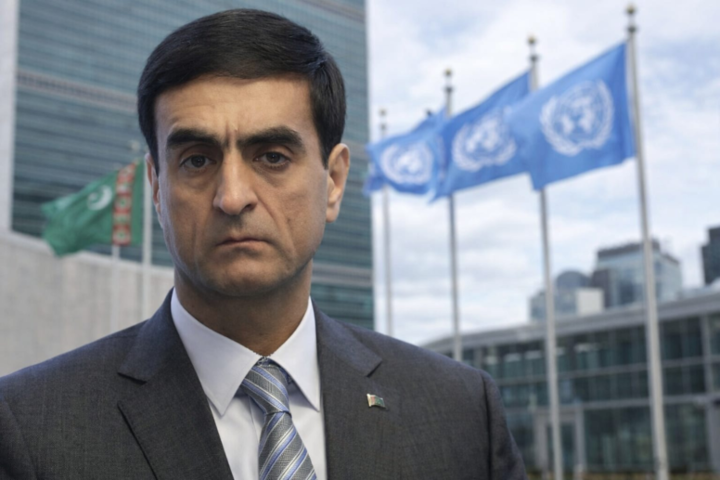
It has recently become known that changes have taken place within Turkmenistan’s diplomatic corps. General Vepa Hajiyev, who previously served as the Permanent Representative of Turkmenistan to the UN Office in Geneva, has been appointed Permanent Representative of Turkmenistan to the United Nations in New York. He replaced Aksoltan Ataeva, whom Turkmen state propaganda calls a “Hero of Turkmenistan.” For many years, during her work in international institutions, Ataeva performed essentially the same function: explaining to the world why everything in Turkmenistan was supposedly fine, even when facts suggested otherwise. Now, it appears that Vepa Hajiyev has taken over this role. This raises a legitimate question: whose interests do Turkmen diplomats actually represent — the interests of the people or the interests of the ruling clan? A Diplomat Who Denies the Obvious Vepa Hajiyev is not a new figure within Turkmenistan’s power structure. Before entering diplomacy, he worked within the National Security structures and later spent many years as Deputy Minister of Foreign Affairs. In December 2023, he was appointed Permanent Representative of Turkmenistan to the UN Office in Geneva. It was in this position that Hajiyev became involved in a controversial episode. During discussions at the UN Committee Against Torture, he made statements that effectively justified the actions of Turkmen authorities toward journalists and human rights defenders. The Case of Journalist Khudaiberdi Allashov Particular attention from the international community was drawn to the case of Khudaiberdi Allashov, a journalist with Radio Azatlyk (RFE/RL). Allashov cooperated with independent media and reported on forced labor during cotton harvesting in the Dashoguz region. In December 2016 he was arrested. His mother, Kurbantach Arazmedova, was detained together with him. According to human rights defenders, both were subjected to torture. Later, Allashov received a suspended sentence, but the pressure did not stop. He was repeatedly summoned for interrogations and beaten. In October 2019, after another detention of her son, his mother died from a heart attack caused by severe stress. Allashov himself remained under constant pressure for years. On August 13, 2024, he died at the age of 35, leaving behind a widow and two children. However, during discussions at the United Nations, Vepa Hajiyev rejected reports of persecution and instead focused on discrediting the journalist’s character rather than addressing the circumstances of the case. The Case of Journalist Soltan Achilova Another example concerns the well-known independent journalist Soltan Achilova. In November 2024 she was once again prevented from leaving Turkmenistan when she planned to travel abroad to receive an international award. According to human rights organizations, early in the morning before her flight Achilova and her daughter were forcibly taken to a hospital under the pretext of a suspected infectious disease. No diagnosis was ever confirmed. Nevertheless, in his statements Hajiyev explained the situation as a medical precaution and claimed the measures were taken to prevent possible infection. Moreover, the diplomat accused Achilova of “fabricating information about Turkmenistan” and creating a “PR image of a supposed defender of civil rights.” Denial of Torture Allegations During the UN Committee Against Torture session, Hajiyev also denied or questioned several well-known cases of human rights violations in Turkmenistan. Among them: the case of Baloch activist Mansur Mingelov, who has been serving a 22-year sentence since 2012 and suffers from severe joint disease; the death of Allamurat Khudayramov, whose body was returned to his family with multiple injuries; the tragic death of Guldjemal Jumamuradova, whose circumstances remain highly questionable according to human rights organizations. Despite numerous testimonies and reports, the diplomat rejected allegations of torture and persecution. A Reminder of International Law It must be emphasized that under the UN Convention Against Torture, no circumstances whatsoever can justify torture. States are obligated to investigate such cases, not to discredit victims. Representatives of the State or Representatives of Power? Permanent representatives to the United Nations receive their authority not from ruling families or political clans. They represent the citizens of their country. Their responsibility is to defend the rights of those citizens — not to justify violations committed against them. When a diplomat uses an international platform to deny persecution of journalists, activists, and human rights defenders, serious questions inevitably arise. Conclusion The appointment of Vepa Hajiyev as Permanent Representative of Turkmenistan to the United Nations in New York may be viewed as a continuation of the same policy: defending the image of the authorities rather than the rights of citizens. However, in today’s world such a strategy is becoming increasingly ineffective. The truth about the human rights situation in Turkmenistan continues to surface — thanks to journalists, human rights defenders, and international organizations. And regardless of how many diplomatic statements are delivered at international forums, one fundamental question remains: Who truly speaks on behalf of the people of Turkmenistan?
As a foundation, every individual's fundamental
protect and develop their rights
we are working for.