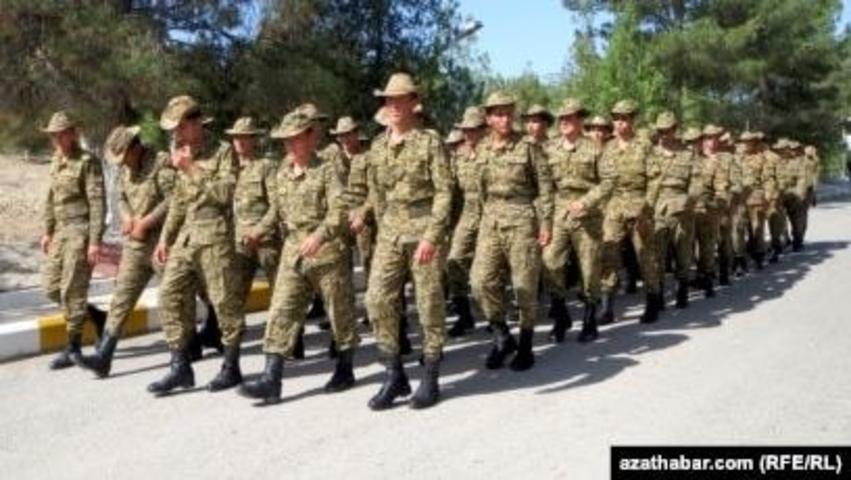
Defending the Homeland as a Sentence? Does the Turkmen Army Foster Patriotism — or a Desire to Leave the Country? Will even more young people try to avoid military service? What matters more to the state — the value of its citizens or the preservation of the existing system? Should the army be a place where young people gain military experience, or a place where they ultimately decide to leave their country? New reports about the conditions faced by conscript soldiers in Turkmenistan once again raise these questions. According to Radio Azatlyk, soldiers serving in military units located across Turkmenistan’s regions are being taken away from their regular military training and assigned to agricultural work and other forms of compulsory labor. Sources cited by the outlet say that this practice is carried out on the basis of instructions from the Ministry of Defense. Commanders reportedly send soldiers to cotton fields and other agricultural areas, including to weed and clear crop fields. The conditions under which this work is reportedly being carried out are particularly alarming. According to a Radio Azatlyk source, soldiers are taken to the fields early in the morning and remain there until evening. During the intense summer heat, they carry water in metal canteens. When their water runs out, some are reportedly forced to drink murky water from canals and irrigation ditches. The source also reported cases of intestinal illness among servicemen, with some sick soldiers being admitted to a military hospital. And these are the very young men whom the state has called upon to defend their homeland. Defending the Homeland — or Forced Labor? Military service should provide young people with the knowledge and skills necessary to protect their country and its population. Soldiers should learn how to use military equipment, receive physical, tactical, and professional training, and develop the skills needed to respond to emergencies. But what does a soldier learn when, instead of receiving military training, he is sent to weed agricultural fields? What does compulsory agricultural labor have to do with the country’s defense capabilities? If the state takes a significant period of a young person’s life under the obligation of military service, it assumes a particular responsibility for that person’s health, safety, and dignity. A soldier operates within a strict chain of command and does not have the same freedom to refuse work as an ordinary civilian employee. For this reason, reports that conscripts are being used for such labor require particularly serious scrutiny. Can Patriotism Be Created by Order? Patriotism cannot be created by command. People cannot be forced to love their country through threats, punishment, or coercion. Patriotism develops when citizens understand: my country values my life, my health, and my dignity. What is a young soldier supposed to feel if, instead of receiving proper military training, he is used as free labor? What should he think about the state if, in extreme heat, he has to search for water and, according to reports, sometimes drink from canals? What kind of relationship with his homeland does such an experience create? Will a young man emerge from such military service more patriotic — or will he become convinced that his life and health are of secondary importance to the existing system? This is a question the authorities of Turkmenistan need to answer. Will Even More Young People Try to Avoid Military Service? Turkmenistan can tighten controls over conscripts. It can increase penalties for draft evasion. It can pursue young men who attempt to avoid military service. But repressive measures cannot eliminate the fundamental question: Why are young people afraid of joining the army in the first place? If military service is associated with poor living conditions, inadequate food, hard labor, health risks, corruption, and an inability to defend one’s rights, attempts to avoid the army become a predictable consequence of the system itself. The worse the conditions of service become, the more families will look for any possible way to protect their sons from them. And wherever there is strong demand for ways to avoid military service, fertile ground for corruption inevitably emerges. A vicious cycle develops: Poor conditions create fear of military service; fear creates a desire to avoid conscription; the desire to avoid conscription fuels demand for corrupt arrangements; and corruption further destroys public trust in state institutions. Punishing young people for not wanting to serve, without asking why they do not want to serve, means fighting the consequences while leaving the underlying causes untouched. The Value of Citizens — or the Value of the System? The military is one of the clearest indicators of how a state treats its own people. If the state genuinely regards a serviceman as a defender of the homeland, it must provide him with safe drinking water, adequate food, medical care, decent sanitary and living conditions, and proper military training. Because a soldier is, first and foremost, a human being and a citizen. He does not become the property of the state simply because he puts on a uniform. If conscripts can instead be used as free labor, a fundamental question arises: Whom does such an army protect — the citizens and the homeland, or the existing state system? The Most Difficult Period May Still Be Ahead According to Radio Azatlyk, the greatest difficulties for servicemen may begin during the upcoming cotton harvest. Citing experience from previous years, a source told the outlet that soldiers working under strict supervision from commanders may each be required to collect a substantial amount of cotton every day. If this practice continues, another question must be asked: Why should agricultural production targets be met through the labor of military conscripts? A conscript does not enter the army to harvest crops. He enters because the state claims that his military training is necessary for the defense of the country. If the state uses his dependent position to make him perform entirely unrelated work, international organizations should pay close attention. The Army as a School for Emigration? There is another consequence that the Turkmen authorities may discuss far less openly. What happens to a young man after he returns from such military service? For two years, he observes the system from within. He sees how commanders treat subordinates. He experiences the living conditions, the lack of choice, and the inability to defend his own rights. After being discharged, he returns to a society where he may face unemployment, low wages, and a lack of prospects. The army may then cease to be a school of patriotism and instead become a school for emigration. A young man may ultimately conclude: If this is how the state treats me, I will build my future somewhere else. Authorities can impose restrictions on leaving the country. They can strengthen controls. But no administrative prohibition can force a person to see a future in a place where he believes he has none. The Homeland and the State System Are Not the Same Thing It is crucial to distinguish between these concepts. A person can sincerely love Turkmenistan, its people, land, language, culture, and traditions while simultaneously demanding that state institutions respect fundamental rights. Criticizing conditions in the army is not criticism of the homeland. On the contrary, demanding decent treatment for servicemen means demanding protection for the citizens of Turkmenistan. Therefore, the question should not only be: “Why do young people not want to serve?” Another question must be asked: “What has the state done to make young people want to defend their country?” --- Forced Labor Must Not Become Part of the Global Economy What is happening goes far beyond Turkmenistan’s internal affairs. If servicemen who operate within a strict chain of command and cannot freely refuse orders are being used for agricultural labor, the international community should not simply stand by and watch. We call on the United Nations, the International Labour Organization (ILO), the European Union, democratic governments, and international human rights organizations to pay particular attention to reports of the forced use of servicemen and other groups of citizens in Turkmenistan’s agricultural sector, including the cotton industry. Independent monitoring and reliable information about the scale of these practices are essential. Particular attention must be paid to the cotton industry. International Businesses Must Examine Their Supply Chains We appeal to foreign companies, investors, textile manufacturers, retailers, importers, financial institutions, and other commercial entities that have direct or indirect links to Turkmenistan’s cotton and textile industries: Do not turn a blind eye to the origin of these products. The entire supply chain must be carefully scrutinized — from the cultivation and harvesting of cotton to its processing and the production of cotton fiber, yarn, fabrics, and finished textile products. It is not enough for an individual company simply to state that it does not directly use forced labor. Companies must know how their raw materials were produced, where they came from, and who was involved in producing them. International businesses must not directly or indirectly profit from products whose supply chains may involve forced labor. We call on Turkmenistan’s international partners not to expand cooperation in the cotton and textile sectors without genuine, independent, and verifiable guarantees that forced labor and systematic human rights violations have been eliminated. Economic interests cannot be placed above human dignity. --- Appeal to the United Nations and the International Labour Organization We specifically appeal to the United Nations and the International Labour Organization. Reports concerning the possible use of military conscripts as a source of forced labor require international attention. We call for efforts to secure independent monitoring of labor conditions in Turkmenistan, including the situation of servicemen, public-sector employees, and other groups who may be compelled to perform agricultural work through administrative pressure or other forms of coercion. It is necessary to establish: whether servicemen are systematically assigned to agricultural work; whether they can refuse such work without punishment; who issues these orders; whether these practices are used during the cotton harvest; and what measures the state is taking to prevent forced labor. Silence must not create conditions in which human rights violations can continue. --- Appeal to the World Health Organization: Who Is Responsible for the Health of Our Soldiers? We also appeal directly to the World Health Organization (WHO) and other international bodies working in the field of public health. Reports concerning the conditions faced by young servicemen in Turkmenistan raise serious concerns. If soldiers are indeed being sent to perform physically demanding work in extreme heat, if they do not have sufficient access to safe drinking water, if they are forced to drink from canals and irrigation ditches, and if this is followed by cases of intestinal illness and hospitalization, this is no longer only a question of labor rights. It is a question of human health and safety. Physical labor in extreme temperatures without adequate access to safe drinking water can create risks of dehydration, heat exhaustion, and heatstroke. Drinking contaminated water poses additional sanitary and epidemiological risks. We therefore ask: Who is responsible for the health of our conscript soldiers? Who monitors the quality of their drinking water? Who is responsible for their food? Who determines acceptable levels of physical exertion during extreme heat? Who monitors sanitary conditions? How is medical assistance organized? How many servicemen seek medical assistance following such work? How many are hospitalized? Are the causes of their illnesses investigated? And most importantly — is reliable information about these cases available to the public? An Independent Assessment Is Needed We call on WHO, within the scope of its mandate and capabilities, to pay attention to this situation and support efforts to obtain reliable information about conditions affecting the health of military conscripts. We also call on the relevant international bodies to examine the responsibilities of the Ministry of Defense of Turkmenistan, military unit commanders, military medical services, and other state authorities responsible for conditions of service, food, drinking water, sanitation, and medical care for servicemen. Wearing a military uniform does not eliminate a person’s right to health. Taking an oath does not eliminate human dignity. Compulsory military service does not give the state the right to expose a person to unjustifiable risks. --- Our Soldiers Are Not Free Labor We also address the authorities of Turkmenistan directly. Our soldiers are not free labor. They are young citizens of Turkmenistan. The state demands that they be prepared to defend the country. Therefore, the state itself must be the first to protect their lives, health, and dignity. If a young man becomes ill because of conditions created during his military service, responsibility cannot simply be shifted onto the soldier or his family. If a serviceman is ordered to perform work unrelated to military training, society has the right to ask on what legal basis this is happening. If such practices are systematic, society has the right to demand that they be stopped. --- Our Appeal to the International Community The Human Rights Platform of the Dayanç / Turkmenistan Civil Movement calls on the United Nations, the ILO, WHO, the European Union, international human rights organizations, democratic governments, international financial institutions, and foreign companies not to ignore reports concerning the treatment of servicemen and the use of forced labor in Turkmenistan. We call for transparency and independent monitoring. We call on companies to conduct genuine due diligence throughout the supply chains of Turkmen cotton and textile products. We call on Turkmenistan’s international partners to take the human rights situation into account when making decisions about economic cooperation with state institutions and state-linked enterprises. As long as systematic human rights violations persist, international cooperation must not continue as though those violations do not exist. Human rights must not become a bargaining chip for economic benefit. Cotton cannot come at the cost of human dignity. Economic profit cannot take precedence over human health and human rights. A soldier must not become a source of free labor. And a state that demands that young people defend their homeland must first demonstrate that it is prepared to protect its own citizens. Because the army should be a place where young people learn how to defend their country — not a place where they ultimately decide that their only future lies outside it. Source: Radio Azatlyk https://www.azathabar.com/a/esgerler-gowaca-otagyna-cekilyar-yssy-howada-kanal-suwuny-icen-oglanlar-keselleyar/33822588.html
As a foundation, every individual's fundamental
protect and develop their rights
we are working for.