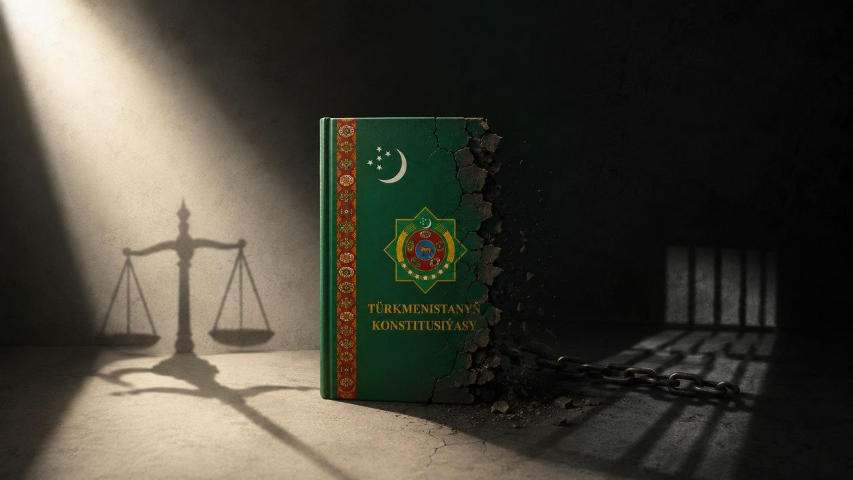
Constitution Day in Turkmenistan: A Celebration of Law or a Festival of Hypocrisy? On May 18, Turkmenistan once again solemnly celebrated Constitution Day. Concerts, flags, official speeches, television broadcasts about the “triumph of law,” a “happy people,” and a “prosperous state.” Everything was as usual — expensive, loud, and beautifully staged. So beautifully staged that, if you muted the sound and ignored reality, you could almost believe this was a free, lawful, and just country. But there is one problem. In Turkmenistan, the Constitution exists mostly for holidays, television broadcasts, and ceremonial displays. In real life, its provisions increasingly resemble decorative inscriptions on a wall — beautifully written, but never intended to be respected. That is why Constitution Day no longer inspires pride for many citizens, but instead evokes laughter, pain, frustration, and profound disappointment. Because it is impossible to endlessly listen to speeches about human rights in a country where people are afraid to speak openly. It is impossible to take official statements about freedom seriously when citizens abroad are denied passports for years in diplomatic missions, despite the direct obligation of the state established under Article 29, Paragraph 3 of Turkmenistan’s migration legislation. It is impossible to believe in “legality” when families remain separated for years because of travel bans and fear of returning home. It is impossible to trust in justice when laws exist only for ordinary citizens, but not for those who are supposed to guarantee them. And this raises the main question: what exactly was celebrated on May 18? The Constitution? Or its systematic violation? Official speeches about rights and prosperity appear especially cynical against the backdrop of a reality where: — independent courts effectively do not exist, — freedom of speech does not exist, — civil activists face pressure and intimidation, — people are afraid to openly complain, — thousands of citizens abroad remain without documents and legal protection, — and discussions about human rights are treated as “defamation of the state.” But, of course, none of this is mentioned during the concerts. There, everything is perfect. There, the people are happy. There, the Constitution is “working.” There, human rights are “fully protected.” Then why are more and more people losing faith in the authorities, in the law, and in official promises? Why are people beginning to lose faith even in international institutions that continue to express “concern,” publish reports, and issue statements while the situation steadily deteriorates? Perhaps because no society can endlessly survive between a televised fairy tale and real life. Turkmenistan has long become a country of beautiful decorations. Beautiful holidays. Beautiful slogans. Beautiful buildings. Beautiful reports. And behind all of this beauty — fear, migration, silence, poverty, lawlessness, and total distrust. For many people, state holidays in Turkmenistan increasingly feel like a bitter mockery of reality. March 8 — in a country where women face discrimination and restrictions. Labor Day — in a country from which people are forced to migrate abroad simply to survive. Constitution Day — in a country where the Constitution itself increasingly exists only as symbolic decoration. And perhaps the most painful part is that people are no longer only tired of the problems themselves. People are tired of the performance. Tired of the endless gap between the official image and real life. Tired of hearing words such as “rights,” “law,” “justice,” and “guarantees” that increasingly inspire not hope, but bitter irony. Because a Constitution can be printed in gold letters. But if it is not implemented, it ceases to be law. And becomes nothing more than a ceremonial souvenir.
As a foundation, every individual's fundamental
protect and develop their rights
we are working for.