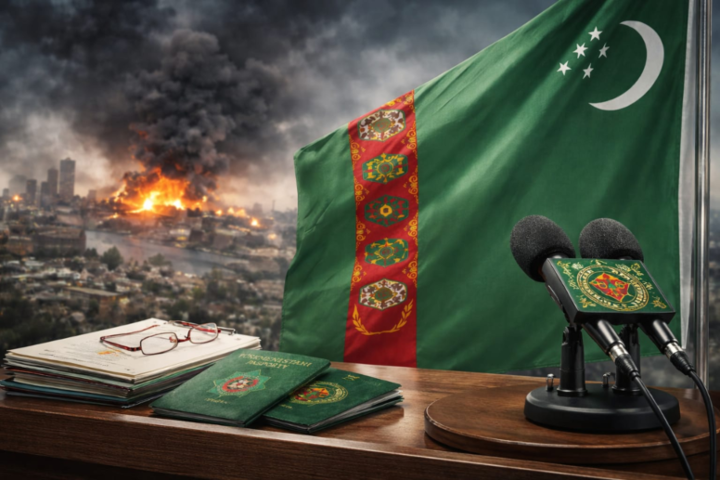
After two weeks of U.S.-Israeli airstrikes on Iran, millions of people have been forced to flee their homes, becoming internally displaced. Destruction, fear, and uncertainty are driving people to seek safety beyond the country’s borders, raising the risk of a large-scale humanitarian crisis across the region. The situation at the Turkmenistan–Iran border is particularly alarming. Although border crossings are formally operational, access for Iranian citizens is effectively closed. People, including those from northern regions of Iran with significant ethnic Turkmen populations, are attempting to seek refuge but are being turned away. According to a source within the border services, who spoke on condition of anonymity, strict orders have been issued from Ashgabat: “We were given a clear order not to allow Iranian citizens to cross the border. Patrols have been reinforced, and the situation is constantly monitored. People come and ask for temporary refuge, but we are not allowed to let them in.” However, the most troubling aspect is not only the closure of the border, but the reasoning behind it. The same source openly acknowledged: “Our capabilities are limited. Our economic situation is such that we cannot even provide our own citizens with basic necessities like bread. Under these conditions, the country is not ready to accept refugees.” This statement points to a deeper systemic crisis within the country, where shortages of essential goods are being used as justification to deny protection to people fleeing war. The Human Rights Platform of the civic movement “Dayanç” expresses serious concern over the situation. Denying refuge to individuals escaping conflict may constitute a violation of international human rights obligations, including the principle of non-refoulement. We emphasize that humanitarian crises test not only a country’s resources, but also its values. Even in difficult economic conditions, fundamental human rights must not be sacrificed. In light of the growing instability in the region, we call for: transparency regarding the situation at the borders; access for international humanitarian organizations to monitor the situation; provision of at least temporary protection for vulnerable individuals; full compliance with international human rights standards without exception. Today, this is not only about state borders — it is about the boundaries of humanity. Source: Azattyq Asia (RFE/RL): https://www.azattyqasia.org/a/situatsiya-v-irane-plohaya-v-tsentralnoy-azii-opasayutsya-pritoka-bezhentsev-na-fone-voyny/33707221.html�
As a foundation, every individual's fundamental
protect and develop their rights
we are working for.