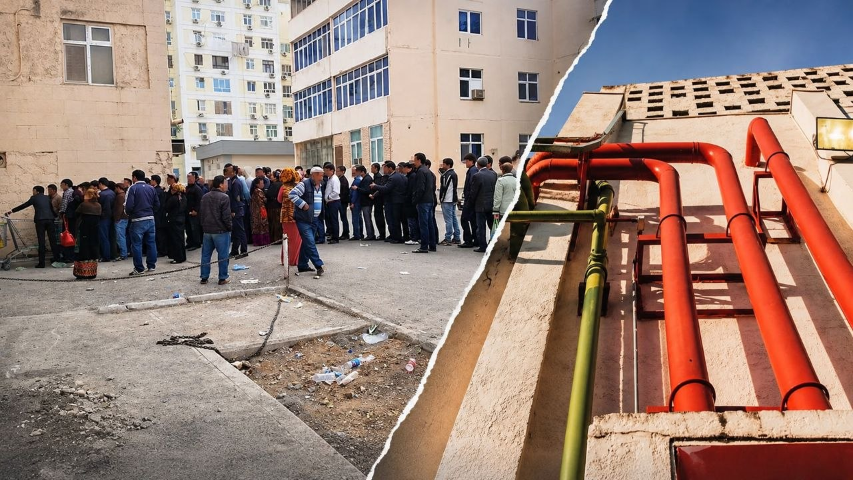
Billions of Cubic Metres of Gas, Grand Announcements and Harsh Reality: Why Are Citizens of Gas-Rich Turkmenistan Forced to Queue for Meat? Analytical Article | 11 November 2026 Turkmenistan is once again announcing economic achievements. Government officials are reporting that natural gas production and export targets have been exceeded, discussing new international energy projects, attracting foreign partners and proclaiming large-scale industrial modernisation. Yet behind these official declarations of prosperity lies a very different reality. While the government reports billions of cubic metres of natural gas being exported, ordinary citizens are forced to spend hours queuing to purchase a few kilograms of meat at an affordable price. Moreover, according to an article published by the independent outlet Chronicle of Turkmenistan on 10 November 2026, security officers have detained individuals attempting to photograph these queues. This raises a fundamental question: if the country's economic situation is truly as prosperous as the authorities claim, why does the state appear to fear photographs of citizens waiting to buy food? Gas Records: The Figures Celebrated by the Authorities On 10 November 2026, RTVI reported that between January and October, Turkmenistan had fulfilled 109.1% of its natural gas export target and 108.3% of its production target. These figures were announced following a government meeting held on 5 November. Maksat Babayev, Chairman of the state-owned Turkmengaz concern, had previously stated that the country expected to produce approximately 80 billion cubic metres of natural gas in 2026. By comparison, production in 2025 amounted to 76.5 billion cubic metres. China remains the largest purchaser of Turkmen natural gas. According to published information, approximately 40 billion cubic metres are intended for export, primarily to China and Uzbekistan. Discussions are also under way regarding the construction of a fourth pipeline line to China, which could potentially increase annual deliveries of Turkmen gas to approximately 65 billion cubic metres. At the same time, Ashgabat intends to develop the Turkmenistan–Afghanistan–Pakistan–India (TAPI) gas pipeline, expand international energy cooperation and attract further investment. However, a significant problem remains: official reports do not disclose the actual volumes of natural gas produced and exported between January and October 2026. The figures of 109.1% and 108.3% represent the fulfilment of government targets, not growth compared with the previous year. Without the publication of underlying data, it is impossible to independently establish the true scale of these economic achievements. It is even more difficult to determine how revenues generated from the country's natural resources translate into improvements in the population's living standards. Queues for Meat: The Other Side of Economic Prosperity On 10 November, the independent outlet Chronicle of Turkmenistan published a report on growing queues for subsidised beef in Kipchak, located approximately 15 kilometres from Ashgabat. According to the publication, meat is being sold for 70 Turkmen manats per kilogram, while comparable products cost approximately 140 manats per kilogram in markets in the capital. This price difference is prompting residents of Ashgabat and surrounding areas to travel to Kipchak to purchase food at a more affordable price. While customers initially had to wait between one and a half and two hours, waiting times now reportedly exceed three hours. Behind these figures lie basic human needs. People are spending their time and energy not to purchase luxury goods, but to obtain an ordinary food product. In a country possessing substantial natural gas reserves and actively expanding its energy exports, access to basic food products remains a serious social concern. Although queues alone do not establish the nationwide scale of food shortages, they are a troubling indication of problems with food affordability and accessibility that require open and independent examination. When Photographing a Queue Becomes Grounds for Detention The most disturbing aspect of the Chronicle of Turkmenistan report concerns the actions of law enforcement authorities. According to eyewitness accounts, numerous police officers and plainclothes personnel from the Ministry of National Security monitor the queues. The publication reports that, on Saturday morning, security officers detained a young woman who was using her mobile phone to record events outside the shop. Witnesses described the detention as forceful and demonstrative. The woman was reportedly placed in a vehicle against her will and taken to an unknown destination. Her subsequent whereabouts and legal status remain unknown based on the information available. If confirmed, these allegations could indicate not only an unjustified restriction on freedom of expression but also a possible arbitrary deprivation of liberty. Particularly concerning is the report that none of the customers present dared to protest openly. Such a reaction may reflect an atmosphere of fear in which citizens are reluctant to express disagreement because of possible consequences. Instead of explaining the reasons for the queues, ensuring transparency in the distribution of subsidised food and addressing potential shortcomings, security personnel are reportedly preventing people from documenting the situation. The issue therefore extends beyond the availability of meat. It concerns the ability of citizens to speak freely about the difficulties they face in everyday life. State Wealth and Public Hardship: A Contradiction That Demands Answers Turkmenistan possesses some of the world's largest natural gas reserves. Energy exports constitute a major source of government revenue. However, the existence of abundant natural resources does not automatically guarantee a decent standard of living for the population. Achieving that requires transparent public financial management, equitable distribution of economic benefits, independent oversight of government expenditure and effective social policies. In Turkmenistan's case, several fundamental questions arise. What is the actual amount of government revenue generated by natural gas exports? What proportion of these resources is allocated to healthcare, education, social protection and food security? Why must citizens spend hours waiting to purchase essential food products at regulated prices? Why is independent reporting on economic and social problems apparently treated as a threat by the authorities? The lack of adequate public reporting prevents these questions from being answered comprehensively. For this reason, Turkmenistan's international energy partners should assess their cooperation not only in terms of supply volumes and investment opportunities, but also in relation to respect for human rights, transparency in public finances and the social consequences of economic policies. Turkmenistan's International Human Rights Obligations The right to adequate food forms part of the right to an adequate standard of living, recognised under Article 11 of the International Covenant on Economic, Social and Cultural Rights. States are required to take steps towards the progressive realisation of this right, using the maximum of their available resources. This does not mean that the mere existence of queues automatically establishes a violation of international law. However, persistent difficulties in accessing essential food products warrant an assessment of the effectiveness of government measures and the allocation of public resources. At the same time, Article 19 of the International Covenant on Civil and Political Rights guarantees freedom of expression, including the freedom to seek, receive and impart information. Photographing events of public interest may fall within the protection afforded by this right. Any restriction must be provided by law, pursue a legitimate aim recognised under the Covenant, and satisfy the requirements of necessity and proportionality. Furthermore, Article 9 of the Covenant protects individuals against arbitrary arrest and detention. If the woman was indeed deprived of her liberty solely for filming a queue, the authorities must explain the legal grounds for their actions and ensure that her procedural rights are respected. International Investment Must Not Become an Excuse for Silence Turkmenistan is seeking to expand energy cooperation with China, Central Asian countries, Türkiye and other international partners. New transport corridors, energy projects and infrastructure modernisation initiatives are being discussed. However, international economic cooperation must not be limited to negotiations over gas volumes, investment agreements and commercial opportunities. Turkmenistan's partners should also pay attention to the living conditions of its population, freedom of independent journalism, access to food and reports of repressive actions by state authorities. International financial institutions and development organisations should likewise ensure that projects they support undergo appropriate assessments of potential social risks. Economic development cannot be measured exclusively by the number of infrastructure projects completed, export volumes or percentages of government targets achieved. One of its most important indicators must remain the quality of human life. The Position of the DAYANÇ Human Rights Platform The Human Rights Platform of the DAYANÇ Civil Movement / Turkmenistan expresses serious concern over published reports concerning the detention of a woman for photographing a queue for food products. We consider the following measures necessary: 1. Establish the identity, whereabouts and legal status of the detained woman, ensure her safety and provide access to legal assistance. 2. Conduct an independent investigation into the circumstances of her detention and any possible use of force by law enforcement officers. 3. End unlawful harassment and persecution of citizens for documenting events of public interest and disseminating information. 4. Ensure transparency in government food distribution programmes, including the accessibility of subsidised products for socially vulnerable groups. 5. Publish reliable statistics on natural gas production and exports, together with information on how the resulting government revenues are used. 6. Call upon Turkmenistan's international partners to take the human rights situation into account when developing economic and energy cooperation. DAYANÇ emphasises that a country's natural resources should serve the well-being of society rather than merely contribute to favourable economic reports. Conclusion: A Government May Conceal a Photograph, but It Cannot Conceal a Social Problem In official statements, Turkmenistan is portrayed as a country of vast energy potential, growing export performance and ambitious investment plans. However, reports of hours-long queues for affordable food and the detention of a woman for attempting to document the situation reveal a different side of life in the country. There is a contradiction between official economic reports and the everyday needs of the population that cannot be ignored. Economic achievements should be measured not only in billions of cubic metres of natural gas, but also by how freely, safely and decently citizens are able to live. A government confident in its achievements should not fear journalists, photographs or questions from society. And when a person must spend three hours queuing for meat and then risk detention for attempting to show that queue to the outside world, the issue is no longer merely economic. It becomes a matter of human dignity, freedom of information and the responsibility of the state towards its own people. The true wealth of a nation is measured not by the volume of gas it exports, but by the well-being and freedom of its citizens. --- Sources Chronicle of Turkmenistan, 10 November 2026 — “Police Detain People Attempting to Photograph Growing Queues for Cheap Meat.” https://share.google/RQmo82tGm6qnUgsI7 RTVI, 10 November 2026 — “Turkmenistan Exceeds Its Ten-Month Gas Export Target by 9.1%.” International Covenant on Civil and Political Rights, Articles 9 and 19. International Covenant on Economic, Social and Cultural Rights, Article 11.
As a foundation, every individual's fundamental
protect and develop their rights
we are working for.