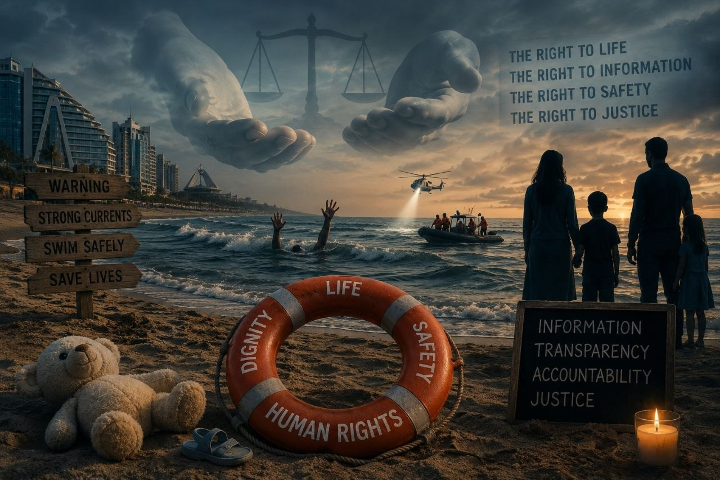
Awaza: The Death of a Child, a Missing Teenager, and the Public’s Right to Information and Safety On 28 July 2026, a tragedy occurred in the Awaza National Tourist Zone, once again raising serious questions not only about the safety of holidaymakers, but also about the right of people in Turkmenistan to information, effective assistance, and an adequate response from the authorities. According to the Turkmen Service of Radio Azatlyk, two minors, aged 12 and 16, entered the Caspian Sea near the Arzuw Hotel and did not return. The body of the 12-year-old child was later found in the sea near the Serdar Hotel. At the time of Azatlyk’s publication, the whereabouts and fate of the 16-year-old teenager remained unknown. The outlet emphasised that the authorities had provided no public explanation regarding the incident and that obtaining independently verified information remains extremely difficult in Turkmenistan’s highly restrictive information environment. A Tragedy Is Not Only a Private Matter for the Family The death of one child and the disappearance of another minor cannot be regarded solely as a private tragedy affecting one family. When a person goes missing at sea, the authorities must act quickly and in a coordinated manner. When a child is involved, every lost minute can be critical. The right to life does not merely require the state to refrain from arbitrarily depriving individuals of their lives. It also entails a positive obligation to take reasonable measures to protect human life, particularly where the authorities know, or ought to know, that serious risks exist. If drownings occur repeatedly along a particular stretch of coastline, or if dangerous currents are known to exist, the state should not simply react after another tragedy. It must take preventive measures: warn the public, install clear safety signs, ensure the presence of trained lifeguards, monitor beaches, and provide accessible information about potential dangers. What Should Happen When a Person Goes Missing? Procedures differ between democratic countries, but the general principle is the same: a search-and-rescue operation should begin as quickly as possible, rather than being accompanied by silence and a lack of public information. When a child goes missing in or near the water, emergency and rescue services, police, fire and rescue units, coast guards, and other specialised agencies may be mobilised. Depending on the circumstances, search operations can involve boats, divers, drones, aircraft, thermal-imaging equipment, and other technical resources. Civil society can also play an important role. Volunteers and local residents may join organised searches, distribute information about the missing person, assist in searching the coastline, and provide potentially important information. Such participation should, however, be coordinated by professional emergency services so that volunteers are not themselves placed at risk and do not interfere with rescue operations. Publicity in such circumstances is not an enemy of the state. On the contrary, it can help save a life. Publishing a photograph and description of the missing person, providing a telephone number for witnesses, identifying the last known location, and issuing regular official updates about the search can mobilise thousands of people and help obtain crucial information that might otherwise be lost. Parents Should Not Be Left Alone With Their Tragedy There is another aspect of such incidents that is often overlooked: the psychological condition and well-being of the parents and relatives of a missing child. Uncertainty about the fate of a loved one can cause profound psychological distress. Families should receive regular and reliable information from the responsible authorities. They should know who is coordinating the search operation and whom they can contact for updates. Parents should be offered professional psychological assistance. Where necessary, social and legal support should also be made available. A family should not be forced to search for rescuers on its own, rely on personal contacts to obtain information, or learn about the fate of a child through rumours. The Right to Information Also Protects Lives Azatlyk draws attention to a broader problem: the lack of transparency and severe restrictions on access to information in Turkmenistan. In matters of public safety, withholding information can have direct consequences for people’s lives and health. If a particular beach has dangerous currents, if drownings have previously occurred there, or if weather and sea conditions make swimming hazardous, the public should know about these risks before another tragedy occurs, not afterwards. Independent media perform a vital public-interest function in such situations. They ask questions of state authorities, warn the public, collect witness accounts, and help establish the circumstances surrounding serious incidents. Attempts to conceal accidents in order to preserve a positive image of a tourist destination may create additional risks, because future visitors may simply be unaware of the danger. The State Must Investigate the Causes of the Tragedy The state’s responsibility does not end when the body of a deceased child is recovered. The circumstances of the child’s death and the disappearance of the second teenager must be established. Authorities should determine the weather and sea conditions at the time of the incident, whether lifeguards and warning signs were present, how quickly the emergency was reported, and when the search-and-rescue operation began. If CCTV cameras are installed at hotels, within the tourist zone, or at nearby facilities, all potentially relevant footage should be preserved immediately so that it is not automatically deleted or overwritten. The families of the deceased and missing children should have access to information about the results of the investigation and, where necessary, to effective legal remedies. At the same time, until verified information is available, it would be inappropriate to conclude in advance that the tragedy resulted from negligence or misconduct. This is precisely why an independent, effective and transparent investigation is necessary. What Needs to Change? Tragedies of this kind demonstrate how closely public safety and human rights are connected. Turkmenistan should ensure: immediate responses and comprehensive search-and-rescue operations whenever a person goes missing; the permanent presence of trained lifeguards at popular recreational areas; clear and accessible warnings about dangerous currents, weather conditions, and other risks; timely public information about serious accidents and emergencies; the ability of independent media to obtain and disseminate information of public interest freely; safe and properly coordinated participation of volunteers in search operations; preservation of CCTV footage and other potential evidence following serious incidents; effective and transparent investigations into deaths and disappearances; regular communication with relatives about the progress of search operations; free psychological, social and, where necessary, legal support for the families of deceased and missing persons. Protecting Human Rights Begins With Protecting Life Building modern tourist infrastructure is not enough. The state must also create a system in which human life is the highest priority. Safety cannot be ensured through silence. Information about risks, independent journalism, professional rescue services, civil society participation, transparent investigations, and support for affected families are not actions directed against the state. They are mechanisms through which a state fulfils one of its most fundamental responsibilities: protecting human life and dignity. In the case of the tragedy in Awaza, the immediate priority must be to continue searching for the missing teenager using all available means and to provide the family with accurate and timely information. We express our deepest condolences to the family and loved ones of the 12-year-old child who lost his life, and we sincerely hope that the fate of the missing 16-year-old teenager will be established as soon as possible. Source: Radio Azatlyk, Turkmen Service of RFE/RL, 30 July 2026: https://www.azathabar.com/a/awazada-bir-caganyn-jesedi-tapyldy-beylekisi-yitdi-resmi-dusundiris-berilmeyar/33818246.html Information concerning the incident itself is attributed to Radio Azatlyk. The human rights analysis and recommendations constitute the analytical component of this article.
As a foundation, every individual's fundamental
protect and develop their rights
we are working for.