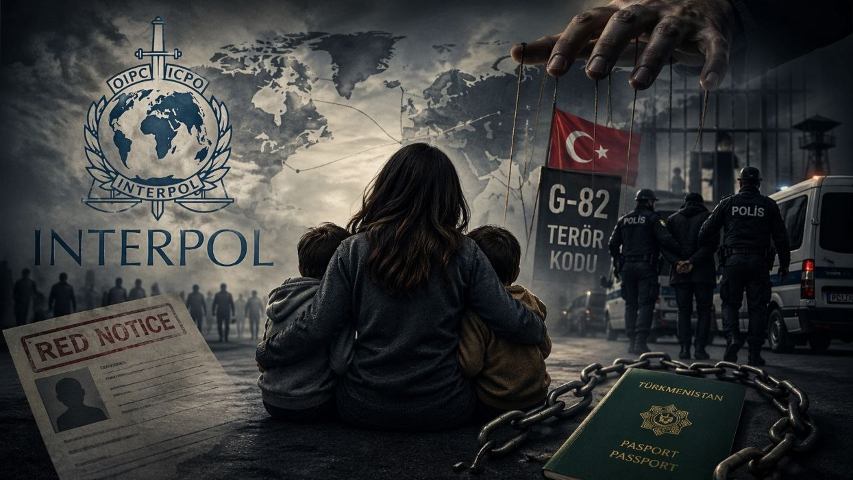
Interpol at Risk: How International Justice Mechanisms Are Being Used for Political Repression The International Criminal Police Organization — Interpol — was created as a tool for cooperation between states in combating crime. Its mission is to ensure security, not to become part of repressive systems. Yet today, there are increasingly alarming signs that certain states are misusing Interpol channels for purposes far beyond their mandate. Turkmenistan is one of the countries where, according to human rights defenders, international mechanisms are being transformed from tools of protection into instruments of persecution. This concerns the use of Interpol Red Notices and diffusions against civil activists, human rights defenders, and dissenting voices. These individuals are not accused of genuine crimes. Their “offense” is exercising their fundamental rights — freedom of expression, freedom of speech, and peaceful civic engagement. This directly contradicts the core principles of Interpol. Under Article 2 of the Interpol Constitution, the organization must act in the spirit of the Universal Declaration of Human Rights. Article 3 of the Interpol Constitution explicitly prohibits any intervention or activities of a political character. The use of international mechanisms for politically motivated persecution is not merely a procedural violation — it undermines the very foundation of the organization. However, the problem does not end with Interpol. In recent years, there has been a growing pattern of using national legal mechanisms in transit countries for similar purposes — persecution followed by deportation. In particular, serious concern arises from the application in Turkey of the G-82 classification (related to terrorism allegations), which, according to available evidence, is in some cases used not to counter genuine threats, but as a tool of pressure against citizens of Turkmenistan. In practice, formal grounds related to national security and counterterrorism may be used to legitimize detention, restrict freedom of movement, and facilitate deportation of individuals who have no connection to terrorist activities. This creates a dangerous precedent in which national security measures become part of transnational repression. The issue goes even further. It becomes a matter of life and death. A striking example is the case of Maral Annaeva, a citizen of Turkmenistan who was forcibly deported together with her minor children. Despite the absence of any substantiated criminal charges, her detention and transfer to a country where torture, arbitrary detention, and enforced disappearances are systematically reported raises serious concern. This case raises a critical question: are international and national mechanisms being used to legitimize political repression? If the answer is even partially yes, the consequences extend far beyond a single country. At the core of international human rights protection lies the principle of non-refoulement — the prohibition against returning individuals to a country where they face a risk of persecution, torture, or inhuman treatment. This principle is enshrined in key international legal instruments: — 1951 Convention relating to the Status of Refugees, Article 33 — prohibits expulsion to territories where life or freedom is at risk; — Convention Against Torture, Article 3 — prohibits transfer to states where there is a risk of torture; — International Covenant on Civil and Political Rights, Articles 7 and 9 — guarantee protection against torture and arbitrary detention. When a person is returned to a state where these norms are systematically violated, responsibility lies not only with that state, but also with all structures that directly or indirectly enable such transfer. This is why the misuse of both international and national security mechanisms constitutes a global threat. This is not a technical issue. It is a matter of trust. If systems designed to combat crime and terrorism are used to persecute dissent, they lose legitimacy. Worse, they become instruments of transnational repression. Today, hundreds of Turkmen citizens remain abroad without valid documentation. They are denied access to passports through diplomatic missions, in violation of national legislation (in particular, Article 29 of the Law on Migration of Turkmenistan, which provides for the issuance of documents through consulates). As a result, people are trapped in a legal vacuum — without protection, without status, and under constant threat of detention. In such conditions, any Interpol notice or the application of classifications such as G-82 can become a trigger for deportation. And then the issue is no longer procedural. It becomes a question of human fate. Cases of forced returns, disappearances, and repression are not isolated. They are repeated. And each new victim is the result of impunity for previous violations. If the international community fails to respond now, such cases will continue. Interpol and its member states face a fundamental choice: To remain instruments of justice — or to become instruments of political pressure. The answer to this question will determine not only the future of the international security system, but also the fate of hundreds of people for whom these mechanisms remain the last hope for protection. Silence in such circumstances is not neutrality. It is complicity.
As a foundation, every individual's fundamental
protect and develop their rights
we are working for.