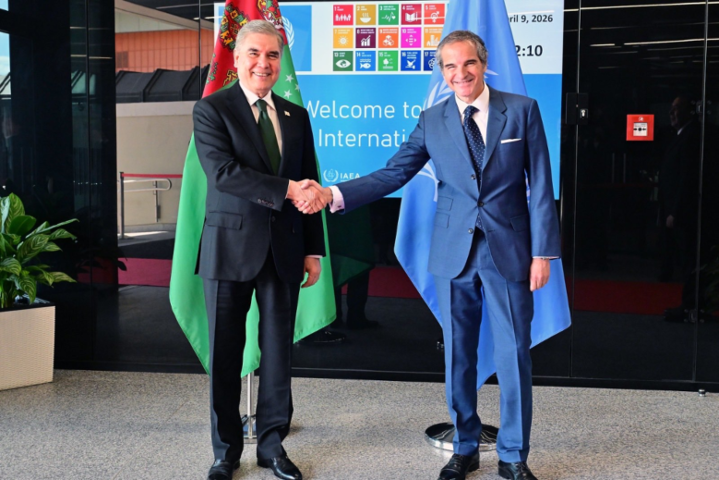
The visit of Gurbanguly Berdimuhamedov, Chairman of the Halk Maslahaty of Turkmenistan, to the International Atomic Energy Agency (IAEA) has raised serious concern among human rights defenders, democratic forces, and civil activists. This is not merely a diplomatic visit. It is an attempt to grant international legitimacy to a figure who does not represent the executive authority, lacks a democratic mandate, and effectively functions as a self-appointed political leader. LEGITIMACY WITHOUT LEGITIMACY Berdimuhamedov has not been elected through free and fair elections. His current role is ideological and extra-institutional, and it does not provide him with the authority to represent the state internationally. Nevertheless, his participation in IAEA events creates a dangerous precedent: international institutions risk becoming instruments for whitewashing authoritarian regimes. A SYSTEM BUILT ON FEAR Turkmenistan remains one of the most closed countries in the world, marked by systemic human rights violations: absence of free and fair elections; suppression of freedom of expression; lack of independent media; absence of an independent judiciary; severe restrictions on freedom of movement. Particular attention must be paid to the complete refusal to issue passports through diplomatic missions, despite the direct requirement of Article 29(3) of the Migration Law. Thousands of citizens are left without documents, without legal status, and without basic rights abroad. TRANSNATIONAL REPRESSION Repression does not stop at the borders of Turkmenistan. In recent years, there has been a disturbing pattern of persecution of activists abroad, including: misuse of INTERPOL mechanisms; pressure through diplomatic channels; forced deportations; enforced disappearances. One of the most alarming cases is Maral Annayeva, who was forcibly deported together with her two minor children and is reportedly subjected to torture and violence. Another high-profile case is the disappearance of Alisher Sakhatov and Abdulla Orusov, who went missing on July 24, 2025, after leaving a deportation center in Edirne, Türkiye. These are not isolated incidents — they represent a systematic policy of repression and intimidation. A HUMANITARIAN CRISIS Thousands of Turkmen citizens: are unable to reunite with their families; exist in a legal vacuum; are vulnerable to human trafficking and criminal networks; risk being drawn into armed conflicts. Returning to Turkmenistan often results in exit bans, based on Article 30(9), which contradicts international law. WHY THIS MATTERS GLOBALLY When international organizations host representatives of such regimes without critical assessment, it sends a dangerous message: ➡️ human rights violations can be ignored ➡️ repression can go unpunished ➡️ authoritarian leaders can gain international legitimacy CALL TO ACTION Democratic forces of Turkmenistan call on the international community to: refuse to legitimize authoritarian rule; assess Berdimuhamedov’s visit critically; increase pressure on the Turkmen authorities; protect individuals at risk; put an end to transnational repression. CONCLUSION Human rights are not a formality or a diplomatic accessory. They are the foundation of the international order. As long as repression, torture, and enforced disappearances continue in Turkmenistan, no international platform should serve to legitimize them. SOURCE AND MEDIA: 🔗 Video of the meeting: https://x.com/i/status/2042330925275787291� 📷 Photo: taken from the same source
As a foundation, every individual's fundamental
protect and develop their rights
we are working for.